
[论文解读] Predicting the Silent Majority on Graphs: Knowledge Transferable Graph Neural Network
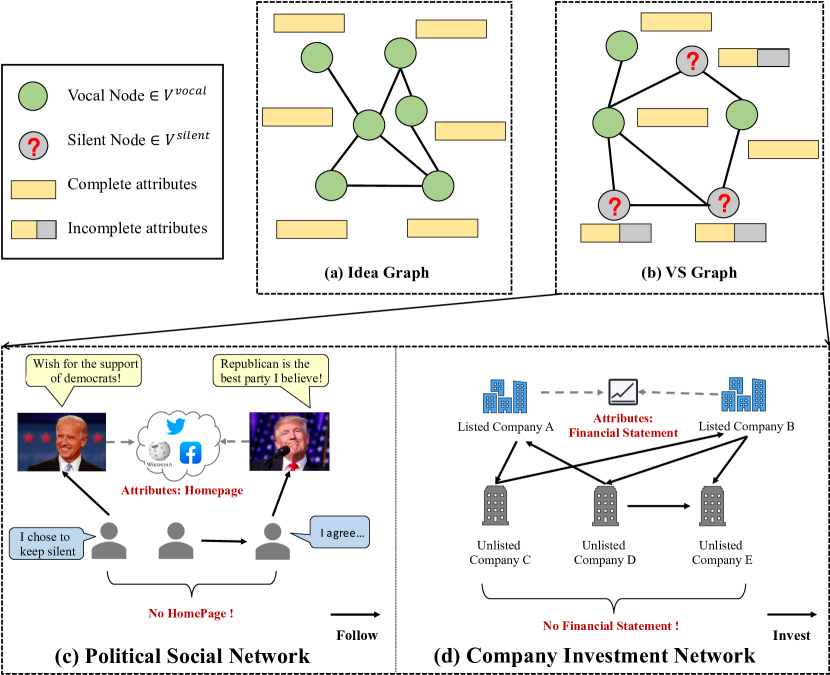
该论文提出知识可迁移图神经网络(KTGNN)以解决VS-Graph中的静默节点分类问题——VS-Graph指具有丰富特征/标签的发声节点(vocal nodes)和具有不完整特征、稀少标签的静默节点(silent nodes)共存的图结构。KTGNN采用领域自适应的特征补全与基于KL散度的知识迁移消息传递机制,在真实世界金融风险与政治选举数据集上实现了最先进性能。
Graphs consisting of vocal nodes ("the vocal minority") and silent nodes ("the silent majority"), namely VS-Graph, are ubiquitous in the real world. The vocal nodes tend to have abundant features and labels. In contrast, silent nodes only have incomplete features and rare labels, e.g., the description and political tendency of politicians (vocal) are abundant while not for ordinary people (silent) on the twitter's social network. Predicting the silent majority remains a crucial yet challenging problem. However, most existing message-passing based GNNs assume that all nodes belong to the same domain, without considering the missing features and distribution-shift between domains, leading to poor ability to deal with VS-Graph. To combat the above challenges, we propose Knowledge Transferable Graph Neural Network (KT-GNN), which models distribution shifts during message passing and representation learning by transferring knowledge from vocal nodes to silent nodes. Specifically, we design the domain-adapted "feature completion and message passing mechanism" for node representation learning while preserving domain difference. And a knowledge transferable classifier based on KL-divergence is followed. Comprehensive experiments on real-world scenarios (i.e., company financial risk assessment and political elections) demonstrate the superior performance of our method. Our source code has been open sourced.
研究动机与目标
- 解决在现实图结构中静默节点因特征不完整与标签稀缺而难以分类的挑战。
- 克服图结构数据中发声节点(观测充分)与静默节点(观测不足)之间的分布偏移问题。
- 开发一种图神经网络框架,自适应地将知识从发声节点迁移至静默节点,同时保留领域特异性差异。
- 在不依赖启发式特征插补或将静默节点视为噪声的前提下,提升静默节点的分类性能。
提出的方法
- 提出一种领域自适应的特征补全与消息传递机制,学习表示时考虑发声节点与静默节点之间的分布偏移。
- 引入基于KL散度的知识可迁移分类器,对齐跨领域的预测结果,实现从发声节点到静默节点的有效知识迁移。
- 采用两阶段训练流程:第一阶段,通过领域感知聚合进行消息传递以学习节点表示;第二阶段,利用KL散度进行知识蒸馏以优化预测结果。
- 采用K跳邻域策略(K=2),确保发声节点的影响充分覆盖静默节点,优化表示学习的接受域。
- 引入对比学习目标,增强发声节点与静默节点表示在类别间的可区分性。
- 采用T-SNE可视化展示KTGNN在保持领域差异的同时,提升了学习表示中类间分离度。
实验结果
研究问题
- RQ1当静默节点相比发声节点缺乏完整特征与标签时,图神经网络如何有效实现其分类?
- RQ2从标注充分的发声节点中获得的知识,能在多大程度上用于改善静默节点的表示与分类?
- RQ3在消息传递过程中应用领域自适应技术,能否缓解发声节点与静默节点间分布偏移导致的性能下降?
- RQ4与标准GNN相比,基于KL散度的知识蒸馏在静默节点上的泛化能力提升程度如何?
- RQ5在VS-Graph中,实现有效知识迁移的最优感受野(如K跳邻域)是什么?
主要发现
- KTGNN在公司金融风险评估与政治选举预测数据集上均达到最先进性能,优于现有GNN与分布外检测基线方法。
- 在K跳消息传递中K=2时模型性能最优,表明发声节点的2跳邻居已足够覆盖图结构中的静默节点。
- KL散度损失中λ=1.0时性能最佳,证实知识蒸馏在对齐跨领域预测结果方面的有效性。
- T-SNE可视化显示,KTGNN在保持发声节点与静默节点之间领域差异的同时,增强了表示空间中类间的可分性。
- 所提方法在极端数据饥渴条件下(特征缺失、标签稀疏)仍显著提升了静默节点分类准确率。
- 消融实验确认,领域自适应消息传递与基于KL的知识迁移均为性能提升的关键组件。
阅读本论文
在 Nubint 阅读器中打开原文,边读边就任意段落提问。
在 Nubint 中阅读本论文本解读由 AI 根据论文原文生成,引用前请核对原文。