
[论文解读] Primordial black holes and stochastic inflation beyond slow roll: I -- noise matrix elements
该论文将随机暴胀框架扩展至非慢滚条件,以研究原初黑洞(PBH)的形成,重点关注在导致超慢滚行为的势能特征中,噪声矩阵元的变化。研究发现,在过渡期间,动量诱导的噪声占主导地位,显著改变了量子扩散过程以及原初曲率扰动的概率密度函数(PDF),从而对PBH质量分数的预测产生关键影响。
Primordial Black Holes (PBHs) may form in the early Universe, from the gravitational collapse of large density perturbations, generated by large quantum fluctuations during inflation. Since PBHs form from rare over-densities, their abundance is sensitive to the tail of the primordial probability distribution function (PDF) of the perturbations. It is therefore important to calculate the full PDF of the perturbations, which can be done non-perturbatively using the 'stochastic inflation' framework. In single field inflation models generating large enough perturbations to produce an interesting abundance of PBHs requires violation of slow roll. It is therefore necessary to extend the stochastic inflation formalism beyond slow roll. A crucial ingredient for this are the stochastic noise matrix elements of the inflaton potential. We carry out analytical and numerical calculations of these matrix elements for a potential with a feature which violates slow roll and produces large, potentially PBH generating, perturbations. We find that the transition to an ultra slow-roll phase results in the momentum induced noise terms becoming larger than the field noise whilst each of them falls exponentially for a few e-folds. The noise terms then start rising with their original order restored, before approaching constant values which depend on the nature of the slow roll parameters in the post transition epoch. This will significantly impact the quantum diffusion of the coarse-grained inflaton field, and hence the PDF of the perturbations and the PBH mass fraction.
研究动机与目标
- 将随机暴胀形式化方法扩展至非慢滚条件,以满足生成大原初扰动(可能形成PBH)的模型需求。
- 计算具有导致超慢滚行为的特征的势能中,标量场噪声矩阵元。
- 评估非慢滚动力学——特别是向超慢滚的过渡——对量子扩散及曲率扰动全概率密度函数(PDF)的影响。
- 确定修改后的噪声项对PDF尾部的影响,该尾部控制着导致PBH形成的罕见、大振幅涨落。
- 为具有非平凡势能特征的暴胀模型提供一种非微扰框架,以计算PBH质量分数。
提出的方法
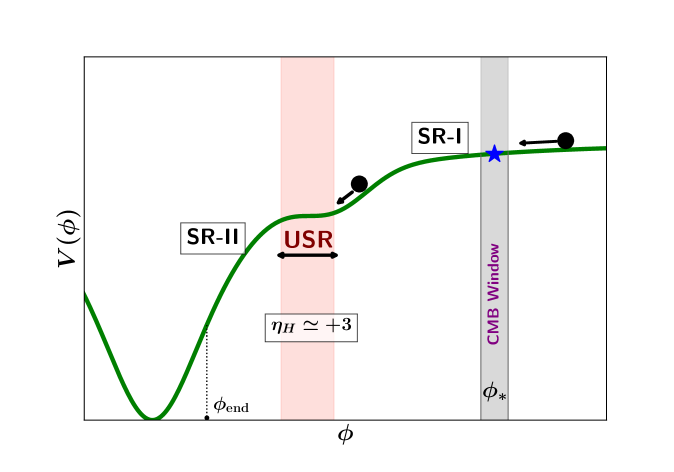
- 对具有导致瞬态超慢滚(USR)相的势能特征的单标量场暴胀模型,解析与数值计算噪声矩阵元。
- 使用分段势能,将标量场的慢滚参数时间演化划分为三个阶段:初始慢滚(SR-I)、超慢滚(USR)和最终慢滚(SR-II)。
- 利用随机暴胀形式化方法,推导出粗粒化标量场的福克-普朗克方程,其中噪声项由标量场势能的曲率及其时间导数决定。
- 使用贝塞尔函数求解三个阶段中标量扰动的模式函数,并在过渡点应用以色列跃迁条件,以连接各区域的解。
- 通过模式函数的导数与曲率扰动的功率谱计算噪声矩阵元,将由于慢滚参数的突变而产生的狄拉克δ函数脉冲纳入考虑。
- 分析噪声项(场噪声与动量噪声)在USR过渡期间的时间演化,追踪其相对大小与渐近行为。
实验结果
研究问题
- RQ1在暴胀势能中,从慢滚向超慢滚过渡期间,随机噪声矩阵元(特别是场噪声与动量诱导噪声)如何演化?
- RQ2在超慢滚阶段,动量诱导噪声与场噪声的相对主导性如何?这对粗粒化标量场的量子扩散有何影响?
- RQ3超慢滚阶段结束后,噪声项的行为如何?它们是否趋近于由后过渡阶段慢滚参数决定的常数值?
- RQ4瞬态超慢滚阶段在多大程度上改变了原初曲率扰动全概率密度函数(PDF)的形状,特别是其尾部?
- RQ5与微扰谱方法相比,该扩展至非慢滚的非微扰随机暴胀框架在PBH质量分数预测中的准确性如何提升?
主要发现
- 在向超慢滚过渡期间,动量诱导的噪声项超过场噪声项,表明主导量子扩散机制发生显著转变。
- 过渡后噪声项在数个e-对数内呈指数衰减,随后恢复至原始量级,并最终趋近于由后过渡阶段慢滚参数决定的常数值。
- 由于慢滚参数η_H的突变,场噪声与动量噪声项在过渡时刻均受到狄拉克δ函数脉冲的影响,这些脉冲通过以色列跃迁条件被纳入计算。
- 噪声矩阵元的晚期行为取决于超慢滚阶段结束后的慢滚参数特性,系统最终趋近于由后过渡动力学决定的稳态区域。
- 噪声项的非单调演化——初始抑制后恢复——意味着对标量场量子扩散产生短暂但显著的影响,直接影响原初PDF的形状。
- 这些结果表明,对PBH形成至关重要的PDF非高斯尾部无法通过微扰方法捕捉,必须依赖本文提出的扩展随机暴胀框架。
阅读本论文
在 Nubint 阅读器中打开原文,边读边就任意段落提问。
在 Nubint 中阅读本论文本解读由 AI 根据论文原文生成,引用前请核对原文。