
[论文解读] Proactive Detection of Voice Cloning with Localized Watermarking
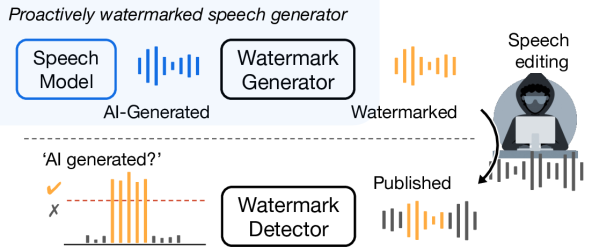
AudioSeal 是一个主动的、局部化的音频水印系统,能够检测、定位到采样级别,并用快速的 single-pass 探测器对 AI 生成的语音进行归属,性能优于此前的水印方法。
In the rapidly evolving field of speech generative models, there is a pressing need to ensure audio authenticity against the risks of voice cloning. We present AudioSeal, the first audio watermarking technique designed specifically for localized detection of AI-generated speech. AudioSeal employs a generator/detector architecture trained jointly with a localization loss to enable localized watermark detection up to the sample level, and a novel perceptual loss inspired by auditory masking, that enables AudioSeal to achieve better imperceptibility. AudioSeal achieves state-of-the-art performance in terms of robustness to real life audio manipulations and imperceptibility based on automatic and human evaluation metrics. Additionally, AudioSeal is designed with a fast, single-pass detector, that significantly surpasses existing models in speed - achieving detection up to two orders of magnitude faster, making it ideal for large-scale and real-time applications.
研究动机与目标
- 激发对语音进行真实性鉴别以对抗语音克隆和生成模型滥用的需求。
- 提出一种局部化水印方法(AudioSeal),以实现对 AI 生成的语音的检测、定位和归属。
- 联合训练生成器和检测器,以嵌入几乎不可察觉的水印并实现高精度检测。
- 引入新颖的知觉和定位损失,以提高不可察觉性和采样级定位。
- 评估在现实世界音频编辑中的鲁棒性、定位准确性和计算效率。
提出的方法
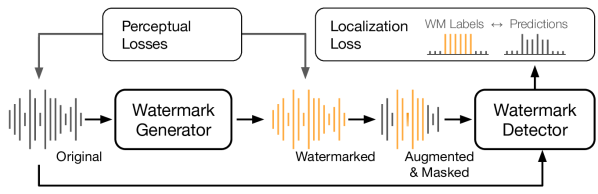
- 生成器和检测器的联合架构,其中生成器向音频添加叠加水印。
- 检测器输出指示水印存在的采样级检测 logits。
- 训练使用屏蔽定位策略以实现精确的采样级定位。
- 受听觉掩蔽启发的新颖 TF-Loudness 感知损失,用于提高不可察觉性。
- 包含水印蒙版增强和鲁棒音频编辑增强的四阶段训练。
- 可选的多位水印用于将音频归因于一个模型/版本。
实验结果
研究问题
- RQ1局部化水印能否在较长音频中实现对 AI 生成语音的采样级检测?
- RQ2所提出的 AudioSeal 方法对常见的现实音频处理和编辑有多鲁棒?
- RQ3检测器是否在不进行穷举式同步的情况下支持快速实时检测?
- RQ4多位信息是否能在不影响检测的前提下实现对特定模型版本的归属?
- RQ5与现有方法相比,水印对感知语音质量的影响如何?
主要发现
- AudioSeal 在广泛的音频编辑下实现了最先进的鲁棒性,并且检测率几近完美。
- 检测器在单次遍历中运行,在每个时间步产生 logits,以实现实时检测。
- 定位精度很高,达到采样级定位(1/16k 秒)且对短水印片段 IoU 近 0.99。
- 在检测速度方面,AudioSeal 比现有方法如 WavMark 快多达两个数量级;生成也快约 14 倍。
- 多位水印使对模型/版本的归属具有高精度;在编辑下检测仍然鲁棒。
- 实证分析表明保持检测器权重私有对抵御对抗性水印去除很重要。
阅读本论文
在 Nubint 阅读器中打开原文,边读边就任意段落提问。
在 Nubint 中阅读本论文本解读由 AI 根据论文原文生成,引用前请核对原文。