
[论文解读] Probabilistic Domain Adaptation for Biomedical Image Segmentation
该论文提出了一种用于生物医学图像分割的概率域自适应方法,通过利用概率U-Net中的不确定性估计改进伪标签过滤。通过利用多个分割样本优化伪标签,并评估联合训练与独立训练策略,该方法在三个具有挑战性的生物医学分割任务中实现了最先进性能,显著优于细胞、线粒体和肺部分割的强基线模型。
Segmentation is a crucial analysis task in biomedical imaging. Given the diverse experimental settings in this field, the lack of generalization limits the use of deep learning in practice. Domain adaptation is a promising remedy: it involves training a model for a given task on a source dataset with labels and adapts it to a target dataset without additional labels. We introduce a probabilistic domain adaptation method, building on self-training approaches and the Probabilistic UNet. We use the latter to sample multiple segmentation hypotheses to implement better pseudo-label filtering. We further study joint and separate source-target training strategies and evaluate our method on three challenging domain adaptation tasks for biomedical segmentation. Our code is publicly available at https://github.com/computational-cell-analytics/Probabilistic-Domain-Adaptation.
研究动机与目标
- 解决深度学习模型在不同实验设置和成像模式下生物医学图像分割中的泛化能力有限的问题。
- 克服确定性模型在域自适应中估计预测置信度时的校准不足问题,以用于伪标签过滤。
- 通过将概率分割与自训练相结合,利用不确定性感知的过滤方法提升伪标签质量,从而改善域自适应性能。
- 研究联合训练与独立训练策略(源域与目标域)对自适应性能的影响。
- 在目标域中标签数据有限的多样化真实世界生物医学成像任务中,证明所提方法的有效性。
提出的方法
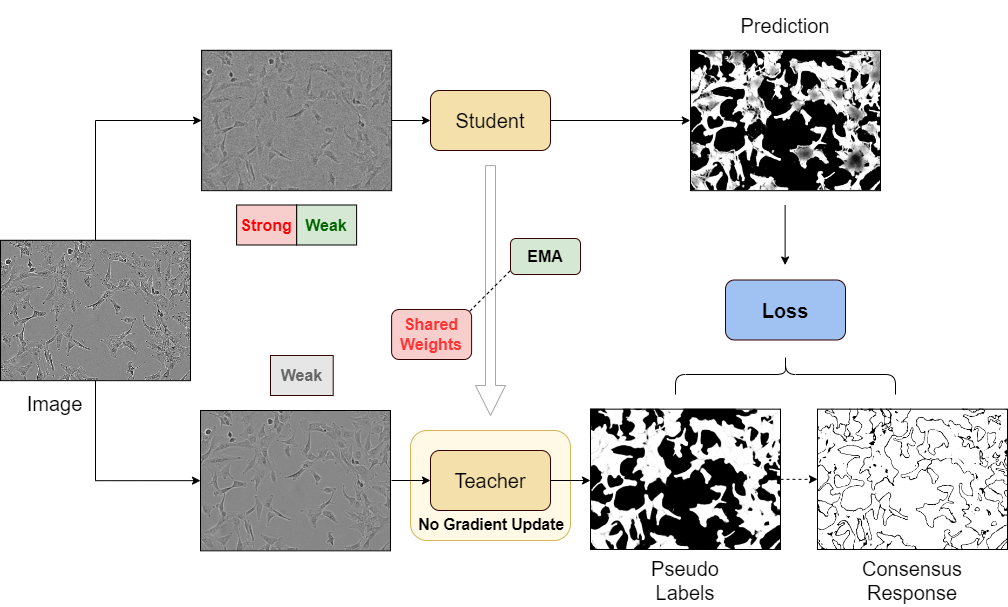
- 采用自训练框架,其中学生模型在标注的源域数据和伪标注的目标域数据上进行训练,教师模型提供预测结果。
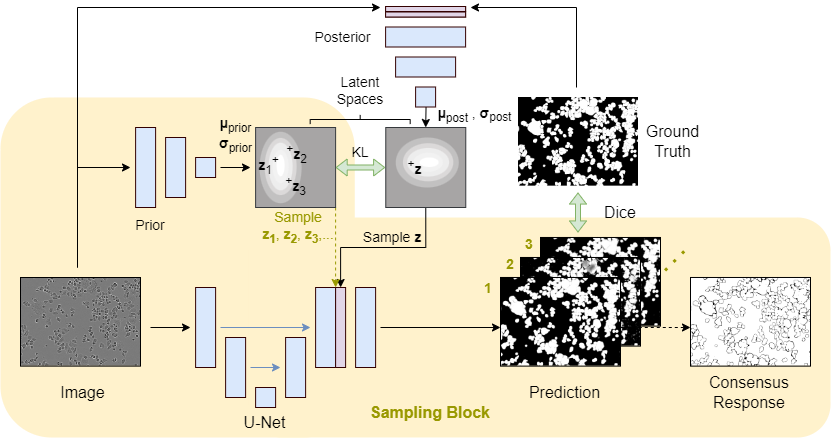
- 使用概率U-Net(PUNet)通过从后验分布中进行随机采样生成多个分割假设,从而实现不确定性感知的置信度估计。
- 采用共识掩码进行伪标签过滤——仅保留多个样本意见一致的预测结果,以克服确定性模型中不可靠的置信度分数。
- 探索两种训练策略:(1) 先独立训练源域,再进行目标域适应(两阶段);(2) 联合在源域和目标域数据上进行训练(单阶段)。
- 在FixMatch风格设置中应用强增强和弱增强,以稳定训练并防止预测崩溃。
- 使用Dice损失进行分割优化,并结合KL散度以在PUNet框架中对齐先验与后验分布。
实验结果
研究问题
- RQ1与确定性置信度估计相比,概率分割是否能改善生物医学图像分割中域自适应的伪标签过滤?
- RQ2联合训练与独立源-目标域训练策略对分割任务中域自适应性能有何影响?
- RQ3基于多个概率样本的共识过滤是否能在低资源目标域中生成更鲁棒、更准确的伪标签?
- RQ4所提方法在存在显著域偏移的多样化生物医学成像任务(如活细胞显微成像、电子显微成像和X射线成像)中表现如何?
- RQ5在目标域无需额外标注数据的情况下,PUNet中的不确定性估计集成是否能增强域自适应的泛化能力?
主要发现
- 所提方法,特别是采用联合训练与共识掩码的$FM_{j}^{m}$变体,在所有三个基准任务中均取得了最佳整体性能。
- 在livecell数据集上,$FM_{j}^{m}$在Huh7上达到0.88的Dice分数,在SkBr3上达到0.87,显著优于基线$UNet$(0.54–0.79)和$PUNet$(0.76–0.83)。
- 在Lucchi和VNC数据集的线粒体分割任务中,$MT_{s}^{w}$分别达到0.90和0.74的Dice分数,优于$UNet$(0.86和0.59)和$PUNet$(0.80和0.46)。
- 在X射线肺部分割任务中,$FM_{j}^{m}$在NIH上达到0.85的Dice分数,在Montgomery上达到0.80,优于$UNet$(0.77–0.78)和$PUNet$(0.76–0.75),尤其在具有挑战性的JSRT2数据集上表现更优。
- 消融实验表明,共识掩码在性能上始终优于无过滤或加权策略,且在大多数情况下,掩码的效果优于加权,尤其是在困难任务上。
- 联合训练($FM_{j}$)始终优于独立训练($FM_{s}$),后者表现出训练不稳定且性能较差,表明联合优化在域自适应中更为有效。
阅读本论文
在 Nubint 阅读器中打开原文,边读边就任意段落提问。
在 Nubint 中阅读本论文本解读由 AI 根据论文原文生成,引用前请核对原文。