
[论文解读] Probing out-of-distribution generalization in machine learning for materials
论文展示的材料 ML 的 heuristic OOD 测试往往探测插值,而非真正的外推;许多模型在多样的 OOD 任务上泛化良好,且在表征性 OOD 情况下扩展可能有害,甚至 scaling 可能有害。
Scientific machine learning (ML) endeavors to develop generalizable models with broad applicability. However, the assessment of generalizability is often based on heuristics. Here, we demonstrate in the materials science setting that heuristics based evaluations lead to substantially biased conclusions of ML generalizability and benefits of neural scaling. We evaluate generalization performance in over 700 out-of-distribution tasks that features new chemistry or structural symmetry not present in the training data. Surprisingly, good performance is found in most tasks and across various ML models including simple boosted trees. Analysis of the materials representation space reveals that most tasks contain test data that lie in regions well covered by training data, while poorly-performing tasks contain mainly test data outside the training domain. For the latter case, increasing training set size or training time has marginal or even adverse effects on the generalization performance, contrary to what the neural scaling paradigm assumes. Our findings show that most heuristically-defined out-of-distribution tests are not genuinely difficult and evaluate only the ability to interpolate. Evaluating on such tasks rather than the truly challenging ones can lead to an overestimation of generalizability and benefits of scaling.
研究动机与目标
- 揭示材料 ML 中 OOD 任务定义的偏差。
- 系统性地在多个数据集和模型上评估 >700 个 OOD 任务。
- 区分表示层面的 OOD 与统计(领域)OOD 及其对泛化的影响。
- 研究训练规模和训练时间如何影响 OOD 表现及神经网络缩放说法。
提出的方法
- 在 JARVIS、Materials Project (MP) 和 Open Quantum Materials Database (OQMD) 上评估六个 OOD 标准。
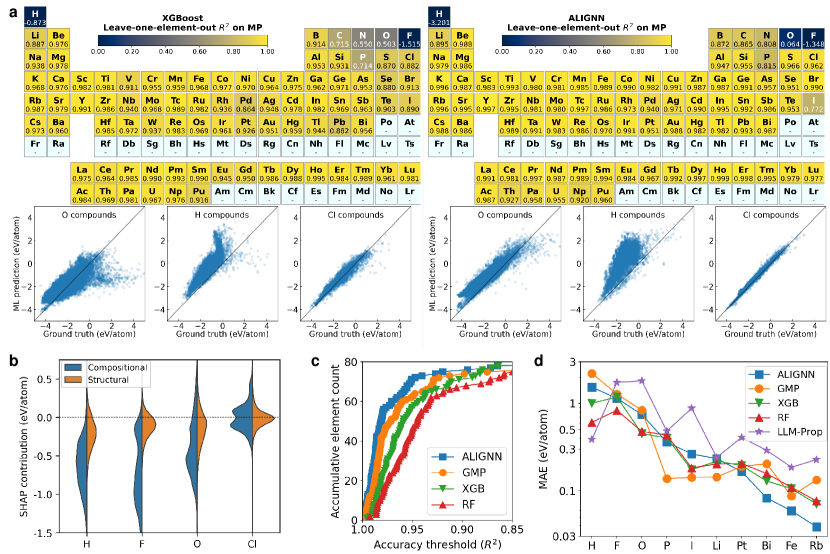
- 训练代表性模型:使用随机森林和 XGBoost,配合 Matminer 描述符;GMP 高斯多极神经网络;ALIGNN 图神经网络;基于 LLM 的 LLM-Prop,结合晶体文本描述。
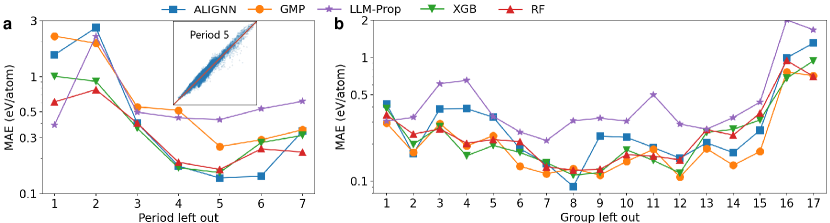
- 在 leave-one-X 任务(元素、族、空间群等)上用 MAE 和 R^2 指标评估性能。
- 使用基于 SHAP 的校正来将成分源 Bias 与结构源 Bias 区分开。
- 应用 UMAP 可视化表征空间,并进行基于核密度的领域识别。
- 通过改变训练时间和数据集规模,比较 OOD 与 ID 数据的神经缩放。
实验结果
研究问题
- RQ1常见的用来定义 OOD 任务的启发式方法与真正超出训练数据的外推之间存在何种关系?
- RQ2当在训练中排除化学与结构分组时,ML 模型是否在这些组之间具有泛化能力?
- RQ3OOD 预测中是否存在系统性偏差?是否能用成分或结构因素来解释?
- RQ4表示域(嵌入空间中的 ID 与 OOD)如何影响观测到的缩放规律?
- RQ5对评估和设计具有鲁棒泛化能力的材料 ML 模型有哪些影响?
主要发现
- 包括简单的树集成在内的许多模型,在大多数基于化学和结构的 OOD 任务上泛化良好。
- 大量 OOD 测试数据在表示空间落在训练分布内,意味着插值而非真正的外推。
- 非金属如 H、F、O 在 OOD 表现较差,原因是化学不相似性而非单纯数据不足,并可识别出成分偏差。
- 基于结构的 OOD 任务通常比基于化学的更具挑战性,但在中高对称性类别仍显示出强泛化;三斜晶系更难。
- 神经缩放定律在表示层面为 ID 泛化成立,但在表示层面为 OOD 时常常失效或反向,表明在真正的 OOD 泛化中的缩放收益可能被高估。
- 基于密度的领域识别(通过 UMAP 和核密度)可以区分表示层面的 ID/OOD 点,并与预测误差相关,尽管并非完美。
阅读本论文
在 Nubint 阅读器中打开原文,边读边就任意段落提问。
在 Nubint 中阅读本论文本解读由 AI 根据论文原文生成,引用前请核对原文。