
[论文解读] Productions of $X(3872)$, $Z_c(3900)$, $X_2(4013)$, and $Z_c(4020)$ in $B_{(s)}$ decays offer strong clues on their molecular nature
本文提出一种三角图机制,用以解释在 $B$ 和 $B_s$ 衰变中产生奇异强子 $X(3872)$、$Z_c(3900)$、$X_2(4013)$ 和 $Z_c(4020)$ 的过程,将它们的同位旋破缺产生比归因于 $\bar{D}^{(*)}D^{(*)}$ 分子波函数的差异。该机制成功预测了与实验数据一致的分支比,并通过因子化方法提取了衰变常数,为这些粒子的分子本质提供了有力证据。
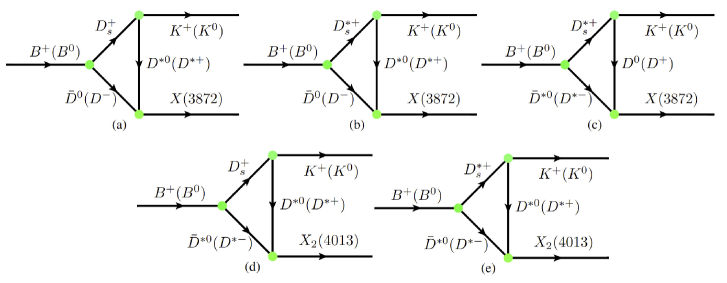
The exotic states $X(3872)$ and $Z_c(3900)$ have long been conjectured as isoscalar and isovector $\bar{D}^*D$ molecules. In this work, we first propose the triangle diagram mechanism to investigate their productions in $B$ decays as well as their heavy quark spin symmetry partners, $X_2(4013)$ and $Z_c(4020)$. We show that the large isospin breaking of the ratio $\mathcal{B}[B^+ o X(3872) K^+]/\mathcal{B}[B^0 o X(3872) K^0] $ can be attributed to the isospin breaking of the neutral and charged $\bar{D}^*D$ components in their wave functions. For the same reason, the branching fractions of $Z_c(3900)$ in $B$ decays are smaller than the corresponding ones of $X(3872)$ by at least one order of magnitude, which naturally explains its non-observation. A hierarchy for the production fractions of $X(3872)$, $Z_c(3900)$, $X_2(4013)$, and $Z_c(4020)$ in $B$ decays, consistent with all existing data, is predicted. Furthermore, with the factorization ansatz we extract the decay constants of $X(3872)$, $Z_c(3900)$, and $Z_c(4020)$ as $\bar{D}^*D^{(*)}$ molecules via the $B$ decays, and then calculate their branching fractions in the relevant $B_{(s)}$ decays, which turn out to agree with all existing experimental data. The mechanism we proposed is useful to elucidate the internal structure of the many exotic hadrons discovered so far and to extract the decay constants of hadronic molecules,which can be used to predict their production in related processes.
研究动机与目标
- 解释实验观测到的 $B^+ \to X(3872)K^+$ 与 $B^0 \to X(3872)K^0$ 之间分支比的显著同位旋破缺。
- 解决尽管预期 $Z_c(3900)$ 应在 $B$ 衰变中产生,但其未被观测到的问题,分析其分支比被抑制的原因。
- 在统一的分子框架下,预测 $X_2(4013)$ 和 $Z_c(4020)$ 在 $B_{(s)}$ 衰变中的产生率。
- 利用因子化假设,从 $B$ 衰变中提取 $\bar{D}^{(*)}D^{(*)}$ 分子态的衰变常数。
- 为这些奇异态的质量、衰变模式和产生率提供一致的解释,支持其分子本质。
提出的方法
- 提出一种三角图机制,用于描述 $X(3872)$、$Z_c(3900)$、$X_2(4013)$ 和 $Z_c(4020)$ 在 $B$ 和 $B_s$ 衰变中的产生。
- 利用重夸克自旋对称性(HQSS)关联 $\bar{D}^{(*)}D^{(*)}$ 分子态,并预测其耦合强度。
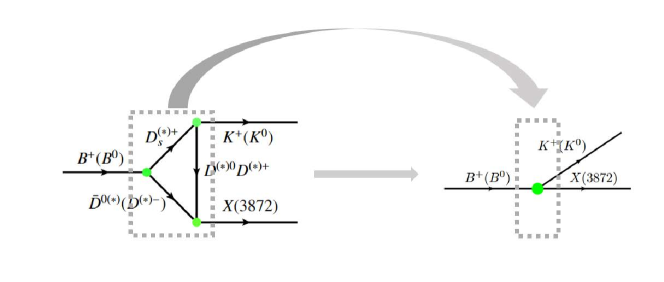
- 应用因子化假设,从 $B$ 衰变振幅中提取分子态的衰变常数。
- 通过在波函数中区分中性与带电的 $\bar{D}^{(*)}D^{(*)}$ 组分,引入同位旋破缺效应。
- 使用具有 $q^2$ 依赖项的接触相互作用,生成如 $Z_c(3900)$ 和 $Z_c(4020)$ 这类共振态。
- 通过拟合威尔逊系数以匹配实验数据,重现观测到的分支比,从而将同位旋破缺的贡献与耦合常数及动力学效应分离。
实验结果
研究问题
- RQ1为何 $B^0 \to X(3872)K^0$ 与 $B^+ \to X(3872)K^+$ 的分支比之比显著小于 1,尽管其衰变动力学相似?
- RQ2为何 $Z_c(3900)$ 尽管预期会被产生,却未在 $B$ 衰变中被观测到,而 $X(3872)$ 却能被观测到?
- RQ3在 $B_{(s)}$ 衰变中,$X(3872)$、$Z_c(3900)$、$X_2(4013)$ 和 $Z_c(4020)$ 的产生率有何层次关系?
- RQ4如何从 $B$ 衰变中提取 $\bar{D}^{(*)}D^{(*)}$ 分子态的衰变常数?
- RQ5这些态波函数中的同位旋破缺效应在多大程度上解释了观测到的产生不对称性?
主要发现
- 同位旋破缺比值 $\mathcal{B}[B^0 \to X(3872)K^0]/\mathcal{B}[B^+ \to X(3872)K^+]=0.62\pm0.13$ 主要源于 $X(3872)$ 波函数中 $\bar{D}^{*0}D^0$ 与 $\bar{D}^{*+}D^-$ 组分的差异。
- $Z_c(3900)$ 在 $B$ 衰变中的分支比至少比 $X(3872)$ 小一个数量级,这解释了其在 $B$ 衰变中未被观测到的原因。
- 在 $B$ 衰变中预测的产生分支比层次关系——$X(3872) > X_2(4013) > Z_c(3900) > Z_c(4020)$——与所有现有实验数据一致。
- 利用因子化假设,提取出 $X(3872)$ 作为 $\bar{D}^{*}D$ 分子态的衰变常数为 $3.86$ GeV,$Z_c(3900)$ 的衰变常数为 $5.02$ GeV。
- $B^+ \to X_2(4013)K^+$ 的预测分支比为 $0.23\pm0.08 \times 10^{-4}$,$B^+ \to Z_c(4020)K^+$ 的预测分支比为 $0.0095\pm0.0033 \times 10^{-4}$,与实验的上限一致。
- 该模型预测存在一种 $\bar{D}^{*}D^{*}$ 分子态,质量为 $4028$ MeV,宽度为 $26$ MeV,与 $Z_c(4020)$ 状态匹配,其耦合常数为 $g_{Z_c(4020)\bar{D}^{*}D^{*}}=1.77$ GeV。
阅读本论文
在 Nubint 阅读器中打开原文,边读边就任意段落提问。
在 Nubint 中阅读本论文本解读由 AI 根据论文原文生成,引用前请核对原文。