
[论文解读] Prometheus 2: An Open Source Language Model Specialized in Evaluating Other Language Models
Prometheus 2 提供开源评估语言模型,能够同时执行直接评估和成对排名,通过将在不同评估格式上训练的模型的权重合并,与先前的开源评估工具相比,与人类和专有语言模型的一致性更高。
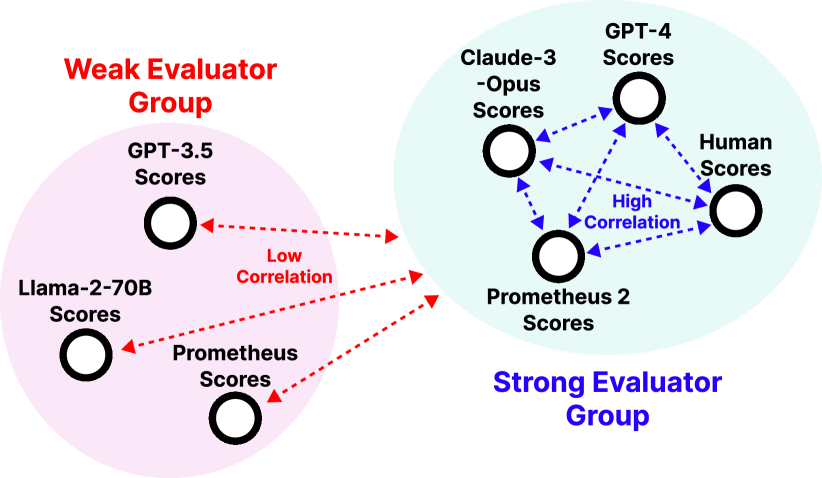
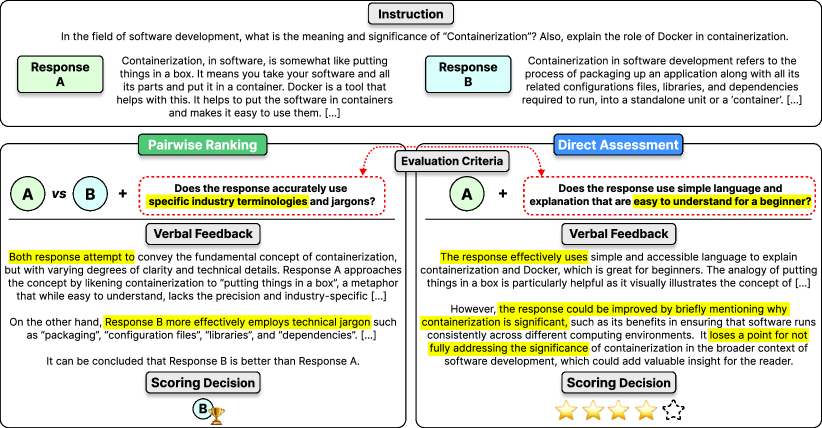
Proprietary LMs such as GPT-4 are often employed to assess the quality of responses from various LMs. However, concerns including transparency, controllability, and affordability strongly motivate the development of open-source LMs specialized in evaluations. On the other hand, existing open evaluator LMs exhibit critical shortcomings: 1) they issue scores that significantly diverge from those assigned by humans, and 2) they lack the flexibility to perform both direct assessment and pairwise ranking, the two most prevalent forms of assessment. Additionally, they do not possess the ability to evaluate based on custom evaluation criteria, focusing instead on general attributes like helpfulness and harmlessness. To address these issues, we introduce Prometheus 2, a more powerful evaluator LM than its predecessor that closely mirrors human and GPT-4 judgements. Moreover, it is capable of processing both direct assessment and pair-wise ranking formats grouped with a user-defined evaluation criteria. On four direct assessment benchmarks and four pairwise ranking benchmarks, Prometheus 2 scores the highest correlation and agreement with humans and proprietary LM judges among all tested open evaluator LMs. Our models, code, and data are all publicly available at https://github.com/prometheus-eval/prometheus-eval.
研究动机与目标
- 促使开发开源、透明的评估工具,以在不依赖专有模型的情况下评估 LM 输出。
- 开发能够覆盖两种常见评估格式的统一评估语言模型:直接评估和成对排名。
- 提出一种数据与训练配方(权重合并)以将基于不同格式训练的评估工具合并。
- 引入 Preference Collection,这是一个具有多样评估标准的细粒度成对排名数据集。
- 证明 Prometheus 2 在基准测试中与人类和专有评审之间具有高相关性。
提出的方法
- 将直接评估与成对排名评估管线正式化,并包含明确的输入组件(包括参考答案、口头反馈和评估标准)。
- 构建两份数据集:Feedback Collection(直接评估)和 Preference Collection(具有 1K 评估标准的成对排名)。
- 提出权重合并(theta_final = alpha * theta_d + (1 - alpha) * theta_p)以融合在不同格式上训练的评估工具,并与单格式及联合训练基线进行比较。
- 探索替代的合并策略(Task Arithmetic、TIES、DARE),并展示线性合并对 Prometheus 2 有效,且为最佳跨格式性能调整 alpha。
- 在四个直接评估基准和四个成对排名基准上,将 Prometheus 2 与基线和专有语言模型进行对比评估。
实验结果
研究问题
- RQ1一个开源评估语言模型是否能够在直接评估和成对排名两个方面,与人类判断和专有 LM 判断保持高一致性?
- RQ2对分别在直接评估和成对排名上训练的评估工具进行权重合并,是否优于单一格式或联合训练的评估工具?
- RQ3多样且标准丰富的数据集(Preference Collection)在提高评估保真度方面扮演了怎样的角色?
- RQ4Prometheus 2 在同领域与跨领域评估设定下的鲁棒性如何?
- RQ5在一种评估格式上训练是否对另一种评估格式有正向迁移,程度如何?
主要发现
- Prometheus 2(7B & 8x7B)在四个直接评估基准和四个成对排名基准中,与人类和专有 LM 的相关性在同类开源评估工具中达到最高。
- 权重合并在多项基准中优于单一格式和联合训练的评估工具,表明通过统一格式实现任务的正向迁移。
- Preference Collection 通过 1K 条标准实现了更为细粒度的评估,提升了模型基于用户定义标准进行评估的能力。
- Prometheus 2-8x7B 在跨域测试中比先前的开源评估工具将与专有 LM 的性能差距缩小约一半。
- 当使用来自直接评估和成对排名格式的合并权重时,不同评估格式之间的一致性提高,表明鲁棒性增强。
阅读本论文
在 Nubint 阅读器中打开原文,边读边就任意段落提问。
在 Nubint 中阅读本论文本解读由 AI 根据论文原文生成,引用前请核对原文。