
[论文解读] Prompt Pre-Training with Twenty-Thousand Classes for Open-Vocabulary Visual Recognition
POMP 在 ImageNet-21K 上预训练一个通用软提示,以实现跨图像分类、语义分割和目标检测的零-shot 开放词汇识别,具有强迁移性能和效率提升。
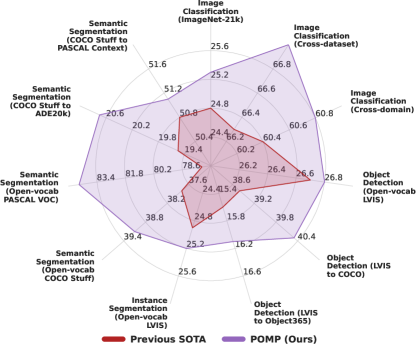
This work proposes POMP, a prompt pre-training method for vision-language models. Being memory and computation efficient, POMP enables the learned prompt to condense semantic information for a rich set of visual concepts with over twenty-thousand classes. Once pre-trained, the prompt with a strong transferable ability can be directly plugged into a variety of visual recognition tasks including image classification, semantic segmentation, and object detection, to boost recognition performances in a zero-shot manner. Empirical evaluation shows that POMP achieves state-of-the-art performances on 21 datasets, e.g., 67.0% average accuracy on 10 classification datasets (+3.1% compared to CoOp) and 84.4 hIoU on open-vocabulary Pascal VOC segmentation (+6.9 compared to ZSSeg). Our code is available at https://github.com/amazon-science/prompt-pretraining.
研究动机与目标
- 激励开放词汇视觉识别,以及需要一个在不同任务间泛化的通用、可迁移提示的必要性。
- 提出在一个大规模、细粒度类别集合上具有内存和计算效率的提示预训练方法(POMP)。
- 证明可以在下游任务中无需微调而嵌入一个预训练的软提示,以提升零-shot 性能。
提出的方法
- 引入 POMP,一种在 ImageNet-21K 上预训练的大量类别的通用软提示。
- 使用局部对比从每张图像中采样子集 K 个负类以降低内存和计算。
- 应用带自适应边距 m 的局部校正以抵消来自负采样的偏差(m = -log((K-1)/(N-1)))。
- 以零-shot 方式将预训练提示转移到下游任务(分类、分割、检测)。
- 评估内存/训练效率及性能,与基线如 CoOp、CoCoOp、MaPLe、基于 CLIP 的零-shot 方法对比。
实验结果
研究问题
- RQ1在 ImageNet-21K 上预训练的通用软提示是否能够在不进行任务特定微调的情况下,推广到开放词汇的分类、分割和检测?
- RQ2结合局部对比和局部校正是否能在>20k 类上实现内存高效的提示预训练,同时保持或提高迁移性能?
- RQ3局部校正中的自适应边距如何影响跨数据集和跨领域的泛化?
- RQ4在多个数据集上,POMP 相对于最先进的提示微调和开放词汇方法的表现和训练效率如何?
- RQ5POMP 提示能否在学习到的特征空间中保持对齐并提高均匀性,以实现鲁棒的开放词汇识别?
主要发现
- POMP 在内存限制低于 16 GB 的情况下,使用 ViT-B/16 进行预训练后,在 ImageNet-21K 上达到最高 25.3% 的准确率。
- 在 10 个下游图像分类数据集上,POMP 达到 67.0% 的平均准确率,优于 CoOp 3.1%。
- 在开放词汇语义分割中,POMP 在 COCO Stuff 上达到 39.1 hIoU,在 Pascal VOC 上达到 84.4 hIoU,分别比 ZSSeg 高出 1.3 和 6.9 hIoU。
- 对于开放词汇 LVIS 对象检测,POMP 达到 37.2 AP 和 57.9 AP50,在各自设置中分别优于 Detic 1.9 AP50 和 0.8 AP50。
- POMP 展现出强大的跨数据集和跨领域迁移,在各任务上实现了具有改进泛化性和鲁棒性的最先进准确率。

阅读本论文
在 Nubint 阅读器中打开原文,边读边就任意段落提问。
在 Nubint 中阅读本论文本解读由 AI 根据论文原文生成,引用前请核对原文。