
[论文解读] Propagating photo-$z$ uncertainties: a functional derivative approach
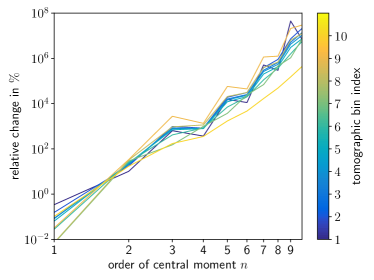
本论文提出了一种函数导数方法,用于在宇宙弱引力透镜巡天中传播光度红移(photo-$z$)不确定性的方法,实现了对源红移分布(SRD)任意扰动下角功率谱的高效灵敏度分析。该方法可实现一次性的快速函数导数计算,表明对于EUCLID级别的精度,仅SRD的均值和方差具有决定性影响,而更高阶矩(n > 2)对偏差控制可忽略不计。
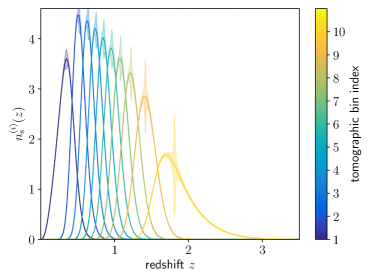
Photometric redshifts are a key ingredient in the analysis and interpretation of large-scale structure (LSS) surveys. The accuracy and precision of these redshift estimates are directly linked to the constraining power of photometric surveys. It is hence necessary to define precision and accuracy requirements for the redshift calibration evision{to not} infer biased results in the final analysis. For weak gravitational lensing of the LSS, the photometry culminates in the estimation of the source redshift distribution (SRD) in each of the tomographic bins used in the analysis. The focus has been on shifts of the mean of the SRDs and how well the calibration must be able to recover those. Since the estimated SRDs are usually given as a normalized histogram with corresponding errors, it would be advantageous to propagate these uncertainties accordingly to see whether the requirements of the given survey are indeed fulfilled. Here we propose the use of functional derivatives to calculate the sensitivity of the final observables, e.g. the lensing angular power spectrum, with respect to the SRD at a specific redshift. This allows the propagation of arbitrarily shaped small perturbations to the SRD, without having to run the whole analysis pipeline for each realization again. We apply our method to an EUCLID survey and demonstrate it with SRDs of the KV450 data set, recovering previous results. Lastly, we note that the moments of the SRD of order larger than two will probably not be relevant when propagating redshift uncertainties in cosmic shear analysis.
研究动机与目标
- 为解决在弱引力透镜巡天中传播光度红移不确定性的问题,而无需对每次实现都重新运行完整分析流程。
- 评估当前及未来巡天(如EUCLID和KV450)的源红移分布(SRD)精度是否满足避免宇宙学约束偏差的严格标准。
- 确定SRD的哪些统计矩(均值、方差、偏度等)对宇宙学参数推断的偏差最为敏感。
- 开发一种计算高效的评估方法,用于量化SRD不确定性对角功率谱的影响,采用函数导数方法。
提出的方法
- 该方法计算了在固定共动距离 $\chi_0$ 处,宇宙弱引力透镜角功率谱 $C_\ell$ 对SRD的函数导数,从而实现对SRD中任意小扰动的灵敏度分析。
- 函数导数仅需计算一次,随后可用于传播从SRD后验分布中采样的扰动,避免了重复运行完整分析流程。
- 该方法通过在函数导数计算中引入狄拉克-$\delta$ 函数约束,考虑了SRD的归一化约束。
- 误差传播通过 $\Delta\chi^2 = \int d\chi \, \delta n(\chi) \cdot \frac{\delta C_\ell}{\delta n(\chi)} \cdot \delta n(\chi)$ 实现,其中 $\delta n(\chi)$ 表示SRD中的小扰动。
- 该方法应用于类似EUCLID的巡 specifications,并在KV450数据上进行了验证,使用DIR协方差矩阵来采样现实的SRD实现。
- 分析包括对均值、方差及高阶矩(至偏度)扰动的比较,结果通过 $\Delta\chi^2$ 和推导出的 $S_8$ 偏移量进行评估。
实验结果
研究问题
- RQ1SRD中微小而任意的扰动如何影响宇宙弱引力透镜的角功率谱?
- RQ2宇宙学约束对SRD的均值、方差及高阶矩的敏感度如何?
- RQ3在第三阶段和第四阶段巡天中,SRD的完整形状不确定性(超越简单的均值偏移)在多大程度上会引入宇宙学参数推断的偏差?
- RQ4函数导数方法能否作为SRD不确定性传播的高效替代方案,避免完全的蒙特卡洛采样?
- RQ5SRD的高阶矩(n > 2)在像EUCLID这样的未来巡天中对偏差控制是否具有相关性?
主要发现
- 保持SRD均值不变的扰动可显著更大而不会引入偏差,支持了校准中仅使用均值偏移的常见做法。
- 对于EUCLID,SRD的均值必须校准至优于0.01%至1%的精度(具体取决于光度红移分箱),以避免宇宙学偏差。
- SRD的方差在10%量级仍具相关性,而对偏度的敏感度虽弱但非零;高阶矩(n > 2)对偏差控制可忽略不计。
- 通过函数导数方法传播KV450的SRD不确定性,对最终宇宙学约束的偏差最大为1σ,证实了当前校准的稳健性。
- 该方法实现了函数导数的一次性快速计算,使得在无需对每次实现重新运行完整分析流程的前提下,高效实现不确定性传播。
- 函数导数方法被证明是全形状采样或参数建模的可行且可扩展的替代方案,尤其适用于自校准和灵敏度分析。
阅读本论文
在 Nubint 阅读器中打开原文,边读边就任意段落提问。
在 Nubint 中阅读本论文本解读由 AI 根据论文原文生成,引用前请核对原文。