
[论文解读] Proposal for many-body quantum chaos detection
本文提出通过实验可观测的物理量中谱相关性的动力学特征——具体而言,是谱形式因子中的斜率-下陷-斜坡-平台结构(相关性空穴)——来探测多体量子混沌。利用小尺寸的自旋-1/2模型(6位自旋的海森堡模型和长程伊辛链),研究表明该相关性空穴可在实验可行的时间尺度和门深度内显现,使得在当前的量子模拟器与量子计算机上实现探测成为可能。
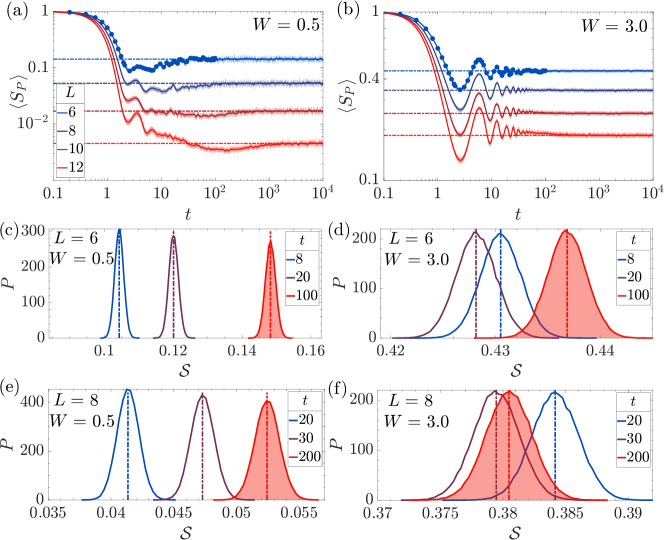
In this work, the term ``quantum chaos'' refers to spectral correlations similar to those found in the random matrix theory. Quantum chaos can be diagnosed through the analysis of level statistics using e.g.~the spectral form factor, which detects both short- and long-range level correlations. The spectral form factor corresponds to the Fourier transform of the two-point spectral correlation function and exhibits a typical slope-dip-ramp-plateau structure (aka correlation hole) when the system is chaotic. We discuss how this structure could be detected through the quench dynamics of two physical quantities accessible to experimental many-body quantum systems: the survival probability and the spin autocorrelation function. The survival probability is equivalent to the spectral form factor with an additional filter. When the system is small, the dip of the correlation hole reaches sufficiently large values at times which are short enough to be detected with current experimental platforms. As the system is pushed away from chaos, the correlation hole disappears, signaling integrability or localization. We also provide a relatively shallow circuit with which the correlation hole could be detected with commercially available quantum computers.
研究动机与目标
- 识别在多体系统中体现量子混沌特征谱相关的实验可观测动力学量。
- 证明谱形式因子中的斜率-下陷-斜坡-平台结构(相关性空穴)可通过真实量子平台中物理可观测量的时间演化进行探测。
- 评估在当前实验设置下检测量子混沌的可行性,特别是针对少体系统与浅层量子线路。
- 评估噪声与有限尺寸效应在增强小系统中相关性空穴可探测性方面的作用。
- 为利用现有量子模拟器与量子计算机实验探测多体量子混沌提供路线图。
提出的方法
- 在混沌的多体自旋-1/2哈密顿量下,计算生存概率与自旋自相关函数作为时间演化可观测量,具体为一维无序海森堡模型与一维横向场长程伊辛模型。
- 通过其傅里叶变换,将编码了能级统计并表现出特征斜率-下陷-斜坡-平台结构的谱形式因子与这些可观测量的动力学联系起来。
- 在小系统(如6位链)上进行数值模拟,以确保海森堡时间足够短,可在当前相干时间范围内完成完整演化。
- 提出使用Trotter分解与混合量子-经经典算法作为近场量子硬件上时间演化的可行方法,以在电路深度与精度之间取得平衡。
- 通过测量噪声实验评估推断相关性空穴存在的测量次数需求。
- 利用有限尺寸效应增强生存概率中下陷与斜坡的可见度,使小系统中检测更加可行。

实验结果
研究问题
- RQ1谱形式因子的特征斜率-下陷-斜坡-平台结构是否可通过多体量子系统中生存概率的动力学在实验中探测到?
- RQ2在当前量子模拟器与量子计算机的相干时间与门深度限制下,生存概率或自旋自相关函数中的相关性空穴是否可观测?
- RQ3量子比特数量与系统尺寸如何影响小自旋链中相关性空穴的可见度与可探测性?
- RQ4噪声或有限尺寸效应是否可增强小系统中量子混沌特征的可探测性?
- RQ5在实验时间序列数据中,可靠推断相关性空穴存在的最小测量次数是多少?
主要发现
- 6位无序海森堡链在海森堡时间内表现出清晰的相关性空穴,且该时间足够短,可在当前量子硬件上实现。
- 即使在相干时间有限的情况下,生存概率中的下陷仍可达到足够大的值,使其在短时间内可被实验探测。
- 当系统处于混沌态时,自旋自相关函数也表现出特征斜率-下陷-斜坡-平台结构,为谱相关的局域实空间探测提供了手段。
- 对于自旋链中的单个激发,海森堡时间随系统尺寸线性增长,使得在小系统中实现完全演化至饱和成为可能。
- 仅需在相关性空穴区域内采集少数时间点的测量数据,即可推断其存在,从而降低实验开销。
- 系统中的噪声可能减少对系综平均的需求,从而在实际实验设置中潜在提升相关性空穴的可探测性。
阅读本论文
在 Nubint 阅读器中打开原文,边读边就任意段落提问。
在 Nubint 中阅读本论文本解读由 AI 根据论文原文生成,引用前请核对原文。