
[论文解读] Proto-CLIP: Vision-Language Prototypical Network for Few-Shot Learning
Proto-CLIP 将来自 frozen CLIP 主干的图像和文本原型结合,学习适配器和记忆以对齐图像和文本原型,从而提升少样本分类性能。
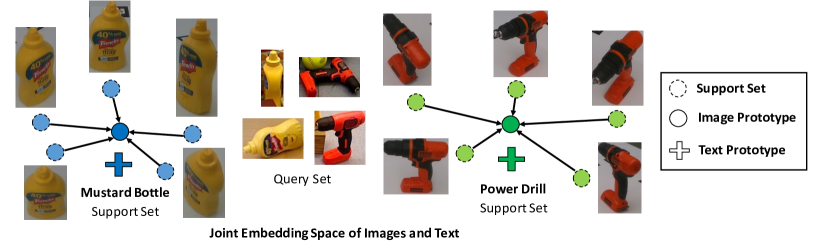
We propose a novel framework for few-shot learning by leveraging large-scale vision-language models such as CLIP. Motivated by unimodal prototypical networks for few-shot learning, we introduce Proto-CLIP which utilizes image prototypes and text prototypes for few-shot learning. Specifically, Proto-CLIP adapts the image and text encoder embeddings from CLIP in a joint fashion using few-shot examples. The embeddings from the two encoders are used to compute the respective prototypes of image classes for classification. During adaptation, we propose aligning the image and text prototypes of the corresponding classes. Such alignment is beneficial for few-shot classification due to the reinforced contributions from both types of prototypes. Proto-CLIP has both training-free and fine-tuned variants. We demonstrate the effectiveness of our method by conducting experiments on benchmark datasets for few-shot learning, as well as in the real world for robot perception. The project page is available at https://irvlutd.github.io/Proto-CLIP
研究动机与目标
- 通过利用大型视觉-语言模型(CLIP)在机器人和普遍视觉任务中用少量示例识别新对象来激发少样本学习。
- 提出一个联合的图像-文本原型框架,使用少样本数据对 CLIP 编码器进行自适应。
- 通过对齐每个类别的图像原型和文本原型来提升少样本分类性能。
- 在标准少样本基准和 FewSOL 上评估 Proto-CLIP,包括现实世界的机器人感知实验。
提出的方法
- 同时使用 CLIP 的图像和文本编码器来形成类别原型:图像原型 c_k^x 和文本原型 c_k^y,通过自适应嵌入计算。
- 通过一个可学习的图像记忆、文本记忆以及应用于查询图像的适配网络来对 CLIP 进行自适应,同时保持 CLIP 编码器冻结。
- 将类别条件概率计算为基于图像的预测和基于文本的预测的凸结合:P(y=k|x^q,S) = alpha P(y=k|x^q,S_x) + (1-alpha) P(y=k|x^q,S_y)。
- 原型通过嵌入的平均来学习:c_k^x = (1/M_k) sum φ_Image(x_i^s) 且 c_k^y = (1/Ṁ_k) sum φ_Text(Prompt_j(y_i^s=k))。
- 使用联合损失进行训练:L1 用于查询分类 + L2 和 L3 通过 InfoNCE(对比)损失对齐图像和文本原型。
- 在训练期间,S(支持集)和 Q(查询集)通常与基于 CLIP 的少样本方法相同,图像/文本编码器保持冻结,只有记忆和适配器被学习。
实验结果
研究问题
- RQ1联合自适应 CLIP 的图像和文本编码器是否比单模态原型方法在少样本分类上更优?
- RQ2在 InfoNCE 目标下对齐图像和文本原型是否有助于在少样本设置中对新类别的识别?
- RQ3可学习的图像/文本记忆和不同的适配器设计如何影响跨数据集的少样本性能?
- RQ4在 Proto-CLIP 中,对查询进行数据增强与基于记忆的自适应之间的权衡是什么?
主要发现
- Proto-CLIP 在多个数据集上持续优于零样本 CLIP 及若干基于 CLIP 的少样本基线,且随着样本数增加,增益扩大。
- 通过对比损失(L2、L3)对齐图像和文本原型有利于性能,验证了联合嵌入假设。
- 使用可学习的图像/文本记忆和适配器比直接使用 CLIP 特征更利于自适应,且适配器的选择(MLP 与卷积)可能取决于数据集。
- 骨干网络选择(如 CLIP ViT 与 ResNet)会影响结果,视觉-语言骨干在少样本场景中通常获得更强的性能。
- 在训练时应用查询增强(Q^T)的 Proto-CLIP 变体通常优于未增强的对照版本,特别是在高样本设置中。

阅读本论文
在 Nubint 阅读器中打开原文,边读边就任意段落提问。
在 Nubint 中阅读本论文本解读由 AI 根据论文原文生成,引用前请核对原文。