
[论文解读] Prototype Global Analysis of LISA Data with Multiple Source Types
本文提出了GLASS,这是首个用于LISA数据的全局分析流程原型,能够使用分块Metropolis-Hastings算法同时拟合多种引力波源类型——超紧凑双星(UCBs)、验证双星(VGBs)、大质量黑洞并合(MBHBs)以及仪器噪声。该方法在LISA数据挑战2a-v2的模拟数据中成功重建了源群体和噪声模型,证明了未来LISA任务中模块化、可扩展的全局拟合框架的可行性。
The novel data analysis challenges posed by the Laser Interferometer Space Antenna (LISA) arise from the overwhelmingly large number of astrophysical sources in the measurement band and the density with which they are found in the data. Robust detection and characterization of the numerous gravitational wave sources in LISA data can not be done sequentially, but rather through a simultaneous global fit of a data model containing the full suite of astrophysical and instrumental features present in the data. While previous analyses have focused on individual source types in isolation, here we present the first demonstration of a LISA global fit analysis containing combined astrophysical populations. The prototype pipeline uses a blocked Metropolis Hastings algorithm to alternatingly fit to a population of ultra compact galactic binaries, known ``verification binaries'' already identified by electromagnetic observations, a population of massive black hole mergers, and an instrument noise model. The Global LISA Analysis Software Suite (GLASS) is assembled from independently developed samplers for the different model components. The modular design enables flexibility to future development by defining standard interfaces for adding new, or updating additional, components to the global fit without being overly prescriptive for how those modules must be internally designed. The GLASS pipeline is demonstrated on data simulated for the LISA Data Challenge 2b. Results of the analysis and a road-map for continued development are described in detail.
研究动机与目标
- 为解决LISA数据中存在大量重叠引力波源和复杂噪声的分析挑战。
- 开发一种可扩展、模块化的框架,能够同时拟合多种源类型和仪器效应。
- 通过LISA数据挑战2a-v2提供的真实模拟LISA数据,证明全局拟合方法的可行性。
- 为未来在LISA数据分析中集成先进噪声模型、爆破事件(glitches)和自校准技术奠定基础。
提出的方法
- GLASS使用分块Metropolis-Hastings算法,联合采样四个模型分量的参数:UCBs、VGBs、MBHBs以及现象学噪声模型。
- 每种源类型均使用解析波形建模:UCBs和VGBs通过时域模板,MBHBs通过后牛顿波形。
- 噪声模型同时考虑仪器噪声和未解析的银河系双星背景,后者被处理为随机信号。
- 该流程具有模块化设计,各组件拥有独立的采样器,通过标准化接口通信,以支持可扩展性。
- 数据按时间段顺序处理,以模拟真实任务运行环境,提升计算可扩展性。
- 采用小波域分析,与基于傅里叶的方法相比,能更自然地处理数据间隙并减少频谱泄漏。
实验结果
研究问题
- RQ1全局拟合框架能否在LISA数据中同时且稳健地建模多种引力波源类型?
- RQ2在信号混淆存在的情况下,模块化分块Metropolis-Hastings算法在恢复源参数和噪声水平方面的表现如何?
- RQ3GLASS流程在重建LISA数据挑战2a-v2模拟数据中UCB、VGB和MBHB群体方面的性能如何?
- RQ4与基于傅里叶的方法相比,小波域方法在处理数据间隙和非平稳噪声方面表现如何?
- RQ5为将全局拟合扩展至完整LISA任务数据,面临的主要挑战和未来扩展方向是什么?
主要发现
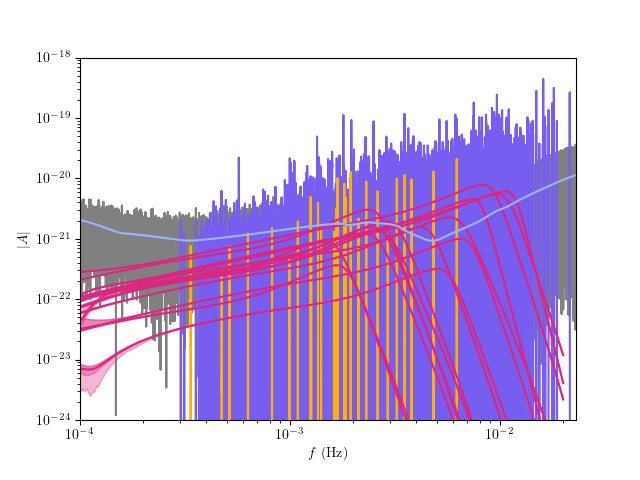
- GLASS流程成功重建了A通道TDI数据的振幅功率谱密度,UCB波形的后验分布与注入信号高度一致。
- 35个验证双星(VGBs)的参数被高保真度恢复,证实了全局拟合方法的鲁棒性。
- 未解析的银河系双星背景被有效建模为随机分量,尽管未来工作将通过源分布的物理先验进一步优化该模型。
- 模块化设计使得可无缝集成新组件(如爆破事件模型和自校准模块),而无需重构核心框架。
- 小波域方法在处理数据间隙方面表现优于传统傅里叶方法,无需额外数据预处理即可减少频谱泄漏。
- 该流程已开始扩展以支持TDI T通道和时变噪声模型,未来计划整合物理仪器模型和相位稳定化效应。
阅读本论文
在 Nubint 阅读器中打开原文,边读边就任意段落提问。
在 Nubint 中阅读本论文本解读由 AI 根据论文原文生成,引用前请核对原文。