
[论文解读] Provably Accurate Shapley Value Estimation via Leverage Score Sampling
本文提出 Leverage SHAP,一种利用杠杆率采样实现可证明准确的 Shapley 值估计方法,将模型评估次数减少至 O(n log n) 的同时保持高精度。通过将 Shapley 值估计重新表述为约束回归问题,并应用杠杆率采样选择信息量丰富的子集,该方法实现了理论保证,并在实践中优于 Kernel SHAP。
Originally introduced in game theory, Shapley values have emerged as a central tool in explainable machine learning, where they are used to attribute model predictions to specific input features. However, computing Shapley values exactly is expensive: for a general model with $n$ features, $O(2^n)$ model evaluations are necessary. To address this issue, approximation algorithms are widely used. One of the most popular is the Kernel SHAP algorithm, which is model agnostic and remarkably effective in practice. However, to the best of our knowledge, Kernel SHAP has no strong non-asymptotic complexity guarantees. We address this issue by introducing Leverage SHAP, a light-weight modification of Kernel SHAP that provides provably accurate Shapley value estimates with just $O(n\log n)$ model evaluations. Our approach takes advantage of a connection between Shapley value estimation and agnostic active learning by employing leverage score sampling, a powerful regression tool. Beyond theoretical guarantees, we show that Leverage SHAP consistently outperforms even the highly optimized implementation of Kernel SHAP available in the ubiquitous SHAP library [Lundberg & Lee, 2017].
研究动机与目标
- 解决现有 Shapley 值近似方法(如 Kernel SHAP)缺乏非渐近复杂度保证的问题。
- 开发一种可证明准确且高效的机器学习可解释性中 Shapley 值估计算法。
- 将准确估计 Shapley 值所需的模型评估次数从 O(2^n) 降低至 O(n log n)。
- 利用杠杆率采样建立 Shapley 值估计与鲁棒主动学习之间的联系。
提出的方法
- 将 Shapley 值估计重新表述为约束最小二乘回归问题,以确保解满足效率性质。
- 应用杠杆率采样选择少量、信息量丰富的联盟(特征子集)进行模型评估,从而减少所需评估次数。
- 采用两阶段采样策略:首先使用杠杆率采样选择少量子集,然后在采样数据上求解回归问题。
- 采用 Kernel SHAP 框架的改进版本,将均匀采样替换为杠杆率采样,以提升估计精度。
- 利用矩阵集中与杠杆率采样理论推导估计误差的理论界,确保高概率下的准确性。
- 在投影掉均值分量以满足效率约束后,使用标准最小二乘法求解所得回归问题。
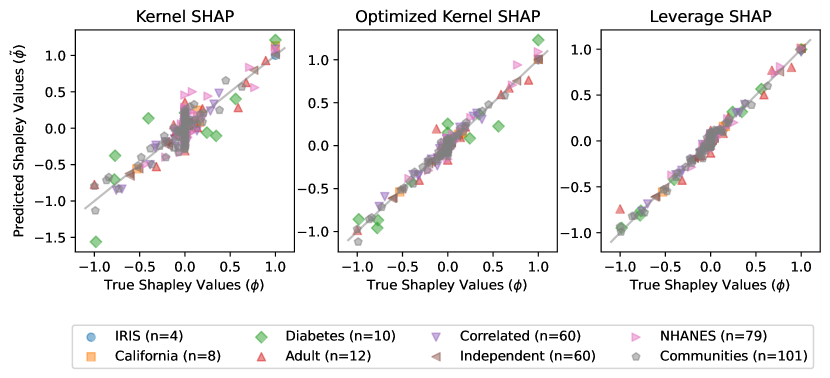
实验结果
研究问题
- RQ1我们能否设计一种具有可证明非渐近精度保证的 Shapley 值估计算法?
- RQ2我们能否在保持或提升精度的同时,将准确估计 Shapley 值所需的模型评估次数降低至 O(2^n) 以下?
- RQ3杠杆率采样能否有效应用于 Shapley 值估计问题,以提升样本效率?
- RQ4与 Kernel SHAP 相比,所提方法在精度和样本复杂度方面表现如何?
主要发现
- Leverage SHAP 仅通过 O(n log n) 次模型评估即可实现可证明准确的 Shapley 值估计,显著降低了计算成本。
- 该方法提供了在高概率下成立的估计误差理论界,填补了 Shapley 值近似理论理解中的关键空白。
- 实验结果表明,Leverage SHAP 在多个数据集和模型上始终优于 SHAP 库中高度优化的 Kernel SHAP 实现。
- 与均匀采样相比,杠杆率采样可实现更具信息量的子集选择,从而实现更快收敛和更高精度。
- 该算法在保持 Kernel SHAP 模型无关特性的基础上,提升了样本效率和理论保证。

阅读本论文
在 Nubint 阅读器中打开原文,边读边就任意段落提问。
在 Nubint 中阅读本论文本解读由 AI 根据论文原文生成,引用前请核对原文。