
[论文解读] Pupil-Adaptive 3D Holography Beyond Coherent Depth-of-Field
本文提出了一种瞳孔自适应的神经框架,用于3D全息成像,能够根据实时瞳孔大小动态调整全息重建中的景深,实现与真实世界非相干光下无法区分的逼真散焦模糊。通过学习与瞳孔相关的感受野,该方法克服了相干全息成像的固有局限,相比先前方法,PSNR最高提升5 dB,并在物理原型机上展示了自然的焦点线索。
Recent holographic display approaches propelled by deep learning have shown remarkable success in enabling high-fidelity holographic projections. However, these displays have still not been able to demonstrate realistic focus cues, and a major gap still remains between the defocus effects possible with a coherent light-based holographic display and those exhibited by incoherent light in the real world. Moreover, existing methods have not considered the effects of the observer's eye pupil size variations on the perceived quality of 3D projections, especially on the defocus blur due to varying depth-of-field of the eye. In this work, we propose a framework that bridges the gap between the coherent depth-of-field of holographic displays and what is seen in the real world due to incoherent light. To this end, we investigate the effect of varying shape and motion of the eye pupil on the quality of holographic projections, and devise a method that changes the depth-of-the-field of holographic projections dynamically in a pupil-adaptive manner. Specifically, we introduce a learning framework that adjusts the receptive fields on-the-go based on the current state of the observer's eye pupil to produce image effects that otherwise are not possible in current computer-generated holography approaches. We validate the proposed method both in simulations and on an experimental prototype holographic display, and demonstrate significant improvements in the depiction of depth-of-field effects, outperforming existing approaches both qualitatively and quantitatively by at least 5 dB in peak signal-to-noise ratio.
研究动机与目标
- 通过建模与瞳孔相关的散焦效应,弥合相干全息显示与自然非相干光成像之间的差距。
- 解决当前计算机生成全息中缺乏真实焦点线索的问题,尤其是由相干光引起的不自然散焦模糊。
- 基于实时观察者瞳孔大小变化,实现在全息显示中的动态景深适应。
- 通过模拟非相干光传输效应,提升全息投影的图像保真度与逼真感。
- 开发一种可泛化的框架,支持多种输入模态,包括单张RGB图像。
提出的方法
- 设计了一个统一的神经框架,以学习基于瞳孔的自适应感受野,并根据眼动追踪数据实时调整。
- 该方法使用可微分的波前传播模型,模拟不同瞳孔大小如何影响全息重建中感知的景深。
- 其包含一个渲染流水线,可在不同瞳孔条件下生成逼真的重建结果,通过调节空间光调制器(SLM)的相位分布来模拟非相干光效应。
- 该框架采用损失函数,同时确保高图像保真度与准确的散焦模糊,最小化振铃效应与斑点噪声等伪影。
- 支持多种输入模态,包括RGB-D与单张RGB图像,具备广泛适用性。
- 系统在配备实时眼动追踪的物理原型显示器上进行了验证,成功展示了对瞳孔变化的动态适应能力。
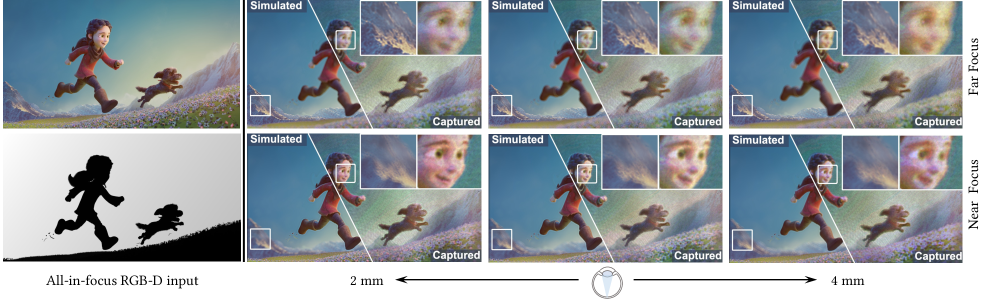
实验结果
研究问题
- RQ1在基于相干光波前调制的约束下,全息显示如何模拟由非相干光引起的逼真散焦模糊?
- RQ2神经框架在多大程度上能够基于实时瞳孔大小测量,动态调整全息投影的景深?
- RQ3瞳孔自适应全息成像是否能超越当前相干全息方法,在图像质量与感知真实感方面实现提升?
- RQ4所提方法在不同输入模态(如单张RGB图像或RGB-D数据)上的泛化能力如何?
- RQ5与瞳孔相关的散焦效应对近眼光学全息显示中的感知景深与视觉舒适度有何影响?
主要发现
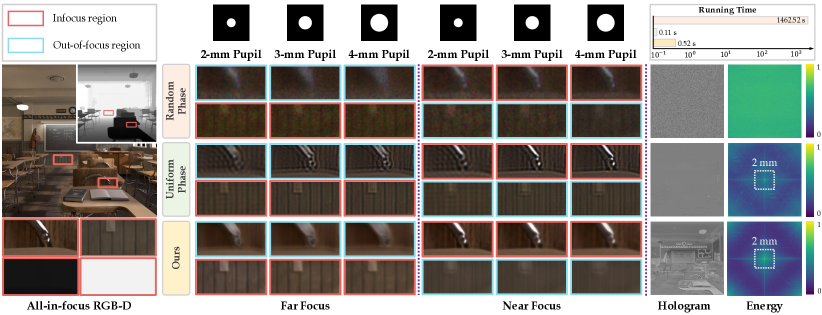
- 所提方法相比最先进方法,PSNR最高提升5 dB,证明了其在图像保真度方面的优越性。
- 使用该框架生成的全息图展现出与真实世界非相干成像高度一致的自然散焦模糊,消除了相干显示中常见的不自然锐利感与伪影。
- 系统成功减轻了离焦区域(尤其是边缘区域)的振铃效应,而这类伪影在先前方法(如TensorHolo V1/V2)中尤为显著。
- 在物理原型显示器上的实验结果证实,瞳孔自适应全息成像在不同瞳孔条件下均能产生感知上逼真的景深效果。
- 该框架在单张RGB图像输入下也表现出良好泛化能力,无需深度图即可生成合理且逼真的散焦效果。
- 主观评估计划在后续工作中进行,但现有结果表明其在感知真实感与视觉舒适度方面有显著提升。
阅读本论文
在 Nubint 阅读器中打开原文,边读边就任意段落提问。
在 Nubint 中阅读本论文本解读由 AI 根据论文原文生成,引用前请核对原文。