
[论文解读] Quafu-RL: The Cloud Quantum Computers based Quantum Reinforcement Learning
本文提出 Quafu-RL,一种基于云的NISQ设备上执行量子强化学习(QRL)的框架,采用硬件高效参数化量子电路(PQC)。通过采用多目标进化算法设计PQC,并结合专为Quafu量子硬件定制的自适应学习算法,作者在10、18和136量子比特设备上成功训练了RL智能体,在100次训练回合内实现稳定性能,且目标要求较为宽松。
With the rapid advent of quantum computing, hybrid quantum-classical machine learning has shown promising computational advantages in many key fields. Quantum reinforcement learning, as one of the most challenging tasks, has recently demonstrated its ability to solve standard benchmark environments with formally provable theoretical advantages over classical counterparts. However, despite the progress of quantum processors and the emergence of quantum computing clouds in the noisy intermediate-scale quantum (NISQ) era, algorithms based on parameterized quantum circuits (PQCs) are rarely conducted on NISQ devices. In this work, we take the first step towards executing benchmark quantum reinforcement problems on various real devices equipped with at most 136 qubits on BAQIS Quafu quantum computing cloud. The experimental results demonstrate that the Reinforcement Learning (RL) agents are capable of achieving goals that are slightly relaxed both during the training and inference stages. Moreover, we meticulously design hardware-efficient PQC architectures in the quantum model using a multi-objective evolutionary algorithm and develop a learning algorithm that is adaptable to Quafu. We hope that the Quafu-RL be a guiding example to show how to realize machine learning task by taking advantage of quantum computers on the quantum cloud platform.
研究动机与目标
- 展示在基于云的量子计算平台中,利用真实噪声中等规模量子(NISQ)设备训练量子强化学习智能体的可行性。
- 通过设计硬件高效的PQC架构,应对NISQ设备中量子比特数量有限、退相干和门保真度不足的挑战。
- 开发一种可适配Quafu量子硬件的学习算法,提升真实设备上的可训练性和性能表现。
- 在标准基准环境(CartPole)上验证该方法,并在真实噪声和资源限制下评估性能。
- 提供一个可复现的流程,用于在云量子平台上部署基于PQC的QRL及其他量子机器学习任务。
提出的方法
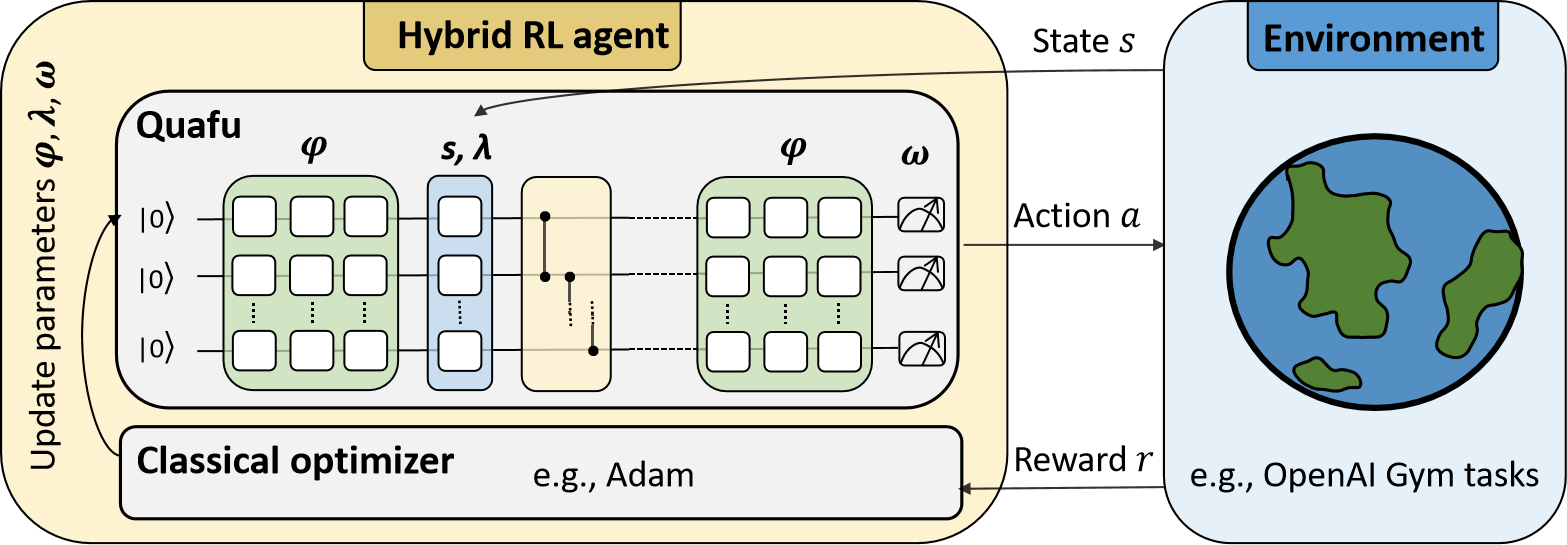
- 采用多目标进化算法搜索硬件高效PQC架构,以在表达能力和低纠缠度之间取得平衡,从而提升在NISQ设备上的可训练性。
- 设计一种定制的基于REINFORCE的学习算法,适配Quafu的量子计算栈,结合经典优化与量子策略评估。
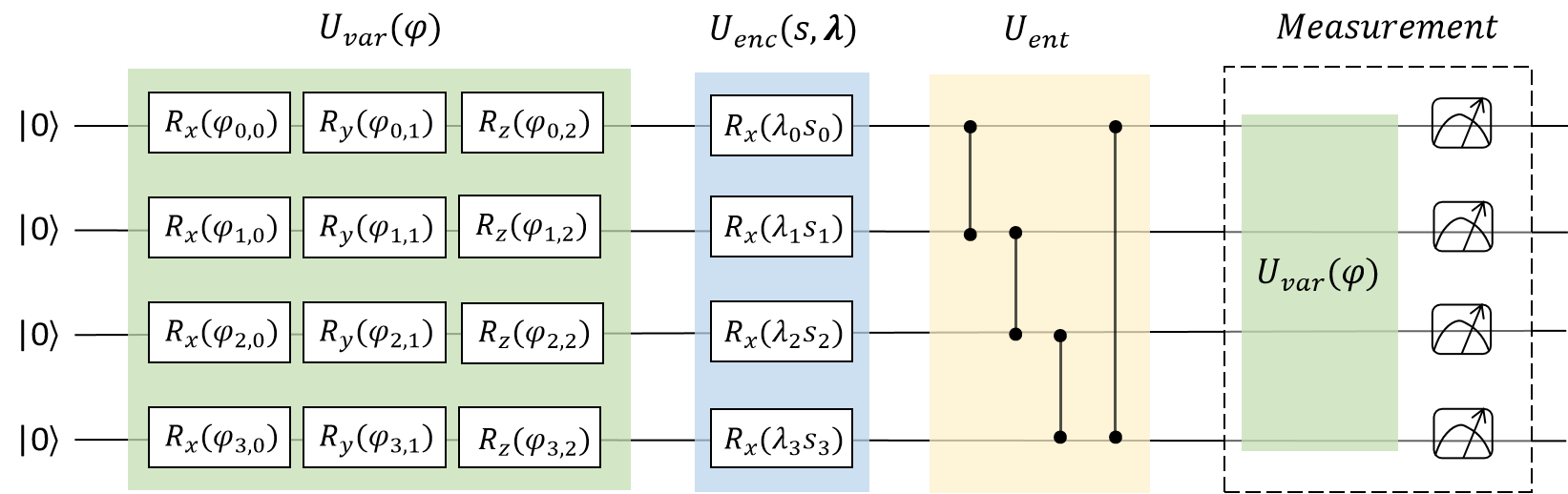
- 将选定的PQC架构集成到量子策略网络中,通过参数化量子电路将状态映射为动作概率。
- 在Quafu的基于云的量子处理器上执行训练和推理:ScQ-P10(10量子比特)、ScQ-P18(18量子比特)和ScQ-P136(136量子比特)。
- 使用TensorFlow Quantum进行优化循环的古典仿真及训练期间的量子电路评估。
- 应用折扣因子 γ = 1.0,并使用可观测量 $[Z_0Z_1Z_2Z_3]$ 计算策略梯度更新中的期望回报。
实验结果
研究问题
- RQ1在量子比特数量有限且噪声水平较高的真实NISQ设备上,能否成功训练量子强化学习智能体?
- RQ2硬件高效的PQC架构在真实量子硬件上对QRL智能体的性能和稳定性有何影响?
- RQ3定制化、设备适配的学习算法在噪声量子处理器上能在多大程度上提升训练收敛性和奖励获取?
- RQ4当在真实量子设备上以放宽目标条件进行训练时,QRL智能体是否能在标准基准环境(如CartPole)中实现有意义的性能表现?
- RQ5当前NISQ设备在支持可扩展量子机器学习工作负载方面存在哪些实际限制?
主要发现
- 在10量子比特的ScQ-P10设备上训练的RL智能体,在100次训练回合内达到最大单集奖励132,平均奖励稳定在约30。
- 在18量子比特的ScQ-P18设备上,智能体达到最大奖励86,并在100轮内保持约30的平均奖励。
- 136量子比特的ScQ-P136设备实现了最高性能,最大奖励达94,平均奖励稳定在约30。
- 在预训练的ScQ-P10模型上进行推理,100轮内平均奖励约为50,表明尽管训练过程存在噪声,仍实现了良好泛化。
- 训练过程显示出收敛迹象:在10量子比特设备上,80轮后移动平均奖励稳定在50以上,尽管原始CartPole目标(200)尚未完全达成。
- 结果表明,通过放宽目标并优化PQC设计,QRL智能体可在实际运行时间限制内成功在真实NISQ设备上训练和评估。
阅读本论文
在 Nubint 阅读器中打开原文,边读边就任意段落提问。
在 Nubint 中阅读本论文本解读由 AI 根据论文原文生成,引用前请核对原文。