
[论文解读] Quantum-enhanced sensing on an optical transition via emergent collective quantum correlations
该论文通过在最多51个囚禁离子的一维链中利用幂律衰减的、与状态相关的相互作用,实现了量子增强传感,生成集体量子关联。实验实现了−3.9 ± 0.3 dB(Wineland参数)的自旋压缩,并在拉比干涉仪中将测量不确定性降低至标准量子极限以下−3.2 ± 0.5 dB,展示了无需全连接的可扩展纠缠。
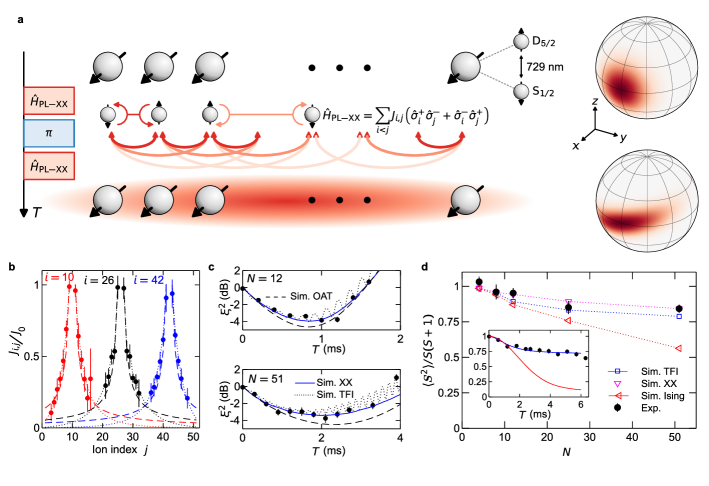
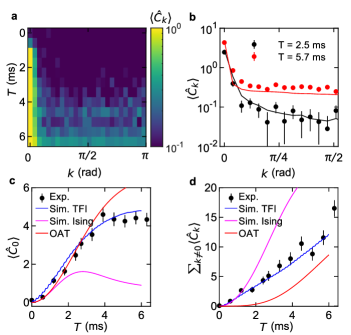
The control over quantum states in atomic systems has led to the most precise optical atomic clocks to date. Their sensitivity is currently bounded by the standard quantum limit, a fundamental floor set by quantum mechanics for uncorrelated particles, which can nevertheless be overcome when operated with entangled particles. Yet demonstrating a quantum advantage in real world sensors is extremely challenging and remains to be achieved aside from two remarkable examples, LIGO and more recently HAYSTAC. Here we illustrate a pathway for harnessing scalable entanglement in an optical transition using 1D chains of up to 51 ions with state-dependent interactions that decay as a power-law function of the ion separation. We show our sensor can be made to behave as a one-axis-twisting (OAT) model, an iconic fully connected model known to generate scalable squeezing. The collective nature of the state manifests itself in the preservation of the total transverse magnetization, the reduced growth of finite momentum spin-wave excitations, the generation of spin squeezing comparable to OAT (a Wineland parameter of $-3.9 \pm 0.3$ dB for only N = 12 ions) and the development of non-Gaussian states in the form of atomic multi-headed cat states in the Q-distribution. The simplicity of our protocol enables scalability to large arrays with minimal overhead, opening the door to advances in timekeeping as well as new methods for preserving coherence in quantum simulation and computation. We demonstrate this in a Ramsey-type interferometer, where we reduce the measurement uncertainty by $-3.2 \pm 0.5$ dB below the standard quantum limit for N = 51 ions.
研究动机与目标
- 通过使用有限范围相互作用而非全连接,证明在大规模囚禁离子阵列中实现量子增强传感。
- 在具有幂律衰减XX相互作用的一维离子链中,实现可扩展的自旋压缩与纠缠。
- 表明集体量子关联(如保持的总横向磁化强度和非高斯多头猫态)在该类系统中自然涌现。
- 在拉比型干涉仪中实现可测量的量子优势,将测量不确定性降低至标准量子极限以下。
- 建立一种可扩展、低开销的量子传感器协议,保持相干性,并推动时间测量与量子模拟的发展。
提出的方法
- 利用最多51个囚禁的40Ca+离子的一维链,通过光学跃迁(D5/2 → D3/2)编码量子比特,以实现高相干性。
- 通过激光驱动的自旋交换(XX型)相互作用实现状态依赖性相互作用,其随离子间距按幂律衰减(α ≈ 0.9–1.0)。
- 施加全局激光脉冲序列,实现类似一轴扭转(OAT)的演化,从自旋相干态(SCS)生成自旋压缩态。
- 通过Wineland参数测量自旋压缩,并利用总横向磁化强度与自旋波激发监测集体自旋动力学。
- 通过Q分布分析检测非高斯特征(如多头猫态),证实多体纠缠的涌现。
- 在压缩态上执行拉比干涉测量,量化相对于标准量子极限的测量不确定性降低程度。
实验结果
研究问题
- RQ1在具有有限范围、幂律衰减相互作用的一维囚禁离子链中,能否在无需全连接的情况下实现可扩展的自旋压缩?
- RQ2此类系统中,集体量子关联(如保持的总横向磁化强度与非高斯态)在多大程度上自然涌现?
- RQ3仅通过局部控制与幂律相互作用,系统能否在拉比型干涉仪中实现低于标准量子极限的量子优势?
- RQ4在退相干与相位退化存在的情况下,系统性能与理想OAT模型相比如何?
- RQ5在真实退相干条件下,随着系统尺寸增大(N = 12至N = 51),自旋压缩与测量不确定性降低的尺度极限是什么?
主要发现
- 对于N = 12个离子,实现了−3.9 ± 0.3 dB的自旋压缩,接近在类似退相干条件下理想OAT模型的性能。
- 对于N = 51个离子,拉比干涉仪中的测量不确定性降低了−3.2 ± 0.5 dB,低于标准量子极限,证明了可测量的量子优势。
- 系统在演化过程中保持了总横向磁化强度,表明尽管存在有限范围相互作用,仍具有稳健的集体行为。
- 有限动量的自旋波激发增长速度慢于非集体模型,证实了集体动力学的涌现。
- 观察到非高斯态(Q分布中显示多头猫态),证实了复杂多体纠缠的生成。
- 自旋压缩的尺度分析显示,当N较大时趋于饱和,受限于缓慢的纠缠生成与退相位,但当J₀加倍时,N = 12时观察到性能提升。
阅读本论文
在 Nubint 阅读器中打开原文,边读边就任意段落提问。
在 Nubint 中阅读本论文本解读由 AI 根据论文原文生成,引用前请核对原文。