
[论文解读] Quantum signal processing with continuous variables
该论文将量子信号处理(QSP)从紧致李群 SU(2) 扩展至非紧致的 SU(1,1),证明了可在连续变量系统中构建类似 QSP 的方案。尽管 SU(1,1) 是非紧致的,作者表明仍可近似任意多项式变换,并提出了切比雪夫多项式、单项式及可调阈值函数的解析协议,从而在量子放大和干涉测量中开启新应用。
Quantum singular value transformation (QSVT) enables the application of polynomial functions to the singular values of near arbitrary linear operators embedded in unitary transforms, and has been used to unify, simplify, and improve most quantum algorithms. QSVT depends on precise results in representation theory, with the desired polynomial functions acting simultaneously within invariant two-dimensional subspaces of a larger Hilbert space. These two-dimensional transformations are largely determined by the related theory of quantum signal processing (QSP). While QSP appears to rely on properties specific to the compact Lie group SU(2), many other Lie groups appear naturally in physical systems relevant to quantum information. This work considers settings in which SU(1,1) describes system dynamics and finds that, surprisingly, despite the non-compactness of SU(1,1), one can recover a QSP-type ansatz, and show its ability to approximate near arbitrary polynomial transformations. We discuss various experimental uses of this construction, as well as prospects for expanded relevance of QSP-like ansätze to other Lie groups.
研究动机与目标
- 将量子信号处理(QSP)的框架从 SU(2) 扩展至与连续变量量子系统相关的非紧致李群 SU(1,1)。
- 研究 QSP 的核心原理(如通过交替酉操作近似多项式函数)是否可在非紧致设置中保持不变。
- 开发解析的相位设计,以实现 SU(1,1) 系统中多项式变换的高效且精确控制。
- 在量子测量与放大中展示实际应用,特别是针对如行波参量放大器等参量驱动系统。
- 为超越 SU(2) 的 QSP 类似算法建立理论基础,为连续变量量子计算中的新量子算法开辟路径。
提出的方法
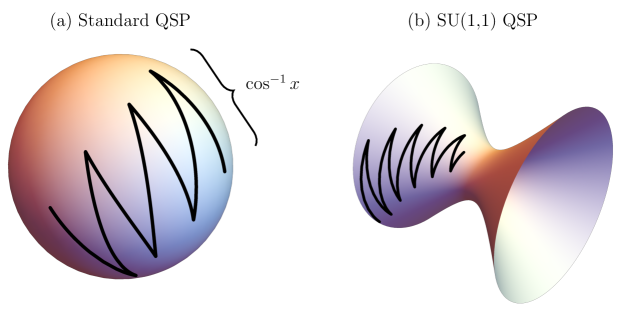
- 通过用双曲函数替代三角函数,推导 SU(1,1) 的改进 QSP 方案,将区间 $[-1,1]$ 映射至 $[1, \infty)$。
- 利用 SU(1,1) 与实双曲平面之间的同构关系,构造由双曲角 $\beta$ 参数化的酉操作。
- 建立 SU(1,1) 中可实现多项式函数与在 $[-1,1]$ 上满足 $|P(x)| \leq 1$ 且在 $[1,\infty)$ 上满足 $|P(x)| \geq 1$ 的多项式之间的对应关系,且具有确定的对称性。
- 证明尽管可能存在收敛缓慢,改进后的方案在满足新有界性约束的连续函数集合中仍保持稠密性。
- 为关键函数构造显式相位序列:切比雪夫多项式、单项式以及可调阈值函数(可调节台阶位置与高度)。
- 分析对参数变化的敏感性,表明 SU(1,1) 方案比 SU(2) 对应方案更敏感,尤其在长长度极限下。
实验结果
研究问题
- RQ1能否在连续变量系统中成功将类似 QSP 的方案从 SU(2) 推广至非紧致群 SU(1,1)?
- RQ2SU(1,1) 框架中可实现多项式变换的功能约束是什么?与 SU(2) 情况有何不同?
- RQ3能否为 SU(1,1) 中的特定函数(如切比雪夫多项式、单项式及阈值函数)构建高效且可解析处理的协议?
- RQ4SU(1,1) 的非紧致性如何影响 QSP 类似方案的收敛速度与参数敏感性?
- RQ5该扩展对连续变量量子技术中的量子测量与放大有何影响?
主要发现
- 尽管 SU(1,1) 是非紧致的,通过用双曲函数替代三角函数,仍可成功构建类似 QSP 的方案。
- SU(1,1) QSP 中可实现函数的集合由在 $[-1,1]$ 上有界于 1 且在 $[1,\infty)$ 上有下界于 1 的多项式构成,且具有确定对称性。
- 尽管最坏情况下的协议长度可能迅速增长,改进后的方案在满足新有界性约束的连续函数集合中仍保持稠密性。
- 为切比雪夫多项式、单项式以及可调阈值函数(台阶位置与高度可精确控制)推导出显式相位设计。
- 该阈值函数在标准 QSP 中并无自然类比,却在连续变量系统信号处理中成为强大工具。
- SU(1,1) QSP 协议对参数变化的敏感性显著高于其 SU(2) 对应方案,表明灵活性与鲁棒性之间存在权衡。

阅读本论文
在 Nubint 阅读器中打开原文,边读边就任意段落提问。
在 Nubint 中阅读本论文本解读由 AI 根据论文原文生成,引用前请核对原文。