
[论文解读] Quasar Luminosity Function at z = 7
本研究首次基于35个光谱确认的类星体,对z=7时的类星体光度函数(LF)进行了稳健测量,结合了SHELLQs巡天(22个暗弱类星体)与文献中的13个更明亮的类星体。结果发现,其亮端斜率显著平坦化,特征星等为M*₁₄₅₀ = −25.60⁺⁰.⁴⁰₋₀.³⁰,亮端斜率为β = −3.34⁺⁰.⁴⁹₋₀.⁵⁷,表明在这一早期宇宙时期,低光度类星体的密度很高。
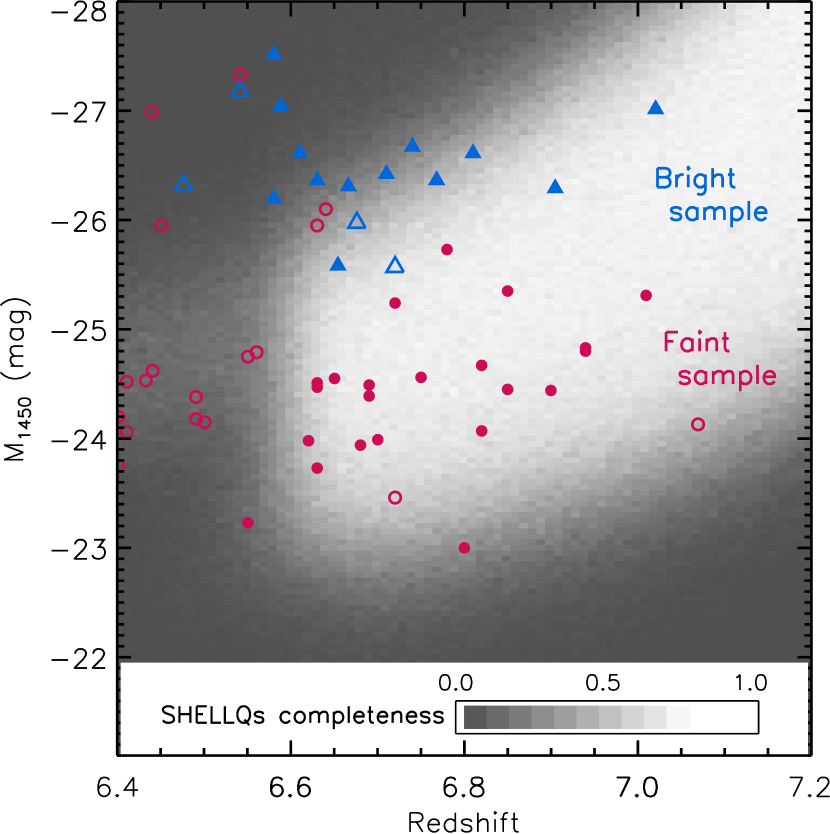
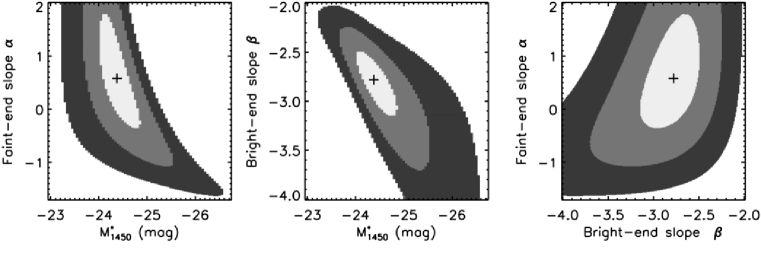
We present the quasar luminosity function (LF) at $z = 7$, measured with 35 spectroscopically confirmed quasars at $6.55 < z < 7.15$. The sample of 22 quasars from the Subaru High-$z$ Exploration of Low-Luminosity Quasars (SHELLQs) project, combined with 13 brighter quasars in the literature, covers an unprecedentedly wide range of rest-frame ultraviolet magnitudes over $-28 < M_{1450} < -23$. We found that the binned LF flattens significantly toward the faint end populated by the SHELLQs quasars. A maximum likelihood fit to a double power-law model has a break magnitude $M^*_{1450} = -25.60^{+0.40}_{-0.30}$, a characteristic density $Φ^* = 1.35^{+0.47}_{-0.30}$ Gpc$^{-3}$ mag$^{-1}$, and a bright-end slope $β= -3.34^{+0.49}_{-0.57}$, when the faint-end slope is fixed to $α= -1.2$ as observed at $z \le 6$. The overall LF shape remains remarkably similar from $z = 4$ to $7$, while the amplitude decreases substantially toward higher redshifts, with a clear indication of an accelerating decline at $z \ge 6$. The estimated ionizing photon density, $10^{48.2 \pm 0.1}$ s$^{-1}$ Mpc$^{-3}$, is less than 1 % of the critical rate to keep the intergalactic medium ionized at $z = 7$, and thus indicates that quasars are not a major contributor to cosmic reionization.
研究动机与目标
- 测量z=7时的类星体光度函数(LF),这是理解超大质量黑洞在宇宙再电离时期增长的关键时期。
- 确定LF在整个光度范围内的形状与归一化,特别是对暗端群体的探测。
- 检验z=7时的LF是否偏离于低红移观测中常见的双幂律模型。
- 约束z≈7时低光度类星体的空间密度,为早期黑洞种子形成与增长模型提供依据。
提出的方法
- 利用昴山望远镜上的FOCAS仪器,对SHELLQs巡天中22个暗弱类星体进行光谱确认。
- 将SHELLQs类星体与文献中13个更明亮的类星体结合,覆盖广泛的本征紫外星等范围(−28 < M₁₄₅₀ < −23)。
- 将观测到的类星体按星等分箱,构建观测到的光度函数。
- 对分箱后的LF进行最大似然拟合,采用双幂律模型,其中暗端斜率固定为α = −1.2,依据z ≤ 6的观测结果。
- 利用HSC-SSP DR3数据(覆盖了330个分配夜晚中的278个),识别并选择候选类星体用于后续光谱观测。
- 进行统计分析,估算特征星等M*₁₄₅₀、特征密度Φ*与亮端斜率β的置信区间。
实验结果
研究问题
- RQ1z=7时类星体光度函数的形状如何,特别是暗端的形态?
- RQ2z=7时低光度类星体的空间密度与低红移时期相比如何?
- RQ3z=7时的光度函数是否在暗端表现出显著的平坦化,表明存在大量低光度活动星系核?
- RQ4对z=7类星体LF进行双幂律拟合的归一化与转折星等为何?
- RQ5这些结果如何约束再电离时期早期黑洞种子形成与增长的模型?
主要发现
- z=7时类星体光度函数在暗端表现出显著的平坦化,主要归因于SHELLQs巡天中22个暗弱类星体的加入。
- 最佳拟合双幂律模型得到的转折星等为M*₁₄₅₀ = −25.60⁺⁰.⁴⁰₋₀.³⁰,表明特征光度点处于高光度区域。
- 特征密度为Φ* = 1.35⁺⁰.⁴⁷₋₀.³⁰ Gpc⁻³ mag⁻¹,表明该红移下类星体的空间密度很高。
- 亮端斜率测量值为β = −3.34⁺⁰.⁴⁹₋₀.⁵⁷,比低红移的典型值更陡,表明极亮类星体的数量迅速下降。
- 当暗端斜率固定为α = −1.2时,整体LF形状与z ≤ 6的LF极为相似,表明类星体演化在此红移范围内具有连续性。
- 结果表明,低光度类星体在z=7时极为普遍,支持高效早期黑洞种子形成与增长的模型。
阅读本论文
在 Nubint 阅读器中打开原文,边读边就任意段落提问。
在 Nubint 中阅读本论文本解读由 AI 根据论文原文生成,引用前请核对原文。