
[论文解读] Quest for CMB spectral distortions to probe the scalar-induced gravitational wave background interpretation of pulsar timing array data
这篇论文研究了 CMB 光谱畸变(SDs)和各向异性如何结合最近 PTA 数据所提出的标量诱导引力波背景来约束模型,采用带对数正态 PPS 峰值的贝叶斯分析以及 PIXIE 类预测。
Gravitational Waves (GW) sourced by second-order primordial curvature fluctuations are among the favored models fitting the recent pulsar timing array (PTA) measurement of a stochastic GW background (SGWB). We study how spectral distortions (SDs) and anisotropies of the cosmic microwave background (CMB) can constrain such scalar fluctuations. Whereas COBE FIRAS data have no sufficient sensitivity to probe the PTA log-normal hypothesis, we show how future PIXIE-like experiments can detect the CMB SDs from the scalar-induced interpretation of the SGWB in PTA data. We finally show how the transformative synergy between PTA data and future CMB SD measurements is important for reconstructing primordial fluctuations at these small scales.
研究动机与目标
- 评估 SDs 和各向异性是否能够约束对 PTA 数据的标量诱导 SGWB 解释。
- 使用原始功率谱中的对数正态峰值参数化来建模小尺度涨落。
- 为 FIRAS 和 PIXIE 灵敏度预测 μ 与 y 型光谱畸变信号。
- 探讨 PTA 结果与 CMB SD 测量在小尺度 PPS 约束中的协同效应。
提出的方法
- 采用原始功率谱的对数正态峰参数化:P_LN(k) = (A_ζ)/(√(2π)Δ) exp[ - (ln(k/k_*)^2)/(2Δ^2) ]。
- 使用 Green’s 函数法对热化过程进行 CMB μ 与 y 型光谱畸变的计算,通过带 PCA 基可视化函数的 CLASS 扩展实现。
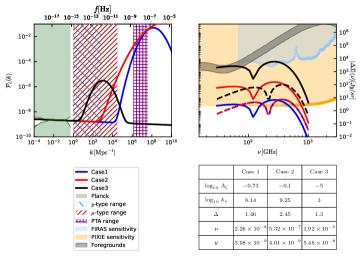
- 为来自 PTA 分析的三个基准情形预测 SD 信号(情形 1:类似 PTA 的最大似然样本;情形 2:落在 68% CL 内;情形 3:峰值落在 FIRAS/PIXIE 窗口内)。
- 对前景和再电离效应进行边缘化,以获得 LN 参数的后验约束。
- 将约束与 FIRAS 和 Planck 数据进行比较,并给出预测的 PPS 分布。
实验结果
研究问题
- RQ1未来的 CMB 光谱畸变是否能够检测到或约束被用于解释 PTA SGWB 信号的 PPS 峰值?
- RQ2前景与再电离如何影响基于 SD 的对小尺度 PPS 的约束?
- RQ3在结合 Planck 和 PTA 先验信息时,PIXIE 类观测在多大程度上提升约束?
- RQ4LN 峰在 P(k) 如何在相关的 k 范围内映射到可观测的 μ 和 y 畸变?
- RQ5PTA 数据与 CMB SD 测量之间在重建小尺度原始涨落方面的协同效应如何?
主要发现
- FIRAS 数据对 LN PPS 峰的约束有限。
- PIXIE 类预测提高了约束并且在情形 3 实现时可以检测到较大的 SD 信号。
- 前景会削弱名义的 SD 灵敏度,即使 μ 值较大也可能阻碍检测。
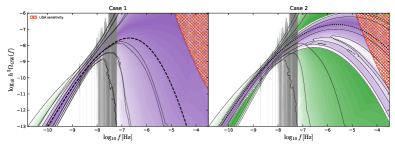
- 情形 2 显示 PIXIE+Planck+NG15 能够恢复并约束 LN 参数,尽管并不总能检测到明显的 PPS 峰。
- 情形 3 产生强烈的检测:μ ≈ (1.92 ± 0.02)×10^-5 和 y ≈ (4.9^{+1.7}_{-3.1})×10^-8(68% 置信),在所测试的 k 范围 [10^2, 10^4] Mpc^-1 内显著排除了近尺度不变 PPS。
- SDs 与 PTA 的协同可以稳健地探测对简单幂律 PPS 的偏离,这是单独任一探测都难以达到的。
阅读本论文
在 Nubint 阅读器中打开原文,边读边就任意段落提问。
在 Nubint 中阅读本论文本解读由 AI 根据论文原文生成,引用前请核对原文。