
[论文解读] Quick-Tune: Quickly Learning Which Pretrained Model to Finetune and How
Quick-Tune 提出了一种贝叶斯优化框架,通过元学习的性能预测器联合选择最优的预训练视觉模型及其微调超参数。该方法利用来自 24 个模型和 87 个数据集的 20,000 个模型-超参数配置的多保真度学习曲线,其性能优于最先进方法,甚至在准确率上超越了大型通用模型 DINOv2,同时显著缩短了搜索时间。
With the ever-increasing number of pretrained models, machine learning practitioners are continuously faced with which pretrained model to use, and how to finetune it for a new dataset. In this paper, we propose a methodology that jointly searches for the optimal pretrained model and the hyperparameters for finetuning it. Our method transfers knowledge about the performance of many pretrained models with multiple hyperparameter configurations on a series of datasets. To this aim, we evaluated over 20k hyperparameter configurations for finetuning 24 pretrained image classification models on 87 datasets to generate a large-scale meta-dataset. We meta-learn a multi-fidelity performance predictor on the learning curves of this meta-dataset and use it for fast hyperparameter optimization on new datasets. We empirically demonstrate that our resulting approach can quickly select an accurate pretrained model for a new dataset together with its optimal hyperparameters.
研究动机与目标
- 为应对从大量模型中选择最佳预训练模型及其超参数的日益严峻挑战。
- 通过元学习和多保真度评估联合优化模型选择与超参数,降低微调的时间与成本。
- 超越传统微调策略、单模型基线方法以及最先进超参数优化方法。
- 证明模型库的多样性与联合优化可带来优于依赖单一大型特征提取器(如 DINOv2)的性能。
- 发布大规模元数据集与代码,以支持可复现性与未来研究。
提出的方法
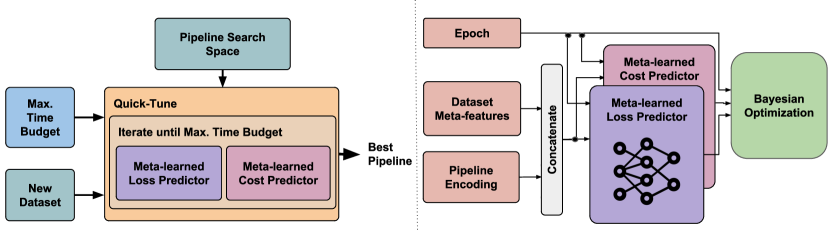
- 该方法使用涵盖 24 个视觉模型和 87 个数据集的 20,000 次微调运行的大规模元数据集,训练一个元学习的深度核高斯过程代理模型。
- 采用多保真度贝叶斯优化,逐 epoch 评估模型,并根据早期性能表现将更多计算资源分配给有前景的配置。
- 性能预测器基于完整学习曲线进行训练,并用于在新数据集上引导搜索,实现时间与准确率之间的成本感知权衡。
- 搜索空间包含多种微调策略,如逐层解冻、不同的学习率调度和权重衰减,以实现全面探索。
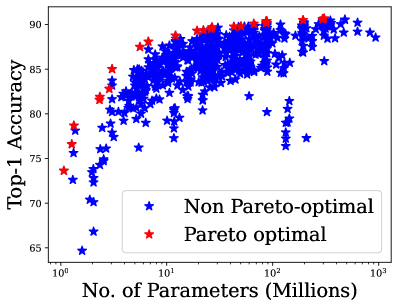
- 基于帕累托前沿的选择方法识别出各数据集上的最优模型,并通过 Quick-Tune 对其进行再优化以进一步精调超参数。
- 评估方法采用归一化遗憾(normalized regret)随运行时间的变化,与 DINOv2 上的网格搜索及其他基线方法进行对比。
实验结果
研究问题
- RQ1在多样化模型-超参数组合上进行元学习训练的性能预测器,能否提升微调流水线选择的效率与准确性?
- RQ2联合优化模型选择与超参数是否优于使用单一预训练模型或类似 DINOv2 的大型通用主干网络?
- RQ3模型库的规模与多样性如何影响最终性能与搜索效率?
- RQ4结合早期停止的多保真度贝叶斯优化能否显著减少搜索时间,同时保持高准确率?
- RQ5与标准超参数优化基线方法相比,所提方法在选择高性能微调配置方面是否更具有效性?
主要发现
- Quick-Tune 在所有数据集上均优于对单一预训练模型进行超参数调优的策略,充分证明了模型多样性的优势。
- 使用包含 24 个模型(24-M)或 15 个模型(15-M)的模型库,性能显著优于仅使用 5 个或 10 个模型的情况,验证了模型多样性的关键作用。
- 在小数据集上,使用单一模型可能更具优势(因探索更快),但要实现高性能,大模型库在大数据集上不可或缺。
- Quick-Tune 在更短的运行时间内实现了优于 DINOv2 经过 104 种配置网格搜索微调的最终准确率,证明了其搜索效率的优越性。
- 与最先进 HPO 方法相比,该方法能更快找到高性能配置,且归一化遗憾随时间下降得更快。
- 开源的元数据集与代码支持可复现性,并为未来模型选择与超参数优化技术的基准测试提供了基础。
阅读本论文
在 Nubint 阅读器中打开原文,边读边就任意段落提问。
在 Nubint 中阅读本论文本解读由 AI 根据论文原文生成,引用前请核对原文。