
[论文解读] Qwen2 Technical Report
Qwen2 引入了一系列开源权重的 LLMs(0.5B 到 72B 的密集模型,以及一个 57B 的 MoE),具备长上下文能力、多语言支持和指令微调,在语言、编码、数学和推理基准上与专有模型及开源基线相比具有竞争力。
This report introduces the Qwen2 series, the latest addition to our large language models and large multimodal models. We release a comprehensive suite of foundational and instruction-tuned language models, encompassing a parameter range from 0.5 to 72 billion, featuring dense models and a Mixture-of-Experts model. Qwen2 surpasses most prior open-weight models, including its predecessor Qwen1.5, and exhibits competitive performance relative to proprietary models across diverse benchmarks on language understanding, generation, multilingual proficiency, coding, mathematics, and reasoning. The flagship model, Qwen2-72B, showcases remarkable performance: 84.2 on MMLU, 37.9 on GPQA, 64.6 on HumanEval, 89.5 on GSM8K, and 82.4 on BBH as a base language model. The instruction-tuned variant, Qwen2-72B-Instruct, attains 9.1 on MT-Bench, 48.1 on Arena-Hard, and 35.7 on LiveCodeBench. Moreover, Qwen2 demonstrates robust multilingual capabilities, proficient in approximately 30 languages, spanning English, Chinese, Spanish, French, German, Arabic, Russian, Korean, Japanese, Thai, Vietnamese, and more, underscoring its versatility and global reach. To foster community innovation and accessibility, we have made the Qwen2 model weights openly available on Hugging Face and ModelScope, and the supplementary materials including example code on GitHub. These platforms also include resources for quantization, fine-tuning, and deployment, facilitating a wide range of applications and research endeavors.
研究动机与目标
- 以广泛的规模谱推进开源权重 LLMs(0.5B–72B 密集模型,57B MoE)。
- 通过架构与数据改进提升长上下文处理能力和多语言能力。
- 通过可扩展的数据策略,结合监督微调和 RLHF,使模型与人类偏好对齐。
- 在语言、编码、数学和推理基准上展示与专有模型的竞争性能。
- 提供权重和工具的开放访问,以促进社区研究和部署。
提出的方法
- 采用基于 Transformer 的密集与专家混合架构,结合 Grouped Query Attention (GQA) 和 Dual Chunk Attention (DCA) 以实现长上下文。
- 采用 Rotary Position Embeddings (RoPE) 和 SwiGLU 激活,辅以 RMSNorm 和 预归一化以提升稳定性。
- 在大型多语言语料库上训练(>7 trillion tokens 对于密集模型;MoE 接收额外的数据再利用)。
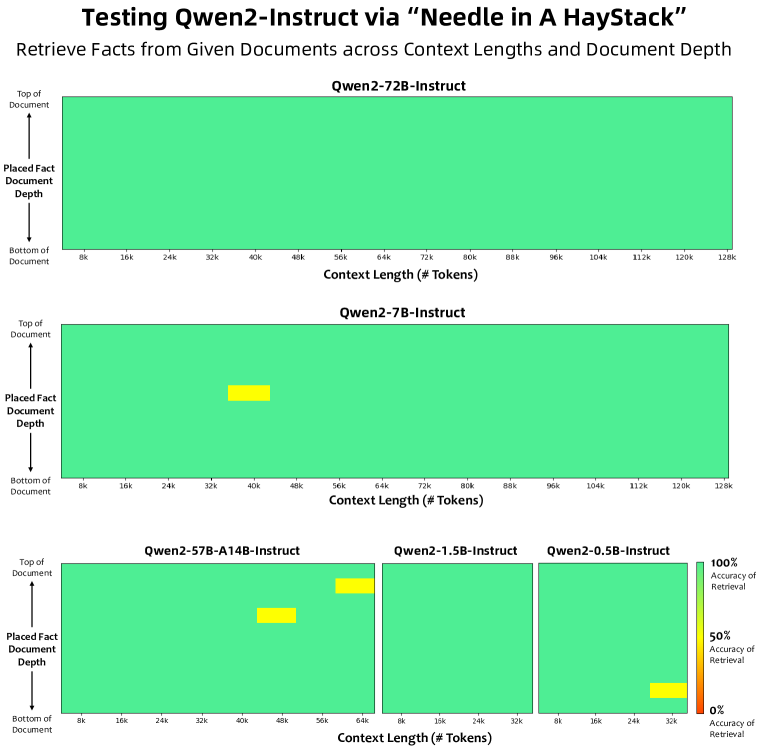
- 将上下文长度扩展到 32,768 tokens,并通过 YARN 与 Dual Chunk Attention 将序列长度扩展到 131,072 tokens。
- 在后训练阶段使用监督微调和 Direct Preference Optimization (DPO) 进行 RLHF,再加上 Online Merging Optimizer 以降低对齐成本。
- 利用协作数据标注和自动数据合成,构建高质量的演示和偏好数据集。
实验结果
研究问题
- RQ1Qwen2 dense and MoE 模型在知识、编码、数学、推理和多语言基准上的表现如何,与开源和专有基线相比?
- RQ2长上下文训练和数据扩展对模型能力和可靠性有何影响?
- RQ3可扩展的对齐(SFT + RLHF 与 DPO 及在线优化)是否能产生对语言有约束、可靠且有帮助的指令遵循模型?
- RQ4在 Qwen2-MoE 中,细粒度 MoE 路由和专家初始化的权衡与效率如何?
- RQ5开放源代码权重和工具在多语言、代码和推理任务中能在多大程度上加速研究和部署?
主要发现
- Qwen2-72B 作为基础模型在 MMLU 上达到 84.2,在 GPQA 上达到 37.9,在 HumanEval 上达到 64.6,在 GSM8K 上达到 89.5,在 BBH 上达到 82.4。
- Qwen2-72B-Instruct 在 MT-Bench 上达到 9.1,在 Arena-Hard 上达到 48.1,在 LiveCodeBench 上达到 35.7。
- Qwen2-57B-A14B MoE 在激活每个 token 14B 参数的同时,达到或超过 30B 密集模型的性能,并在编码和数学方面取得良好成绩。
- Qwen2 展示了跨约 30 种语言的强大多语言能力,包括 English、Chinese、Spanish、French、German、Arabic、Russian、Korean、Japanese、Thai、Vietnamese 等。
- 较小的 0.5B 和 1.5B 模型表现出竞争力,其中 1.5B 在数学和中文理解上超过了若干基线。
- 开源权重和补充材料在 Hugging Face、ModelScope 和 GitHub 上公开可用,以支持研究与部署。
阅读本论文
在 Nubint 阅读器中打开原文,边读边就任意段落提问。
在 Nubint 中阅读本论文本解读由 AI 根据论文原文生成,引用前请核对原文。