
[论文解读] RAG-Driver: Generalisable Driving Explanations with Retrieval-Augmented In-Context Learning in Multi-Modal Large Language Model
RAG-Driver 引入检索增强的上下文学习(retrieval-augmented in-context learning)用于多模态大语言模型,以在未微调的情况下对未见环境提供强零-shot泛化的驾驶行动解释、理由和下一步控制预测。
We need to trust robots that use often opaque AI methods. They need to explain themselves to us, and we need to trust their explanation. In this regard, explainability plays a critical role in trustworthy autonomous decision-making to foster transparency and acceptance among end users, especially in complex autonomous driving. Recent advancements in Multi-Modal Large Language models (MLLMs) have shown promising potential in enhancing the explainability as a driving agent by producing control predictions along with natural language explanations. However, severe data scarcity due to expensive annotation costs and significant domain gaps between different datasets makes the development of a robust and generalisable system an extremely challenging task. Moreover, the prohibitively expensive training requirements of MLLM and the unsolved problem of catastrophic forgetting further limit their generalisability post-deployment. To address these challenges, we present RAG-Driver, a novel retrieval-augmented multi-modal large language model that leverages in-context learning for high-performance, explainable, and generalisable autonomous driving. By grounding in retrieved expert demonstration, we empirically validate that RAG-Driver achieves state-of-the-art performance in producing driving action explanations, justifications, and control signal prediction. More importantly, it exhibits exceptional zero-shot generalisation capabilities to unseen environments without further training endeavours.
研究动机与目标
- 通过在多模态LLM中利用检索增强的上下文学习(RA-ICL),解决端到端自动驾驶在可解释性和泛化性方面的不足。
- 以检索到的专家示例为基础来支撑驾驶决策,以提升动作解释、理由和控制信号预测的质量。
- 展示对未见环境的强零-shot泛化能力,无需额外训练。
- 在驾驶解释基准上显示出最先进的性能,并在控制预测准确性方面具有竞争力。
提出的方法
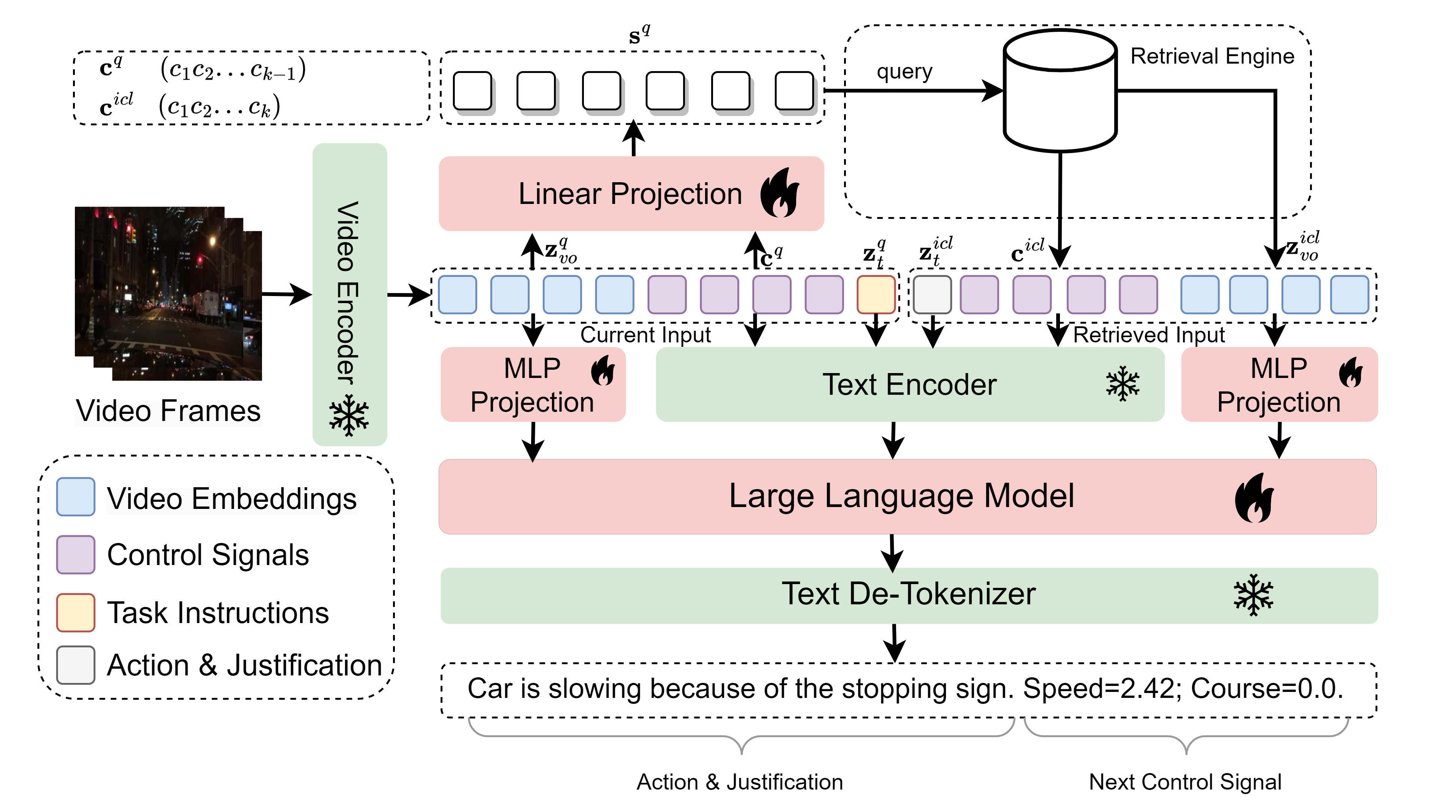
- 使用多模态LLM骨干(Vicuna 1.5)从视频输入和文本指令中联合预测驾驶动作解释、理由,以及下一步控制信号。
- 采用预训练视频编码器(LanguageBind),并使用两层MLP投影将视频嵌入对齐到语言标记,实现跨模态对齐。
- 构建带有专家解释和理由标注的混合嵌入(视频 + 控制信号)的记忆数据库;通过三元组损失学习混合嵌入空间以实现检索。
- 通过从记忆中检索两个相似的驾驶经验,将它们前置到查询上,并与多模态LLM一起处理,从而在推理阶段实现隐式元优化。
- 分两阶段训练:(i) 在 VIDAL-10M 上进行视觉-语言对齐的预训练,(ii) 使用 BDD-X 进行带监督的上下文指令微调,提供针对三项任务(Action Explanation、Action Justification、Next Control Signal Prediction)的 16K 对QA对。
- 利用在混合嵌入空间中计算余弦相似度的检索机制,获取与RA-ICL最相关的两个样本。
实验结果
研究问题
- RQ1在未见环境中,使用带检索增强的多模态LLM的 RA-ICL 是否能够在不进行微调的情况下提升驾驶决策的可解释性(动作解释和理由)?
- RQ2在端到端驾驶任务中,将决策建立在检索到的专家演示之上,是否能够提升下一步控制信号预测(航向和速度)的准确性?
- RQ3在驾驶场景中,使用混合嵌入(视频 + 控制)相较于仅视觉嵌入用于检索的影响是什么?
- RQ4对于驾驶任务,是否需要有监督的微调来实现有效的上下文学习,还是可以通过合适的记忆和提示实现零-shot RA-ICL?
- RQ5相较于现有方法,RA-ICL 在分布外的驾驶环境(零-shot)上的泛化能力如何?
主要发现
- RAG-Driver 在 BDD-X 基准测试上实现了最先进的自省式驾驶解释性能。
- 在仅用 BDD-X 进行训练时,其动作解释和理由与专业方法及部分基于MLLM的方法相比具有竞争力甚至更优。
- RA-ICL 以混合检索显著提升了控制信号预测(航向和速度),超越基线(包括 DriveGPT4),在多容忍度和 RMSE 下。
- 消融实验表明混合相似度(混合视频+控制)检索优于仅视觉相似度,并且训练时与推理时的 ICL 都有益。
- 该模型展示了对未见环境(Spoken-SAX)的强零-shot泛化能力,使用基于 BDD-X 构建的记忆数据库,体现了鲁棒的泛化能力。
- 定性结果在夜间和恶劣天气条件下显示出易理解、可被人类理解的解释和理由,支持实际可解释性。
阅读本论文
在 Nubint 阅读器中打开原文,边读边就任意段落提问。
在 Nubint 中阅读本论文本解读由 AI 根据论文原文生成,引用前请核对原文。