
[论文解读] Random unitaries in extremely low depth
本文证明,随机量子幺正矩阵——特别是近似幺正 $k$-设计和伪随机幺正矩阵(PRUs)——可以在极浅的电路深度内实现:设计为 $\log n$,PRUs 为 $\text{poly}\log n$ 或 $\text{poly}\log\log n$,无论几何结构如何,包括一维情形。该构造在 $\log n$ 或 $\text{poly}\log n$ 大小的局部区域上使用局部随机幺正矩阵,实现了最优的 $n$-标度,并为指数深度的哈尓随机电路提供了高效且低深度的替代方案。
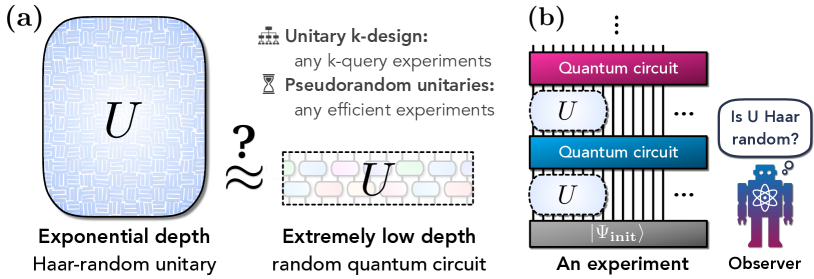
We prove that random quantum circuits on any geometry, including a 1D line, can form approximate unitary designs over $n$ qubits in $\log n$ depth. In a similar manner, we construct pseudorandom unitaries (PRUs) in 1D circuits in $ ext{poly}(\log n)$ depth, and in all-to-all-connected circuits in $ ext{poly}(\log \log n)$ depth. In all three cases, the $n$ dependence is optimal and improves exponentially over known results. These shallow quantum circuits have low complexity and create only short-range entanglement, yet are indistinguishable from unitaries with exponential complexity. Our construction glues local random unitaries on $\log n$-sized or $ ext{poly}(\log n)$-sized patches of qubits to form a global random unitary on all $n$ qubits. In the case of designs, the local unitaries are drawn from existing constructions of approximate unitary $k$-designs, and hence also inherit an optimal scaling in $k$. In the case of PRUs, the local unitaries are drawn from existing PRU constructions. Applications of our results include proving that classical shadows with 1D log-depth Clifford circuits are as powerful as those with deep circuits, demonstrating superpolynomial quantum advantage in learning low-complexity physical systems, and establishing quantum hardness for recognizing phases of matter with topological order.
研究动机与目标
- 在电路深度上实现远低于以往构造的近似幺正 $k$-设计和伪随机幺正矩阵(PRUs)。
- 在所有几何结构(包括一维和全连接网络)中,实现随机幺正生成的最优 $n$-标度深度。
- 证明仅具有短程纠缠的浅层电路能够模拟指数复杂度的哈尓随机幺正矩阵的统计行为。
- 通过降低经典阴影、量子优势协议和拓扑相识别等实际应用的资源需求,推动量子信息领域的实用化。
提出的方法
- 通过在 $\log n$ 或 $\text{poly}\log n$ 量子比特的小块上铺砌局部随机幺正矩阵,构建全局随机幺正矩阵。
- 在 $\log n$-大小的块上使用现有的近似幺正 $k$-设计,以 $\tilde{\mathcal{O}}(k)\cdot\log(n/\varepsilon)$ 深度构建全局 $\varepsilon$-近似 $k$-设计。
- 在 $\text{poly}\log n$-大小的块上利用推测的伪随机幺正系综(如 $PFC$)在任意几何结构上以 $\text{poly}\log n$ 深度构建 PRUs。
- 在全连接电路中使用相同的基于块的拼接方法,以 $\text{poly}\log\log n$ 深度构建 PRUs。
- 通过证明任何更浅的构造都无法达到相同的近似保真度,确立深度中 $n$-依赖关系的最优性。
- 应用集中不等式和矩计算(例如切比雪夫不等式)来限制输出分布与均匀性及哈尓测度的偏差。
实验结果
研究问题
- RQ1是否可以在任意量子电路几何结构(包括一维)中以 $\log n$ 深度构造近似幺正 $k$-设计?
- RQ2是否可以在任意几何结构中以 $\text{poly}\log n$ 深度实现伪随机幺正矩阵(PRUs),并在全连接网络中以 $\text{poly}\log\log n$ 深度实现?
- RQ3这些构造中深度的 $n$-依赖关系是否最优,能否进一步改进至低于 $\log n$?
- RQ4仅具有短程纠缠的浅层电路能否模拟指数复杂度的哈尓随机幺正矩阵的统计特性?
- RQ5此类浅层构造对学习物理系统中的量子优势和识别拓扑序有何影响?
主要发现
- 近似幺正 $k$-设计可在任意几何结构中以 $\tilde{\mathcal{O}}(k)\cdot\log(n/\varepsilon)$ 深度构造,实现最优的 $n$-标度。
- 伪随机幺正矩阵(PRUs)可在任意连通有界度几何结构中以 $\text{poly}\log n$ 深度构造,并在全连接电路中以 $\text{poly}\log\log n$ 深度构造。
- 对于设计和 PRUs,深度中的 $n$-依赖关系均为最优,相比以往需要多项式深度的构造,实现了指数级改进。
- 所构造系综的输出分布以高概率远离均匀分布,证实其不会坍缩为平凡分布。
- 该方法使使用对数深度 Clifford 电路实现经典阴影,可达到与线性深度电路相同的保真度保证,显著降低实验开销。
- 该构造表明,由于生成幺正矩阵的伪随机性,任何量子实验识别量子态中的拓扑序都是超多项式困难的。

阅读本论文
在 Nubint 阅读器中打开原文,边读边就任意段落提问。
在 Nubint 中阅读本论文本解读由 AI 根据论文原文生成,引用前请核对原文。