
[论文解读] RANS-PINN based Simulation Surrogates for Predicting Turbulent Flows
本文提出 RANS-PINN,这是一个使用两方程组 k-epsilon 湍流模型来模拟湍流流动的物理信息神经网络框架,具有分阶段训练策略和对未见雷诺数的参数扩展。
Physics-informed neural networks (PINNs) provide a framework to build surrogate models for dynamical systems governed by differential equations. During the learning process, PINNs incorporate a physics-based regularization term within the loss function to enhance generalization performance. Since simulating dynamics controlled by partial differential equations (PDEs) can be computationally expensive, PINNs have gained popularity in learning parametric surrogates for fluid flow problems governed by Navier-Stokes equations. In this work, we introduce RANS-PINN, a modified PINN framework, to predict flow fields (i.e., velocity and pressure) in high Reynolds number turbulent flow regimes. To account for the additional complexity introduced by turbulence, RANS-PINN employs a 2-equation eddy viscosity model based on a Reynolds-averaged Navier-Stokes (RANS) formulation. Furthermore, we adopt a novel training approach that ensures effective initialization and balance among the various components of the loss function. The effectiveness of the RANS-PINN framework is then demonstrated using a parametric PINN.
研究动机与目标
- 为湍流快速代理建模提供动机,适用于 DNS/LES 成本过高的情况。
- 将二维方程组的 RANS 湍流模型(k-epsilon)集成到 PINN 框架中。
- 开发稳健的训练机制,使数据损失与物理损失在湍流场中保持稳定。
- 在多种几何形状上展示代理能力,并扩展到基于雷诺数的参数化 PINN。
提出的方法
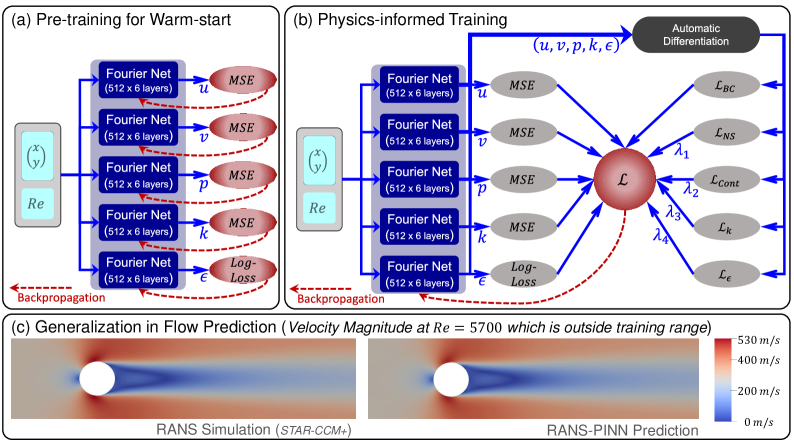
- 以傅里叶神经算子作为速度、压力、k、epsilon 代理的骨干网络。
- 先以数据损失对网络进行预训练,然后在残差归一化的基础上加入 PDE 物理损失。
- 对耗散项 epsilon 使用对数损失,以处理近壁和剪切区域。
- 以 STAR-CCM+ 的 CFD 数据进行监督,并在损失中强制满足连续性、NS、以及 k-epsilon 方程。
- 通过将雷诺数作为输入来训练参数化 PINN,以实现跨 Re 值的泛化。
- 利用带有特定损失权重的衰减 Adam 优化器来平衡各分量。
实验结果
研究问题
- RQ1RANS-PINN 是否能够在使用 k-epsilon RANS 模型的湍流流动中准确预测速度场和压强场?
- RQ2分阶段训练是否改善数据+物理损失的平衡与湍流 PINN 的收敛?
- RQ3参数化 PINN 是否可以在无需新的 CFD 数据的情况下对未见雷诺数的流动进行预测?
主要发现
- RANS-PINN 相较于仅数据或数据+物理且对 epsilon 使用对数损失时,在圆柱流动中表现出更低的验证损失和更出色的预测性能。
- 对于给定 Re 的 NACA 2412 和背向阶梯,方法在速度和压力场上给出低的验证误差。
- 以 Re 作为输入的参数化 PINN 能在未见雷诺数下预测流场,同时需要更少的 CFD 数据且推理更快。
- 对 epsilon 使用对数损失的训练提高了稳定性,降低了靠近壁面和剪切层处预测场的间断性。
- 该方法在三种几何形状(圆柱、背向阶梯、NACA 2412)上展现出准确预测,并实现对新 Re 情况的近实时预测。
阅读本论文
在 Nubint 阅读器中打开原文,边读边就任意段落提问。
在 Nubint 中阅读本论文本解读由 AI 根据论文原文生成,引用前请核对原文。