
[论文解读] RARES: Runtime Attack Resilient Embedded System Design Using Verified Proof-of-Execution
RARES 提出了一种轻量级、硬件辅助的运行时攻击弹性框架,专为资源受限的嵌入式系统设计,利用16位控制寄存器(Ctrl_register)实现实时内存修改攻击检测。该框架支持特定用例的防护与本地恢复,无需突然系统重启,仅在FPGA上引入2.3%的资源开销,同时保持完整的正式验证。
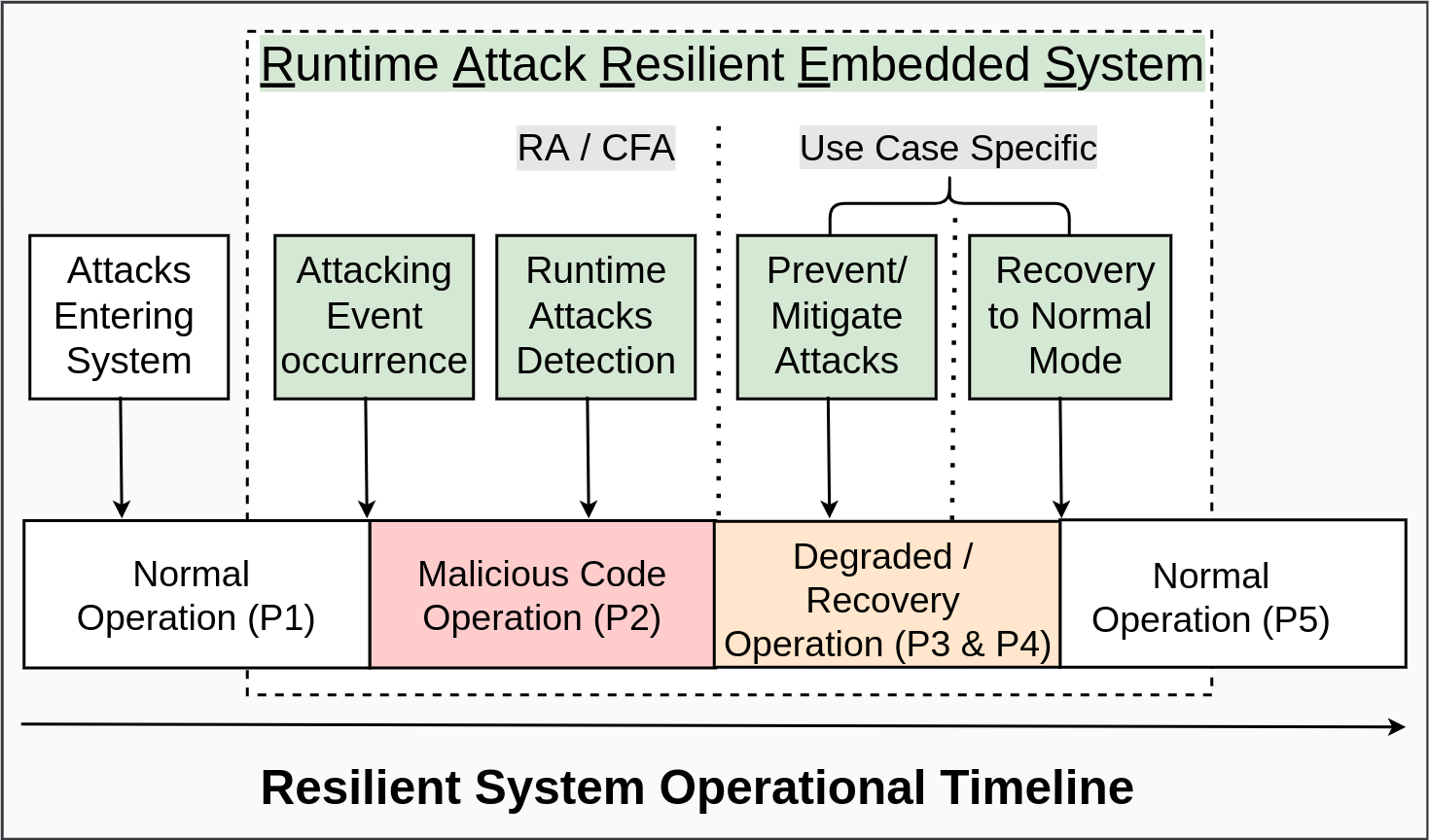
Modern society is getting accustomed to the Internet of Things (IoT) and Cyber-Physical Systems (CPS) for a variety of applications that involves security-critical user data and information transfers. In the lower end of the spectrum, these devices are resource-constrained with no attack protection. They become a soft target for malicious code modification attacks that steals and misuses device data in malicious activities. The resilient system requires continuous detection, prevention, and/or recovery and correct code execution (including in degraded mode). By end large, existing security primitives (e.g., secure-boot, Remote Attestation RA, Control Flow Attestation (CFA) and Data Flow Attestation (DFA)) focuses on detection and prevention, leaving the proof of code execution and recovery unanswered. To this end, the proposed work presents lightweight RARES -- Runtime Attack Resilient Embedded System design using verified Proof-of-Execution. It presents first custom hardware control register (Ctrl_register) based runtime memory modification attacks classification and detection technique. It further demonstrates the Proof Of Concept (POC) implementation of use-case-specific attacks prevention and onboard recovery techniques. The prototype implementation on Artix 7 Field Programmable Gate Array (FPGA) and state-of-the-art comparison demonstrates very low (2.3%) resource overhead and efficacy of the proposed solution.
研究动机与目标
- 解决资源受限的物联网和 CPS 设备中缺乏持续、轻量级运行时检测与恢复机制的问题,以应对内存修改攻击。
- 使系统开发人员能够设计针对应用的防护与恢复策略,而无需依赖突然的系统重启。
- 在极小的硬件面积内,集成经形式化验证的执行证明、安全启动与本地恢复机制。
- 通过自定义硬件控制寄存器(Ctrl_register)对运行时内存修改攻击进行分类与检测。
- 在保持 APEX 等先前系统形式化验证与安全属性的基础上,扩展功能。
提出的方法
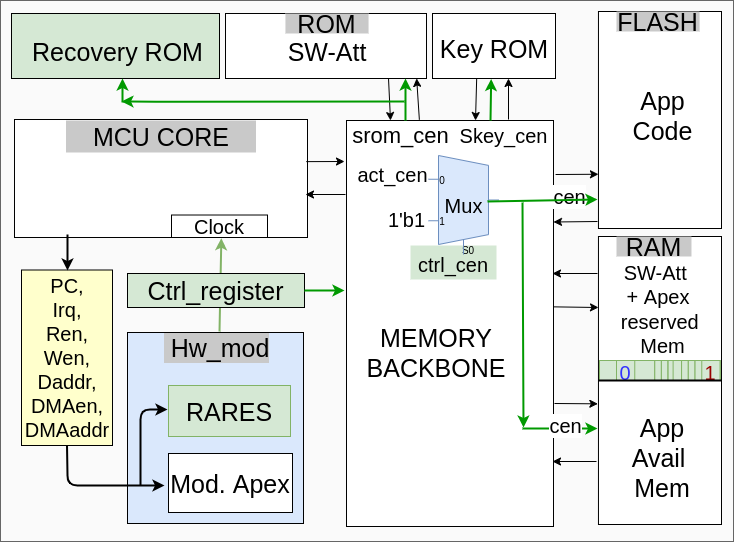
- 引入一个16位硬件控制寄存器(Ctrl_register),在运行时更新以检测内存修改攻击,且软件仅可读访问。
- 将运行时内存修改攻击分为三类,并利用 Ctrl_register 状态变化检测异常行为。
- 在 APEX 基础上扩展轻量级硬件模块,用于存储 Ctrl_register 状态,实现持续的运行时完整性监控。
- 通过允许开发人员基于攻击检测信号定义自定义逻辑,支持特定用例的防护与恢复。
- 通过存储关键代码段的恢复ROM实现本地恢复,支持无需OTA或手动重新烧录的安全降级操作。
- 保留 APEX 的全部20个LTL形式化验证属性,确保正确性与安全保证。
实验结果
研究问题
- RQ1如何在资源受限的嵌入式系统中持续、高效地检测运行时内存修改攻击?
- RQ2轻量级硬件控制寄存器(Ctrl_register)是否能以极低的性能与资源开销,有效检测运行时代码篡改?
- RQ3在安全关键应用中,如何在不依赖突然系统重启的情况下维持系统弹性?
- RQ4在运行时弹性系统中,实现经形式化验证的执行证明、安全启动与本地恢复所需的最小硬件开销是多少?
- RQ5系统开发人员如何将特定用例的防护与恢复机制集成到经形式化验证、轻量级的运行时安全框架中?
主要发现
- RARES 相较于 APEX,仅增加2.3%的LUT和2.3%的硬件寄存器,证明其资源开销极低。
- RARES-A 变体采用16位 Ctrl_register,仅增加2字节保留内存与2.3%硬件开销,同时保留 APEX 的全部20个LTL形式化验证属性。
- RARES-B 变体增加16KB本地恢复ROM,相比 RARES-A,硬件寄存器增加7.37%,LUT增加10.3%,仍保持轻量化。
- RARES 通过 Ctrl_register 机制成功实现对内存修改攻击的持续运行时检测,无需依赖CFA或DFA等日志密集型技术。
- 与 APEX 和 VRASED 等先前系统不同,RARES 避免了突然系统重启,支持在安全恢复前以降级模式运行。
- 该方案可通过附加自定义硬件模块推广至其他微控制器,支持多样化用例的定制化恢复策略。
阅读本论文
在 Nubint 阅读器中打开原文,边读边就任意段落提问。
在 Nubint 中阅读本论文本解读由 AI 根据论文原文生成,引用前请核对原文。