
[论文解读] Real-time Detection of AI-Generated Speech for DeepFake Voice Conversion
论文创建了真实音频与 AI 生成语音的 DEEP-VOICE 数据集,分析统计音频特征,并展示 XGBoost 在检测基于 RVC 的语音转换时,对 1 秒音频区间实现实时推断 0.004 ms,准确率达到 99.3%。
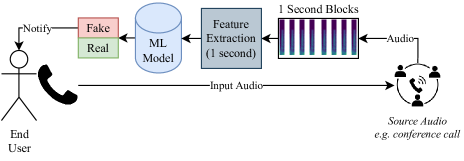
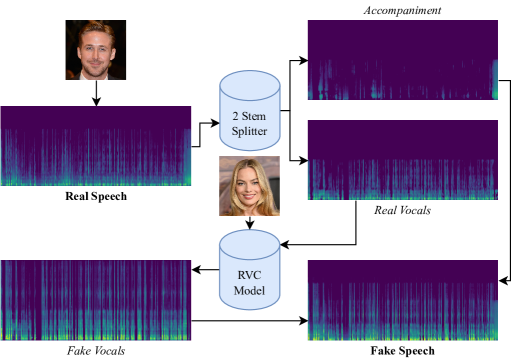
There are growing implications surrounding generative AI in the speech domain that enable voice cloning and real-time voice conversion from one individual to another. This technology poses a significant ethical threat and could lead to breaches of privacy and misrepresentation, thus there is an urgent need for real-time detection of AI-generated speech for DeepFake Voice Conversion. To address the above emerging issues, the DEEP-VOICE dataset is generated in this study, comprised of real human speech from eight well-known figures and their speech converted to one another using Retrieval-based Voice Conversion. Presenting as a binary classification problem of whether the speech is real or AI-generated, statistical analysis of temporal audio features through t-testing reveals that there are significantly different distributions. Hyperparameter optimisation is implemented for machine learning models to identify the source of speech. Following the training of 208 individual machine learning models over 10-fold cross validation, it is found that the Extreme Gradient Boosting model can achieve an average classification accuracy of 99.3% and can classify speech in real-time, at around 0.004 milliseconds given one second of speech. All data generated for this study is released publicly for future research on AI speech detection.
研究动机与目标
- 需要动机:在实时通信中防止隐私泄露和误导性表述,需要检测 AI 生成的语音。
- 开发一个原创数据集(DEEP-VOICE),涵盖来自八位公众人物的真实和通过基于检索的语音转换(RVC)生成的语音。
- 分析用于区分真实与 AI 生成语音的音频特征的统计显著性。
- 评估多种机器学习模型并进行超参数优化,以实现实时检测。
提出的方法
- 生成包含来自八位个人的真实语音 62 分 22 秒及通过检索式语音转换(RVC)生成的 AI 语音的 DEEP-VOICE 数据集。
- 对每个 1 秒片段提取 26 个音频特征,包括色度图、MFCC、谱特征、ZCR 和 RMS。
- 通过对 AI 生成的样本进行欠采样,使其与真实样本达到 1:1 的平衡。
- 在 10 折交叉验证和种子 42 的条件下,训练并评估一组 ML 模型(XGBoost、Random Forest、QDA、LDA、Ridge、Gaussian Naive Bayes、Bernoulli NB、KNN、SVM、SGD、Gaussian Process),并进行超参数优化。
- 对 XGBoost(共 330 回合)和 Random Forest(310 棵树)、KNN(1 个邻居)进行超参数优化,并报告推断时间(每 1 秒 0.004–0.057 ms)。
- 评估指标包括准确率、精确率、召回率、F1、MCC、ROC AUC。
实验结果
研究问题
- RQ1实时检测是否能够将真实人声与通过检索式语音转换(RVC)生成的 AI 语音区分开来?
- RQ2哪些音频特征最能区分真实与 AI 生成的语音,以及在实时约束下不同机器学习模型的表现如何?
- RQ3超参数如何影响在实时检测 DeepFake 语音转换中的准确性和推断时间?
- RQ4在通话或会议中部署一个实时警告系统以标记 AI 生成的语音是否可行?
主要发现
- XGBoost 在 330 次提升轮次下,在 10 折交叉验证中达到 99.3% 的准确率(精确率 0.995,召回率 0.991,F1 0.993,MCC 0.986,ROC AUC 0.993)。
- XGBoost 对 1 秒音频的推断时间平均为 0.004 ms。
- Random Forest(310 棵树)达到 98.89% 的准确率(精确率 0.995,召回率 0.983,F1 0.989,MCC 0.978,ROC AUC 0.989),且每 1 秒为 0.057 ms。
- KNN(1 个邻居)以 0.143 ms/秒达到 81.48% 的准确率,而 QDA 的准确率为 94.8%,推断时间为 0.002 ms。
- 总体而言,XGBoost 和 Random Forest 在各折之间显示出较强的泛化能力,并实现基于 RVC 的语音转换的实时检测。
阅读本论文
在 Nubint 阅读器中打开原文,边读边就任意段落提问。
在 Nubint 中阅读本论文本解读由 AI 根据论文原文生成,引用前请核对原文。