
[论文解读] Real-time scheduling of renewable power systems through planning-based reinforcement learning
本文提出 GridZero,一种基于规划的强化学习框架,用于在高时间分辨率下实时调度可再生能源系统,联合优化机组组合与经济调度。通过将蒙特卡洛树搜索与安全层及混合动作空间建模相结合,该方法相比传统日前调度,使可再生能源弃用率降低 48%,负荷切除率降低 62%,显著提升了电网灵活性与可再生能源消纳能力,且无需硬件升级。
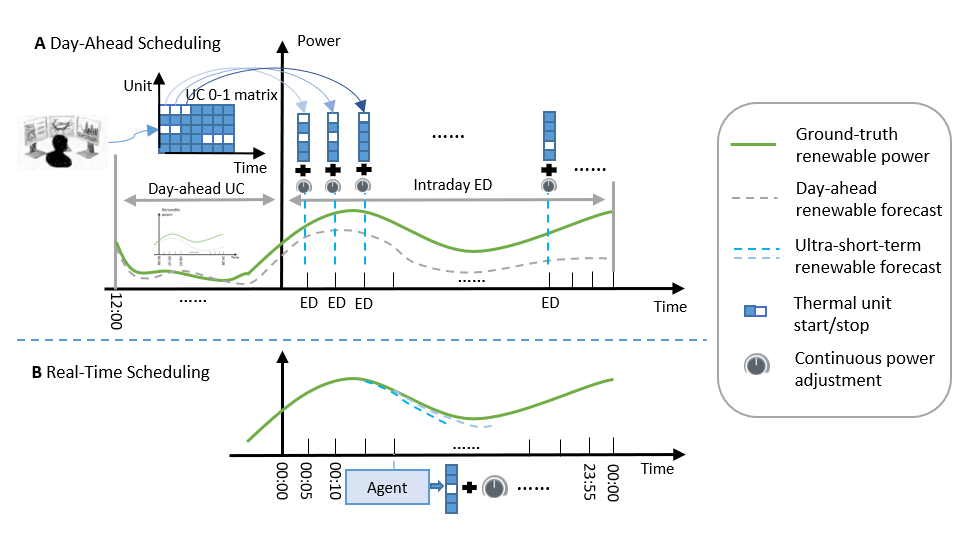
The growing renewable energy sources have posed significant challenges to traditional power scheduling. It is difficult for operators to obtain accurate day-ahead forecasts of renewable generation, thereby requiring the future scheduling system to make real-time scheduling decisions aligning with ultra-short-term forecasts. Restricted by the computation speed, traditional optimization-based methods can not solve this problem. Recent developments in reinforcement learning (RL) have demonstrated the potential to solve this challenge. However, the existing RL methods are inadequate in terms of constraint complexity, algorithm performance, and environment fidelity. We are the first to propose a systematic solution based on the state-of-the-art reinforcement learning algorithm and the real power grid environment. The proposed approach enables planning and finer time resolution adjustments of power generators, including unit commitment and economic dispatch, thus increasing the grid's ability to admit more renewable energy. The well-trained scheduling agent significantly reduces renewable curtailment and load shedding, which are issues arising from traditional scheduling's reliance on inaccurate day-ahead forecasts. High-frequency control decisions exploit the existing units' flexibility, reducing the power grid's dependence on hardware transformations and saving investment and operating costs, as demonstrated in experimental results. This research exhibits the potential of reinforcement learning in promoting low-carbon and intelligent power systems and represents a solid step toward sustainable electricity generation.
研究动机与目标
- 解决传统日前调度在处理可再生能源出力预测不准确方面的局限性。
- 克服传统优化方法在动态不确定条件下实时高分辨率调度中的计算不可行性。
- 开发一种强化学习框架,联合优化机组组合与经济调度,同时遵守复杂的电网约束,如输电容量和无功功率限制。
- 实现基于现有发电机灵活性的实时高频控制决策,减少对昂贵硬件升级的依赖。
- 通过自研模拟器(GridSim)在真实电力系统环境中,证明端到端强化学习调度的可行性和优越性。
提出的方法
- 提出 GridZero,一种混合动作空间框架,结合连续有功功率调节与离散启停动作,用于电力发电机。
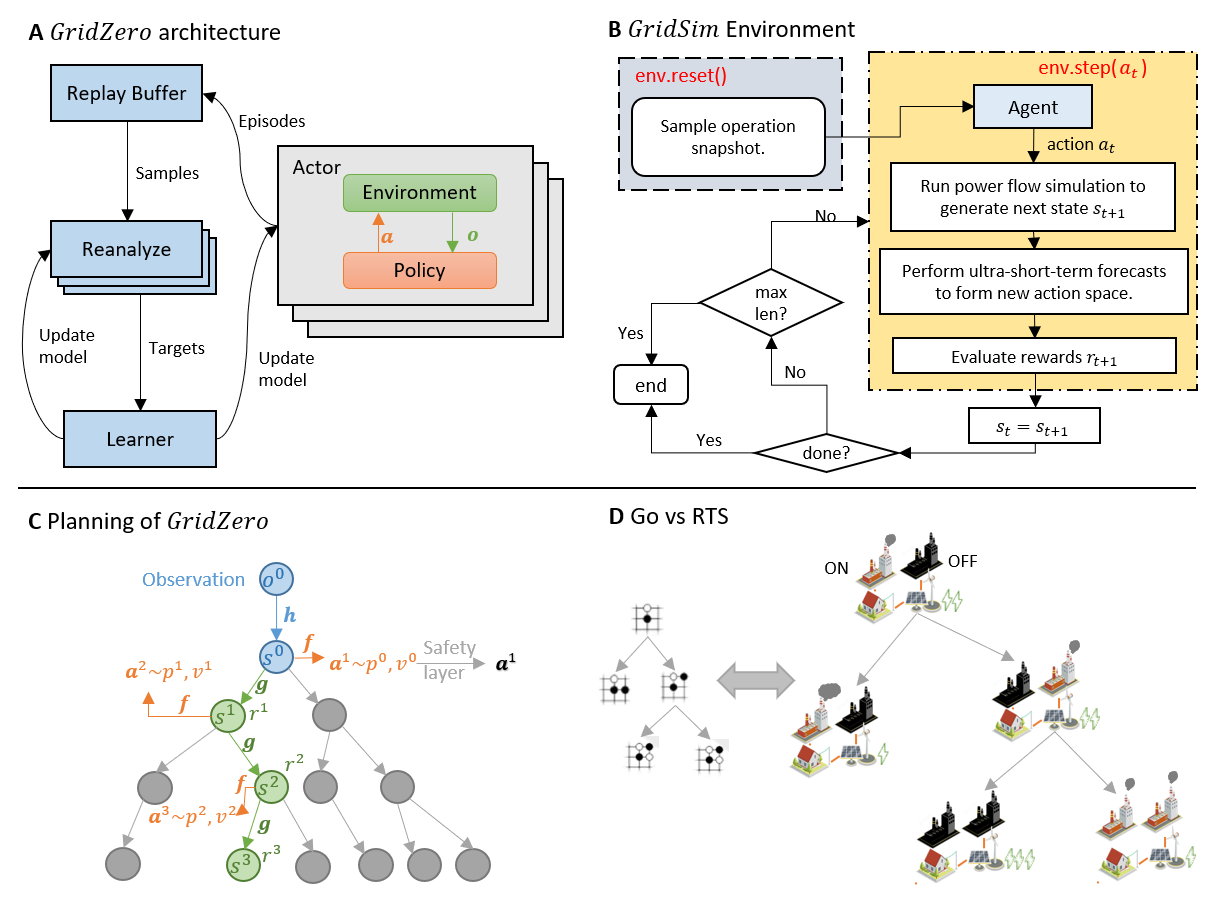
- 将蒙特卡洛树搜索(MCTS)与安全层结合,通过基于发电限值的动态调整规则,将策略输出映射为可行且功率平衡的动作集合。
- 采用多噪声探索策略:标准正态噪声、方差加倍的高斯噪声,以及采样动作的混合,以平衡探索与稳定性。
- 设计混合策略损失函数,结合连续动作的 KL 散度与离散动作的交叉熵,并引入与 one-hot 动作目标对齐的访问次数先验。
- 使用自研电力系统模拟器(GridSim)对包含 118 个母线、176 条线路和 24 台发电机的现实输电网络进行建模,支持风电与光伏的接入。
- 通过式 (12) 实现时变动作空间变换,以确保实时可行性并强制执行有功功率平衡约束。
实验结果
研究问题
- RQ1基于规划的强化学习框架能否有效处理实时电力调度中机组组合与经济调度的联合优化?
- RQ2将 MCTS 与安全层结合,如何提升在高维混合整数动作空间中的约束满足度与可行性?
- RQ3与传统日前调度相比,基于强化学习的实时调度在多大程度上可降低可再生能源弃用率与负荷切除率?
- RQ4所提出的混合动作空间与多噪声探索策略在复杂电力系统环境中如何提升学习稳定性与性能?
- RQ5该框架能否在不依赖昂贵硬件升级或长时间计算的前提下实现实时高效部署?
主要发现
- 与传统日前调度相比,GridZero 将可再生能源弃用率降低 48%,显著提升了可再生能源利用率。
- 在相同条件下,负荷切除率降低 62%,表明系统可靠性与安全性得到增强。
- 该框架实现亚秒级推理速度的实时调度,支持高频控制决策,而传统 MIP 方法在计算上难以实现。
- 安全层确保所有动作均满足有功功率平衡与发电机限值,维持系统可行性且不违反运行约束。
- 结合访问次数对齐的混合策略损失,实现了稳定训练,并有效联合优化了连续与离散动作。
- GridSim 中的实验结果表明,训练后的智能体在多样化场景下(包括高比例可再生能源与波动负荷)具有良好的泛化能力。
阅读本论文
在 Nubint 阅读器中打开原文,边读边就任意段落提问。
在 Nubint 中阅读本论文本解读由 AI 根据论文原文生成,引用前请核对原文。