
[论文解读] Recent Advances in Speech Language Models: A Survey
本综述首次全面概述了语音语言模型(SpeechLMs),这些模型可直接从音频生成语音,无需依赖文本中间步骤,从而克服了ASR+LLM+TTS流程中存在的信息丢失和错误累积等局限性。本文详细介绍了SpeechLM的架构、训练方法、评估指标,并识别了端到端训练、实时推理、安全性以及低资源语言支持方面的关键挑战与未来方向。
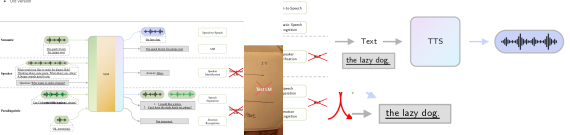
Large Language Models (LLMs) have recently garnered significant attention, primarily for their capabilities in text-based interactions. However, natural human interaction often relies on speech, necessitating a shift towards voice-based models. A straightforward approach to achieve this involves a pipeline of ``Automatic Speech Recognition (ASR) + LLM + Text-to-Speech (TTS)", where input speech is transcribed to text, processed by an LLM, and then converted back to speech. Despite being straightforward, this method suffers from inherent limitations, such as information loss during modality conversion, significant latency due to the complex pipeline, and error accumulation across the three stages. To address these issues, Speech Language Models (SpeechLMs) -- end-to-end models that generate speech without converting from text -- have emerged as a promising alternative. This survey paper provides the first comprehensive overview of recent methodologies for constructing SpeechLMs, detailing the key components of their architecture and the various training recipes integral to their development. Additionally, we systematically survey the various capabilities of SpeechLMs, categorize their evaluation metrics, and discuss the challenges and future research directions in this rapidly evolving field. The GitHub repository is available at https://github.com/dreamtheater123/Awesome-SpeechLM-Survey
研究动机与目标
- 为解决ASR+LLM+TTS流程在模态转换过程中存在的信息丢失和错误累积问题。
- 系统性地概述端到端语音生成中SpeechLM的架构、组件及训练方法。
- 对SpeechLM的评估指标进行分类与分析,涵盖性能的多个维度。
- 识别实现实时生成、安全风险以及低资源语言支持方面的关键挑战。
- 提出推动SpeechLM技术发展的未来研究方向,包括端到端训练与改进的安全措施。
提出的方法
- 提出一种基于底层组件与训练方法的新分类体系,用于对SpeechLMs进行分类。
- 回顾关键架构组件:语音分词器、自回归语言模型,以及语音合成用声码器。
- 分析涉及大规模语音数据预训练及下游任务微调的训练方法。
- 引入多维评估框架,包括自动评估与人工评估指标,用于衡量语音质量、连贯性与表现力。
- 探索端到端训练策略,实现从声码器输出到分词器输入的梯度反传,从而提升语音连贯性。
- 提出可流式处理的声码器与基于波形的生成方法,以降低实时应用中的延迟。
实验结果
研究问题
- RQ1SpeechLMs如何克服ASR+LLM+TTS流程中固有的信息丢失与错误累积问题?
- RQ2哪些关键架构组件与训练方法使得SpeechLMs能够实现高效的端到端语音生成?
- RQ3如何在语音质量、语义准确性与情感表现力等多个维度上对SpeechLMs进行评估?
- RQ4在实现低延迟、实时语音生成方面,SpeechLMs面临的主要挑战是什么?
- RQ5如何提升SpeechLMs的安全性与鲁棒性,特别是在语音生成中存在毒性内容与隐私泄露风险(如说话人身份推断)方面?
主要发现
- SpeechLMs能够保留语调、音色与语调等副语言信息,而这些信息在基于文本的LLMs中会丢失,从而实现更具表现力与自然的语音生成。
- SpeechLM的端到端训练可通过实现从声码器输出到分词器输入的梯度反传,减少错误传播并提升语音连贯性。
- 当前声码器因需等待完整标记序列才能生成,导致显著延迟,凸显了对可流式处理或自回归声码器的需求。
- SpeechLMs在低资源语言中展现出强大潜力,即使文本数据稀缺,也能通过利用现有语音数据实现有效建模。
- SpeechLMs的安全风险包括生成有毒或不当内容,以及通过说话人身份推断导致的隐私泄露,这些是相较于纯文本模型特有的挑战。
- 对SpeechLMs的评估需采用多维度方法,结合自动评估指标(如MOS、STOI)与人工评估,以全面衡量语音质量、连贯性与情感细微差别。
阅读本论文
在 Nubint 阅读器中打开原文,边读边就任意段落提问。
在 Nubint 中阅读本论文本解读由 AI 根据论文原文生成,引用前请核对原文。