
[论文解读] Reconstructing Training Data from Multiclass Neural Networks
该论文表明,通过基于梯度的优化方法,可以从多分类神经网络中重建训练数据,利用梯度下降的隐式偏差恢复决策边界附近的样本。结果表明,权重衰减可提升重建质量,并成功实现从最多包含5,000个样本、100个类别的模型中进行重建——显著扩展了以往仅限于二分类器和小规模数据集的研究工作。
Reconstructing samples from the training set of trained neural networks is a major privacy concern. Haim et al. (2022) recently showed that it is possible to reconstruct training samples from neural network binary classifiers, based on theoretical results about the implicit bias of gradient methods. In this work, we present several improvements and new insights over this previous work. As our main improvement, we show that training-data reconstruction is possible in the multi-class setting and that the reconstruction quality is even higher than in the case of binary classification. Moreover, we show that using weight-decay during training increases the vulnerability to sample reconstruction. Finally, while in the previous work the training set was of size at most $1000$ from $10$ classes, we show preliminary evidence of the ability to reconstruct from a model trained on $5000$ samples from $100$ classes.
研究动机与目标
- 将数据重建从二分类扩展到多分类神经网络,克服先前研究仅限于二分类器的关键局限。
- 探究标准训练实践(如权重衰减)是否增加模型对重建攻击的脆弱性。
- 将重建能力扩展至更大规模的数据集,例如从100个类别中重建5,000个样本,突破以往研究1,000个样本的限制。
- 分析模型泛化能力与重建可行性之间的关系,特别是在训练误差非零的情况下。
- 探讨边缘接近度在实现重建中的作用,尤其是在权重衰减正则化下的情况。
提出的方法
- 将Lyu & Li (2019)提出的隐式偏差理论扩展至多分类设置,证明梯度流收敛于最大间隔问题的KKT点。
- 设计一种重建损失函数,通过在输入空间上使用梯度下降,优化输入图像以满足由隐式偏差导出的KKT条件。
- 将该重建方法应用于在CIFAR-10和CIFAR-100数据集上训练的多分类MLP模型,包括有无权重衰减的情况。
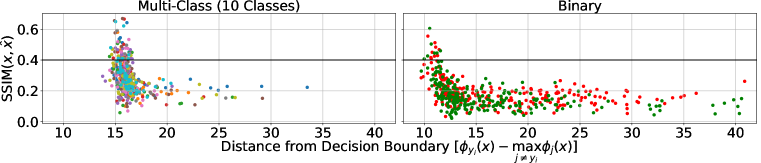
- 使用结构相似性(SSIM)定量评估重建质量,并与样本到决策边界的距离进行比较。
- 采用两阶段优化:第一阶段,优化输入以最小化由KKT条件导出的损失;第二阶段,通过L2正则化和迭代精炼进行优化。
- 分析权重衰减模型中训练样本相对于边界的分布,显示样本在边界上的集中度显著提高。
实验结果
研究问题
- RQ1能否从多分类神经网络中重建训练数据,从而将先前仅限于二分类器的研究工作扩展至多分类场景?
- RQ2在训练过程中使用权重衰减是否会增加模型对数据重建攻击的脆弱性?
- RQ3重建能力在多大程度上可扩展至更大规模的数据集,例如从100个类别中重建5,000个样本?
- RQ4当训练误差非零时,泛化性能(如测试误差)与重建成功率之间存在何种相关性?
- RQ5在权重衰减模型中,样本与决策边界的接近程度与重建质量之间存在何种关系?
主要发现
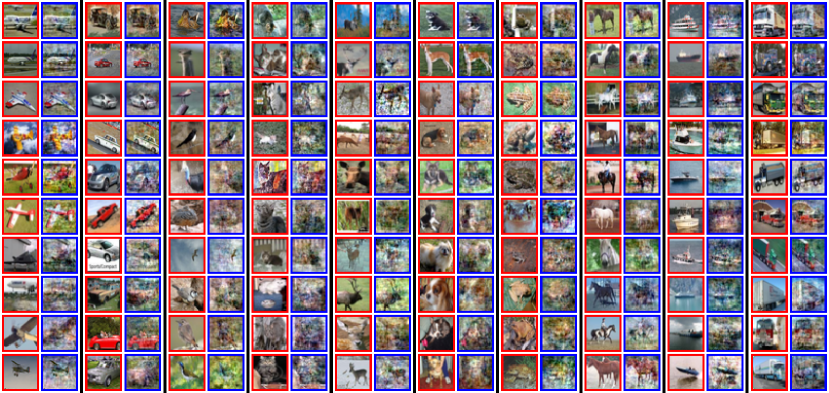
- 成功实现了多分类场景下的数据重建,即使在100个类别中训练5,000个样本的模型中,也观察到了高质量的重建结果。
- 权重衰减显著提升了重建质量,并使得在标准(非极小)权重初始化下训练的模型也能成功实现重建。
- 对于某些权重衰减值,有更高比例的训练样本恰好位于决策边界上,使其对重建攻击更加脆弱。
- 即使在训练误差非零的模型中,重建依然可行,表明Lyu & Li (2019)的理论假设并非严格必要。
- 在使用权重衰减的模型中,成功重建样本数量(SSIM > 0.4)相比无权重衰减的模型有显著提升。
- SSIM与距离边界的散点图显示强相关性:样本越接近边界,重建越准确,尤其在权重衰减条件下更为明显。
阅读本论文
在 Nubint 阅读器中打开原文,边读边就任意段落提问。
在 Nubint 中阅读本论文本解读由 AI 根据论文原文生成,引用前请核对原文。