
[论文解读] Reducing approximate Longest Common Subsequence to approximate Edit Distance
本文提出了一种从近似最长公共子序列(LCS)到近似编辑距离(ED)的新型归约方法,实现了首个针对二进制LCS的高效$(1/2 + \epsilon)$-近似算法——打破了长期存在的$1/2$-近似障碍。该方法利用对字符计数的细粒度分析与子串匹配策略,通过黑箱近似ED算法,借助动态分区与平衡字符串段上的贪心匹配,实现LCS近似。
Given a pair of strings, the problems of computing their Longest Common Subsequence and Edit Distance have been extensively studied for decades. For exact algorithms, LCS and Edit Distance (with character insertions and deletions) are equivalent; the state of the art running time is (almost) quadratic and this is tight under plausible fine-grained complexity assumptions. But for approximation algorithms the picture is different: there is a long line of works with improved approximation factors for Edit Distance, but for LCS (with binary strings) only a trivial $1/2$-approximation was known. In this work we give a reduction from approximate LCS to approximate Edit Distance, yielding the first efficient $(1/2+ε)$-approximation algorithm for LCS for some constant $ε>0$.
研究动机与目标
- 为克服二进制LCS长期存在的$1/2$-近似障碍,尽管编辑距离近似已有进展,但该障碍始终未能突破。
- 建立从近似LCS到近似编辑距离的细粒度归约,表明更好的LCS近似并不比更好的ED近似更困难。
- 设计一种确定性且高效的二进制LCS算法,仅使用常数因子近似ED预言机,实现$(1/2 + \epsilon)$-近似因子。
- 证明可利用近线性时间近似ED算法,实现$O(n^{1+\delta})$-时间的$(1/2 + \epsilon)$-近似LCS。
提出的方法
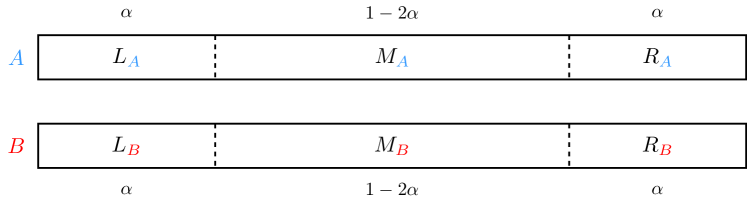
- 将输入字符串$A$和$B$划分为长度相等的左、中、右三段,每段长度为$\alpha$,以实现对字符分布的局部分析。
- 使用黑箱近似编辑距离算法估计$\widetilde{\text{ED}}(A,B)$,据此根据子串中$0$和$1$的计数选择匹配策略。
- 应用贪心匹配过程$\textsc{Match}(X,Y,b)$,基于$b$-计数的极小值,寻找仅由位$b$组成的$X$与$Y$的最长公共子序列。
- 根据$B$的左右部分中$0$和$1$的分布,定义不同情况,使用阈值$\alpha/2 \pm \beta$指导算法分支。
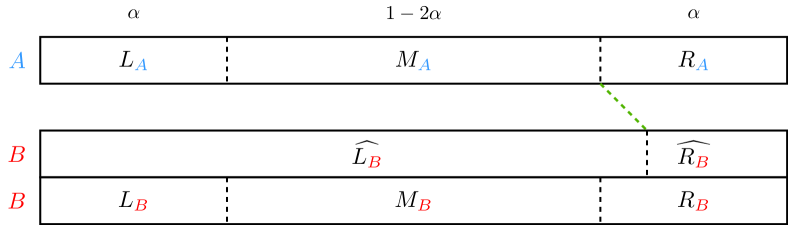
- 通过组合多个$\textsc{Match}$调用在重叠或相邻子串(如$L_A \cup M_A$和$L_B \cup M_B$)上的结果,构造长度$\geq \alpha + 2\beta$的公共子序列。
- 当$\textsc{Match}$结果较小时,采用回退策略,切换至最佳匹配或ED估计路径,以确保输出长度为$\Omega(\alpha)$。
实验结果
研究问题
- RQ1能否仅使用常数因子近似编辑距离预言机,实现二进制LCS的$(1/2 + \epsilon)$-近似?
- RQ2是否存在一种细粒度归约,将近似LCS归约为近似编辑距离,同时保持亚二次时间复杂度?
- RQ3能否利用近似编辑距离算法的技术,打破二进制LCS的$1/2$-近似障碍?
- RQ4字符串子串(如$0$和$1$计数)的哪些结构性质可被利用以设计更优的LCS近似算法?
- RQ5能否利用近线性时间近似编辑距离算法,实现$O(n^{1+\delta})$-时间的$(1/2 + \epsilon)$-近似LCS?
主要发现
- 本文建立了从近似LCS到近似编辑距离的归约:若存在$c$-近似ED算法,则存在$(1/2 + \epsilon(c))$-近似LCS。
- 该算法在时间$T(n) + O(n)$内实现二进制LCS的$(1/2 + \epsilon)$-近似,其中$T(n)$为近似ED预言机的运行时间。
- 通过代入[CDG+18]中$\widetilde{O}(n^{2-2/7})$-时间的常数因子ED近似算法,本文实现了$\widetilde{O}(n^{2-2/7})$-时间的$(1/2 + \epsilon)$-近似LCS。
- 利用近线性时间近似ED算法(如[KS19, BR19]),本文获得了对任意$\delta > 0$的$O(n^{1+\delta})$-时间$(1/2 + \epsilon)$-近似LCS。
- 在有利情况下,该算法保证生成长度至少为$\alpha + 2\beta$的公共子序列,其中$\alpha$为字符串长度的一半,$\beta$为一小常数。
- 该归约对ED预言机中的次线性加性误差具有鲁棒性,因此与近期近线性时间ED近似算法兼容。
阅读本论文
在 Nubint 阅读器中打开原文,边读边就任意段落提问。
在 Nubint 中阅读本论文本解读由 AI 根据论文原文生成,引用前请核对原文。