
[论文解读] Regularized dynamical parametric approximation
该论文提出了一种正则化动态参数逼近方法,用于求解时间依赖的演化方程,即使参数化方式不规则(如高斯函数之和或神经网络)也能适用。尽管参数导数的小奇异值导致病态性,该方法通过平衡正则化与时间离散化,实现了稳定的收敛性,并在量子动力学和常微分方程流映射问题上得到理论与数值验证。
This paper studies the numerical approximation of evolution equations by nonlinear parametrizations $u(t)=Φ(\param(t))$ with time-dependent parameters $\param(t)$, which are to be determined in the computation. The motivation comes from approximations in quantum dynamics by multiple Gaussians and approximations of various dynamical problems by tensor networks and neural networks. In all these cases, the parametrization is typically irregular: the derivative $Φ'(\param)$ can have arbitrarily small singular values and may have varying rank. We derive approximation results for a regularized approach in the time-continuous case as well as in time-discretized cases. For the latter, there is a nontrivial interplay between the regularization parameter and the time stepsize, depending also on the defect size and local bounds of the second derivative of the parametrization map $Φ$. When this is appropriately taken into account, the approach can be successfully applied in irregular situations, even though it runs counter to the basic principle in numerical analysis to avoid solving ill-posed subproblems when aiming for a stable algorithm. The paper also includes two theoretical case studies: regularized parametric steepest descent for optimization and regularized parametric Strang splitting for the time-dependent Schrödinger equation. Numerical experiments with sums of Gaussians for approximating quantum dynamics and with neural networks for approximating the flow map of a system of ordinary differential equations illustrate and complement the theoretical results.
研究动机与目标
- 解决时间依赖的非线性参数逼近中的数值不稳定性问题,尤其当参数化导数具有任意小的奇异值或变化的秩时。
- 开发一种正则化方法,即使在标准数值原则会拒绝此类不适定子问题时,仍能保持稳定与收敛。
- 为正则化最小二乘问题的时间连续与时间离散形式提供理论收敛性分析。
- 在使用多高斯逼近的量子动力学和使用深度神经网络的常微分方程流映射上进行数值验证。
- 建立对时间离散化和正则化参数具有鲁棒性的后验误差界。
提出的方法
- 通过正则化最小二乘问题构建时间连续的动态参数逼近:最小化 $ \norm{\boldsymbol{\texttt{u}} - f(\boldsymbol{\texttt{u}})}^2 + \tilde{\boldsymbol{\texttt{e}}}^2 \norm{\boldsymbol{\texttt{q}}'}^2 $,其中 $ \boldsymbol{\texttt{u}} = \boldsymbol{\texttt{u}}(t) = \boldsymbol{\texttt{F}}(q(t)) $,且 $ \tilde{\boldsymbol{\texttt{e}}} $ 为时间相关的正则化参数。
- 使用标准时间推进格式求解 $ q(t) $ 的相应微分方程,每一步均涉及一个正则化的线性最小二乘求解。
- 当 $ f(y) = Ay + g(y) $ 且 $ A $ 无界时,引入修正形式,要求 $ \boldsymbol{\texttt{y}}' - Ay $ 在 $ \boldsymbol{\texttt{F}}(q) $ 的切空间中能被良好逼近。
- 基于正则化最小二乘问题的残差推导后验误差界,其在时间离散化下保持稳定。
- 将该方法应用于使用复高斯函数之和的薛定谔方程,以及使用深度神经网络的常微分方程流映射。
- 在多高斯设定下,利用高斯积分的解析公式高效计算初始参数值与雅可比矩阵。
实验结果
研究问题
- RQ1在参数导数具有任意小奇异值的严重病态情况下,正则化动态参数逼近是否能稳定收敛?
- RQ2尽管底层最小二乘子问题不适定,正则化方法是否仍能保持收敛阶?
- RQ3正则化参数 $ \tilde{\boldsymbol{\texttt{e}}} $ 的选择如何影响时间离散化解的精度与稳定性?
- RQ4在使用多高斯参数化的量子动力学模拟中,该方法能否实现稳定的能量与范数守恒?
- RQ5基于正则化最小二乘问题残差推导的后验误差界,是否对时间步长与正则化参数的变化具有鲁棒性?
主要发现
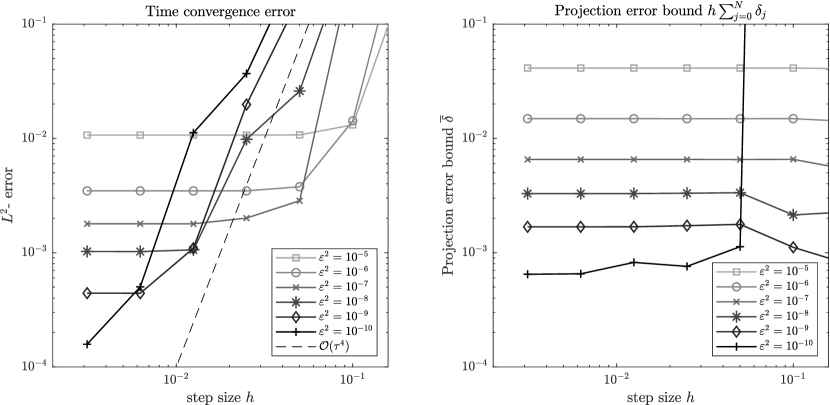
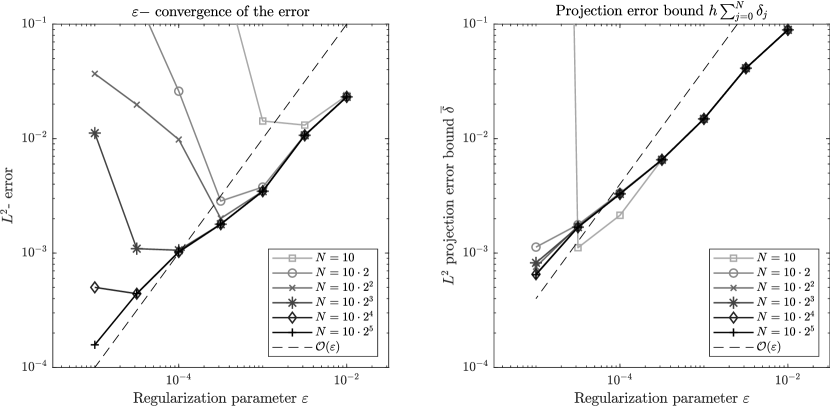
- 当正则化参数 $ \tilde{\boldsymbol{\texttt{e}}} $ 与时间步长 $ h $ 选择得当时,正则化动态参数逼近即使在参数导数具有任意小奇异值的情况下,也能实现时间上的最优收敛阶。
- 在 $ M=36 $ 个复高斯函数的双阱薛定谔问题中,当 $ \tilde{\boldsymbol{\texttt{e}}} = 10^{-5} $ 时,模拟在 $ h = 4 \times 10^{-3} $ 处出现较大的能量误差并提前终止,表明小 $ \tilde{\boldsymbol{\texttt{e}}} $ 会导致不稳定。
- 当采用较大的正则化参数(如 $ \tilde{\boldsymbol{\texttt{e}}} = 10^{-3} $)时,能量误差遵循经典四阶龙格-库塔格式的预期阶数,且无时间步长限制。
- 仅当 $ \tilde{\boldsymbol{\texttt{e}}} $ 较大时才观察到范数守恒,较小的 $ \tilde{\boldsymbol{\texttt{e}}} $ 导致质量误差显著增加,表明正则化对保持物理不变量至关重要。
- 投影误差的后验误差界对时间步长保持稳定,并准确捕捉了 $ \tilde{\boldsymbol{\texttt{e}}} $ 的影响,表明其对数值离散化具有鲁棒性。
- 该方法成功使用深度神经网络逼近了常微分方程系统的流映射,误差界反映了正则化效应,且对时间离散化不敏感。
阅读本论文
在 Nubint 阅读器中打开原文,边读边就任意段落提问。
在 Nubint 中阅读本论文本解读由 AI 根据论文原文生成,引用前请核对原文。