
[论文解读] Resource Theory of Imaginarity: New Distributed Scenarios
本文提出了一种分布式虚数理论,证明了量子态中的虚部在量子信息任务中可实现操作优势。该研究在两体系统中通过LQRCC协议,建立了虚数纯化与态转换的精确解,证明了在无辅助比特的通道判别中虚数可带来量子优势,并在光子实验设置中验证了相关协议,表明虚数在分布式场景中是一种非平凡的量子资源。
The resource theory of imaginarity studies the operational value of imaginary parts in quantum states, operations, and measurements. Here we introduce and study the distillation and conversion of imaginarity in distributed scenario. This arises naturally in bipartite systems where both parties work together to generate the maximum possible imaginarity on one of the subsystems. We give exact solutions to this problem for general qubit states and pure states of arbitrary dimension. We present a scenario that demonstrates the operational advantage of imaginarity: the discrimination of quantum channels without the aid of an ancillary system. We then link this scenario to LOCC discrimination of bipartite states. We experimentally demonstrate the relevant assisted distillation protocol, and show the usefulness of imaginarity in the aforementioned two tasks.
研究动机与目标
- 开发一种分布式虚数资源理论,其中一方(鲍勃)持有资源,另一方(爱丽丝)通过局部操作与经典通信协助。
- 解决任意两比特态及任意维度纯态的辅助虚数纯化问题。
- 在无辅助比特的量子通道判别中,展示虚数的真正操作优势,即当虚数存在时,实通道才可被区分。
- 建立无辅助比特通道判别与LOCC归一化乔伊矩阵判别的正式联系。
- 通过光子量子系统实验实现并验证理论协议,确认虚数在真实量子任务中的实用性。
提出的方法
- 使用局部操作、实操作与经典通信(LQRCC)在分布式场景中形式化虚数资源理论,其中仅鲍勃的系统可具有虚数。
- 通过凸优化框架定义并求解辅助虚数纯化问题,推导出比特与纯态情形下的精确解析解。
- 将无辅助比特通道判别映射为归一化乔伊矩阵的LOCC判别,从而可使用已有的量子态判别工具。
- 构建一种协议,通过乔伊同构将通道判别任务映射至LOCC场景,同时保持成功判别的概率不变。
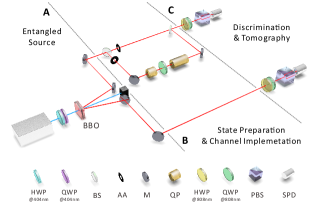
- 使用自发参量下转换生成纠缠态并模拟量子通道,在光子系统中实验实现协议。
- 利用波片与分束器制备维尔纳态并控制偏振,实现具有或不具有虚数的实操作与测量。
实验结果
研究问题
- RQ1在仅一方持有资源而另一方通过局部操作与经典通信协助的分布式场景中,虚数能否被纯化?
- RQ2在LQRCC操作下,从任意两比特态中可纯化出的最大虚数量是多少?
- RQ3虚数是否在无辅助比特的量子通道判别中提供真正的操作优势?若存在,其量化方式为何?
- RQ4实量子通道的判别与它们的归一化乔伊态的LOCC判别之间有何关系?
- RQ5能否通过光子量子系统实验验证虚数在通道判别中理论上的优势?
主要发现
- 在LQRCC协议下,针对任意两比特态及任意维度纯态,推导出虚数纯化的精确解析解。
- 本文证明,在无辅助比特场景中,当使用虚数时,两个实量子通道可被完美区分,但若限制为实态与实测量,则完全不可区分。
- 建立了无辅助比特通道判别与归一化乔伊矩阵LOCC判别的正式等价性,表明虚数的优势源于测量过程的非局域性。
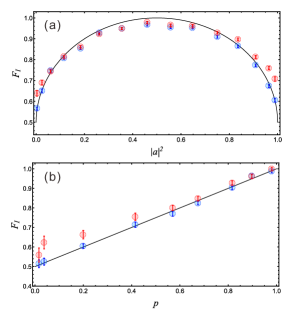
- 光子系统中的实验实现成功演示了纯化协议与通道判别优势,验证了理论预测。
- 结果表明,虚数并非单纯的数学构造,而是分布式量子信息处理中具有物理实用价值的资源。
- 研究表明,量子操作中虚部的存在使在无辅助系统情况下原本不可能的任务成为可能,即使在实操作限制下亦如此。
阅读本论文
在 Nubint 阅读器中打开原文,边读边就任意段落提问。
在 Nubint 中阅读本论文本解读由 AI 根据论文原文生成,引用前请核对原文。