
[论文解读] ResQuNNs: Towards Enabling Deep Learning in Quantum Convolution Neural Networks
本文提出ResQuNNs,一种新颖的架构,通过引入残差块来增强梯度流动,使量子卷积神经网络中的可训练量子卷积层成为可能。该方法显著提升了训练性能和泛化能力,实证结果表明,通过战略性地放置残差连接,可实现所有层的完整梯度访问,从而解锁更深层、更高效的量子神经网络。
In this paper, we present a novel framework for enhancing the performance of Quanvolutional Neural Networks (QuNNs) by introducing trainable quanvolutional layers and addressing the critical challenges associated with them. Traditional quanvolutional layers, although beneficial for feature extraction, have largely been static, offering limited adaptability. Unlike state-of-the-art, our research overcomes this limitation by enabling training within these layers, significantly increasing the flexibility and potential of QuNNs. However, the introduction of multiple trainable quanvolutional layers induces complexities in gradient-based optimization, primarily due to the difficulty in accessing gradients across these layers. To resolve this, we propose a novel architecture, Residual Quanvolutional Neural Networks (ResQuNNs), leveraging the concept of residual learning, which facilitates the flow of gradients by adding skip connections between layers. By inserting residual blocks between quanvolutional layers, we ensure enhanced gradient access throughout the network, leading to improved training performance. Moreover, we provide empirical evidence on the strategic placement of these residual blocks within QuNNs. Through extensive experimentation, we identify an efficient configuration of residual blocks, which enables gradients across all the layers in the network that eventually results in efficient training. Our findings suggest that the precise location of residual blocks plays a crucial role in maximizing the performance gains in QuNNs. Our results mark a substantial step forward in the evolution of quantum deep learning, offering new avenues for both theoretical development and practical quantum computing applications.
研究动机与目标
- 为解决QuNN中静态、不可训练的量子卷积层的局限性,这些层仅允许在经典层上进行学习。
- 克服在具有多个可训练量子卷积层的深层QuNN中梯度流动不佳的挑战。
- 设计一种基于残差的架构,确保所有量子卷积层的梯度可访问。
- 通过实证方法识别最优的残差块配置,以最大化训练效率和模型泛化能力。
- 通过实现端到端训练的量子特征提取层,使更深、更灵活的QuNN成为可能。
提出的方法
- 提出ResQuNNs,一种残差学习框架,通过在量子卷积层之间插入残差块来改善梯度流动。
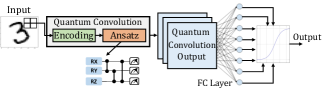
- 使用包含Ry和CNOT门的参数化量子电路(PQCs)作为量子卷积层,实现对量子操作的反向传播。
- 引入跳跃连接,使梯度能从深层直接传播到浅层,缓解梯度消失问题。
- 系统评估不同残差块放置方式(如O1+O2、(X+O1)+O2)以识别可实现完整梯度访问的配置。
- 使用Adam优化器(学习率为0.01)在MNIST上训练模型,对比有无残差连接的配置。
- 利用可视化工具分析梯度传播,验证仅特定配置可使梯度通过所有量子卷积层。
实验结果
研究问题
- RQ1与冻结层相比,使量子卷积层可训练如何影响QuNN的性能?
- RQ2为实现对多个可训练量子卷积层的有效反向传播,需要哪些架构修改?
- RQ3不同残差块的放置方式如何影响深层QuNN中的梯度流动和模型泛化?
- RQ4在多层QuNN中,哪些残差配置可实现所有量子卷积层的完整梯度访问?
- RQ5QuNN中的残差连接能否同时提升训练准确率和验证性能,表明更好的泛化能力?
主要发现
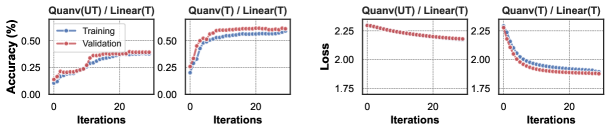
- 不可训练量子卷积层的模型表现欠佳,学习过程主要由最后的全连接层主导。
- 使量子卷积层可训练显著提升了训练性能,证明了优化量子特征提取器的必要性。
- 残差连接极大改善了训练效果,缺乏残差连接的模型几乎无法学习。
- O1+O2残差配置在训练和验证准确率上均优于X+O1,表明其具有更优的梯度流动和泛化能力。
- 在三层QuNN中,15种可能的残差配置里仅有两种实现了所有量子卷积层的完整梯度访问:(O1+O2)+O3和((X+O1)+O2)+O3。
- 尽管(X+O1)+O2配置的验证准确率高于O1+O2,但表明直接输入传播可能导致记忆化,而完整的梯度流动则能增强泛化能力。
阅读本论文
在 Nubint 阅读器中打开原文,边读边就任意段落提问。
在 Nubint 中阅读本论文本解读由 AI 根据论文原文生成,引用前请核对原文。