
[论文解读] Rethinking Multi-User Semantic Communications with Deep Generative Models
本文提出了一种新颖的生成式语义通信框架,用于多用户场景,利用零空间扩散模型在接收端重建缺失或损坏的数据。通过仅传输必要的语义比特,并借助扩散模型填补空白和去噪,该系统在极低子载波比(低至 N/M = 0.1)和低信噪比条件下仍能实现高感知质量,优于传统的 DeepJSCC 和 LDPC 方法。
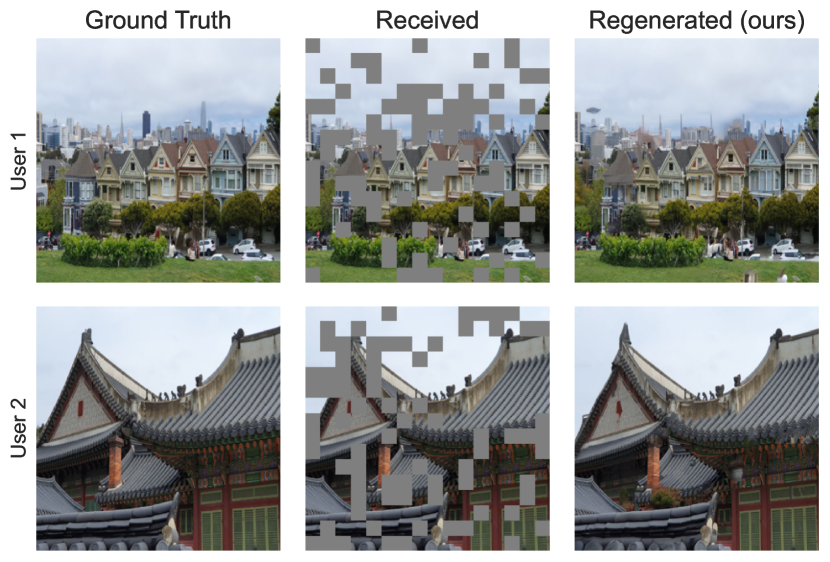
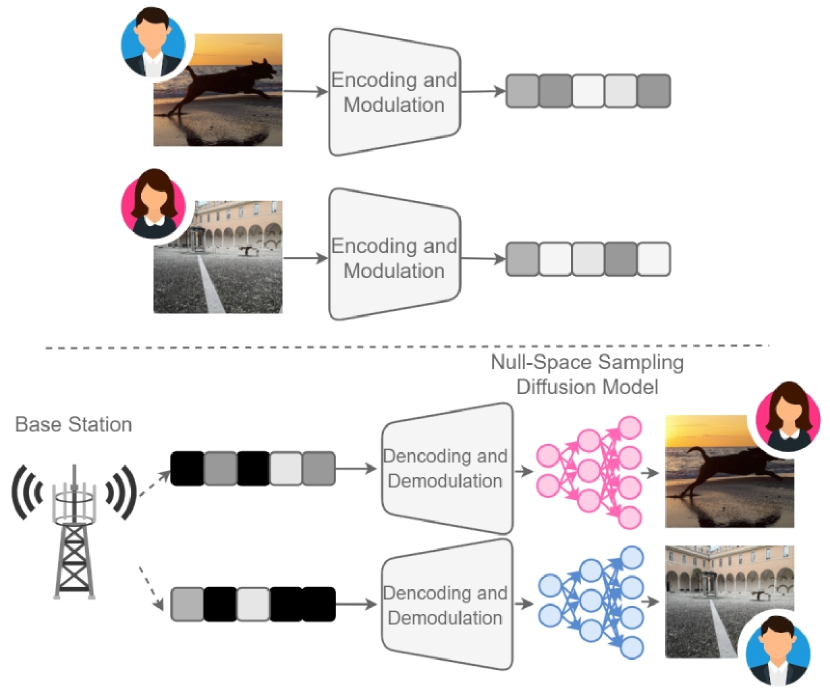
In recent years, novel communication strategies have emerged to face the challenges that the increased number of connected devices and the higher quality of transmitted information are posing. Among them, semantic communication obtained promising results especially when combined with state-of-the-art deep generative models, such as large language or diffusion models, able to regenerate content from extremely compressed semantic information. However, most of these approaches focus on single-user scenarios processing the received content at the receiver on top of conventional communication systems. In this paper, we propose to go beyond these methods by developing a novel generative semantic communication framework tailored for multi-user scenarios. This system assigns the channel to users knowing that the lost information can be filled in with a diffusion model at the receivers. Under this innovative perspective, OFDMA systems should not aim to transmit the largest part of information, but solely the bits necessary to the generative model to semantically regenerate the missing ones. The thorough experimental evaluation shows the capabilities of the novel diffusion model and the effectiveness of the proposed framework, leading towards a GenAI-based next generation of communications.
研究动机与目标
- 为应对频谱拥塞下高效多用户通信的挑战,将关注点从最大化数据传输转向最小化必要的语义比特。
- 在子载波有限且信道噪声高的多用户场景中,实现鲁棒的信号重建。
- 将深度生成模型——特别是扩散模型——整合到语义通信流程中,实现仅通过极少传输信息再生内容。
- 将多用户通信问题形式化为可通过扩散模型采样中的零空间分解求解的逆问题。
- 在极端条件下(包括低信噪比和低 N/M 比)证明所提框架的有效性。
提出的方法
- 该框架将多用户语义通信形式化为一个逆问题,接收端从部分、噪声或缺失的数据中重建完整信号。
- 设计了一种零空间扩散模型,用于从信道矩阵的零空间采样,使模型能够生成缺失或损坏的信号分量。
- 通过零空间分解对扩散采样过程进行调整,以符合通信约束,确保仅传输必要比特。
- 该方法利用预训练的扩散模型,能够从压缩的语义表示中生成高保真度的图像和音频。
- 系统在类似 OFDMA 的资源分配下进行评估,仅使用部分子载波(N < M),接收端通过生成建模填补空白。
- 在不同 N/M 比(0.1 至 0.7)和信噪比水平(−10 至 10 dB)下,使用 CelebA-HQ 图像对方法进行验证,评估指标包括 SSIM、PSNR、FID 和 LPIPS。
实验结果
研究问题
- RQ1在子载波分配有限的多用户通信系统中,扩散模型能否有效重建缺失或损坏的信号分量?
- RQ2在低信噪比和低 N/M 比等极端信道条件下,所提出的零空间采样策略表现如何?
- RQ3当仅传输原始信号的一小部分时,生成模型在多大程度上能保持感知质量?
- RQ4在噪声和带宽受限条件下,与传统语义通信方法(如 DeepJSCC 和 LDPC)相比,所提框架在鲁棒性和性能方面表现如何?
- RQ5生成模型能否在一个统一框架中同时实现去噪和信号补全?
主要发现
- 在 N/M 比为 0.4(256 个子载波中的 102 个)时,该方法实现了 SSIM 0.8,表明即使在显著数据丢失下仍能实现高质量重建。
- 在 N/M 比为 0.2(256 个子载波中的 51 个)时,SSIM 仍保持在 0.66,图像重建结果清晰可辨且视觉上合理。
- 仅在极端的 N/M 比 0.1(256 个子载波中的 26 个)时性能显著下降,表明在广泛子载波限制范围内具有强鲁棒性。
- 该方法在所有信噪比水平下均持续优于基线方法(DeepJSCC、LDPC),包括 −10 dB 的极端低信噪比情况,后者无法恢复有意义的内容。
- 零空间扩散模型能有效对受损信号去噪,在高加性高斯白噪声(AWGN)下仍能保持感知质量,视觉和定量结果均证实了这一点。
- 该框架对缺失数据和信道噪声均表现出强韧性,在所有测试场景中 SSIM、PSNR、FID 和 LPIPS 指标上均取得优异表现。
阅读本论文
在 Nubint 阅读器中打开原文,边读边就任意段落提问。
在 Nubint 中阅读本论文本解读由 AI 根据论文原文生成,引用前请核对原文。