
[论文解读] Retrieval & Fine-Tuning for In-Context Tabular Models
该论文提出 LoCalPFN,即一种检索与微调增强的 TabPFN 变体,以提升上下文学习在表格分类任务中的表现。通过使用 k-最近邻作为动态上下文,并对模型进行端到端微调,LoCalPFN 在 95 个 OpenML 数据集上实现了最先进性能,超越了包括 XGBoost 和随机森林在内的神经网络与树模型基线。
Tabular data is a pervasive modality spanning a wide range of domains, and the inherent diversity poses a considerable challenge for deep learning. Recent advancements using transformer-based in-context learning have shown promise on smaller and less complex datasets, but have struggled to scale to larger and more complex ones. To address this limitation, we propose a combination of retrieval and fine-tuning: we can adapt the transformer to a local subset of the data by collecting nearest neighbours, and then perform task-specific fine-tuning with this retrieved set of neighbours in context. Using TabPFN as the base model -- currently the best tabular in-context learner -- and applying our retrieval and fine-tuning scheme on top results in what we call a locally-calibrated PFN, or LoCalPFN. We conduct extensive evaluation on 95 datasets curated by TabZilla from OpenML, upon which we establish a new state-of-the-art with LoCalPFN -- even with respect to tuned tree-based models. Notably, we show a significant boost in performance compared to the base in-context model, demonstrating the efficacy of our approach and advancing the frontier of deep learning in tabular data.
研究动机与目标
- 解决基于 Transformer 的上下文学习(ICL)模型(如 TabPFN)在大规模复杂表格数据集上的可扩展性限制。
- 通过用自适应的局部 k-NN 上下文替代静态全数据集上下文,提升表格 ICL 中的泛化能力与决策边界学习能力。
- 通过在检索到的局部上下文上进行端到端微调,提升性能,克服复杂或高基数数据集中的欠拟合问题。
- 建立一种基于神经网络的新最先进表格分类方法,超越成熟的树模型。
提出的方法
- 对每个查询点检索其 k-最近邻,以构建动态的、局部化的上下文,而非使用完整的训练集。
- 在检索到的 k-最近邻上下文上应用端到端微调,使基础 TabPFN 模型适应局部数据模式。
- 采用近似邻居检索方案,使检索步骤可微,从而支持反向传播与可微微调。
- 将检索与微调整合为统一框架,称为 LoCalPFN(局部校准 PFN),扩展了 TabPFN 的上下文学习能力。
- 采用上下文大小启发式策略:取 10×√(n_train) 与预设最大值的最小值,确保可扩展性与稳定性。
- 使用来自 TabZilla 的 95 个数据集基准验证性能,与 TabPFN、树模型及其他 ICL 变体进行比较。
实验结果
研究问题
- RQ1用 k-最近邻作为上下文替代完整训练集,能否提升表格上下文学习的分类性能?
- RQ2在检索到的局部上下文上进行端到端微调,是否能显著提升复杂表格数据集中的泛化能力与决策边界学习?
- RQ3所提出的检索与微调框架在性能上是否优于最先进树模型(如 XGBoost 和随机森林)?
- RQ4该方法对所用邻居数量的变化是否具有鲁棒性?
- RQ5该框架能否扩展至改进除 TabPFN 外的其他表格上下文学习基础模型?
主要发现
- LoCalPFN 在 95 个 OpenML 数据集上达到新最先进性能,超越了神经网络与树模型基线,包括 XGBoost 与随机森林。
- 仅使用 TabPFN- k NN 变体(无微调)即显著优于原始 TabPFN,证明了局部上下文检索的有效性,即使不进行微调。
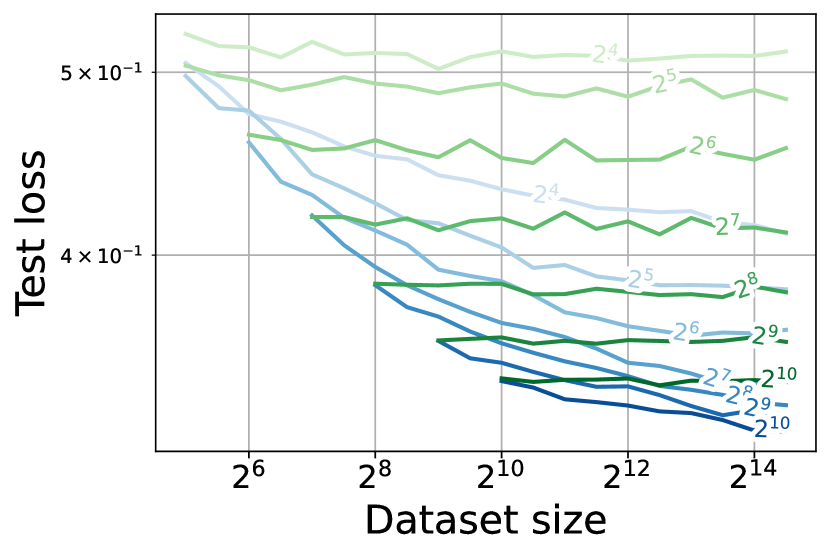
- LoCalPFN 在仅使用 50 个邻居作为上下文时,已超越随机森林基线;在使用 500 个邻居时,超越 XGBoost,表明其具有强大的样本效率。
- 性能对 k 的选择具有鲁棒性,在 k ≥ 100 的条件下,不同上下文大小下均保持稳定增益。
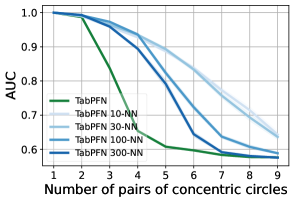
- 在复杂合成数据集(如同心圆)上,该方法表现出显著性能提升,而原始 TabPFN 因欠拟合而失效。
- 尽管推理成本高于树模型,但轻量级的 TabPFN- k NN 变体运行速度与树模型相当,同时实现了更优的准确率。
阅读本论文
在 Nubint 阅读器中打开原文,边读边就任意段落提问。
在 Nubint 中阅读本论文本解读由 AI 根据论文原文生成,引用前请核对原文。