
[论文解读] Revealing Phase Transition in Dense Matter with Gravitational Wave Spectroscopy of Binary Neutron Star Mergers
该论文表明,通过多模引力波(GW)光谱学,特别是通过抑制单臂螺旋不稳定性,可以探测双中子星并合中的高密度禁闭相变。该不稳定性与相变的能量密度间隙反相关。对 $l=2,m=1$ 和 $l=2,m=2$ 引力波模式的信噪比进行单次测量,即可约束相变的强度。
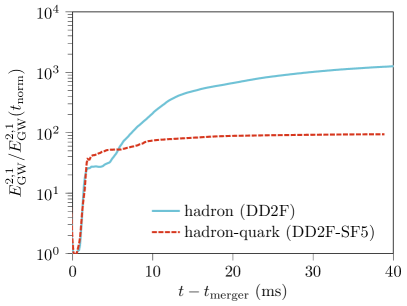
We use numerical relativity simulations of binary neutron star mergers to show that high density deconfinement phase transitions (PTs) to quark matter can be probed using multimodal postmerger gravitational wave (GW) spectroscopy. Hadron-quark PTs suppress the one-armed spiral instability in the remnant. This is manifested in an anti-correlation between the energy carried in the $l=2, m=1$ GW mode and energy density gap which separates the two phases. Consequently, a single measurement of the signal-to-noise ratios of the $l=2, m=1$ and $l=2, m=2$ GW modes could constrain the energy density gap of the PT.
研究动机与目标
- 研究双中子星并合中的高密度禁闭相变是否可通过引力波(GW)辐射模式探测到。
- 确定与非轴对称动力学相关的单臂螺旋不稳定性是否可作为并合残余物质中相变的探测工具。
- 建立 $l=2,m=1$ 引力波模式中携带的能量与强子相和夸克相之间能量密度间隙 $\Delta e$ 之间的定量联系。
- 评估下一代引力波探测器(如 Cosmic Explorer 和 Einstein Telescope)对这类相变的可探测性。
提出的方法
- 使用自适应网格细化和 CTGamma 时空求解器,通过 WhiskyTHC 代码对 8 个高分辨率的双中子星并合数值相对论模拟进行计算。
- 采用共形薄壳形式的初始数据构建准圆形轨道,并通过提升星体的叠加方法模拟抛物线形、偏心的并合事件。
- 采用具有不同能量密度间隙 $\Delta e$ 的方程态模型,模拟强子-夸克相变,并与纯强子情形进行比较。
- 分析并合后的引力波光谱,重点关注 $l=2,m=1$ 和 $l=2,m=2$ 模式,以在真实探测器配置下提取信噪比(SNR)。
- 使用 $40\text{ km}$ Cosmic Explorer 配置模拟探测器响应,估算在 1–4 kHz 频段内的可探测性和灵敏度。
- 量化 $l=2,m=1$ 引力波能量与 $\Delta e$ 之间的反相关性,从而从引力波观测中推断相变强度。
实验结果
研究问题
- RQ1是否可以通过并合后信号的多模引力波光谱学探测到高密度禁闭相变的存在及其强度?
- RQ2相变如何影响并合残余物中单臂螺旋不稳定的激发?
- RQ3是否存在可测量的反相关性,即 $l=2,m=1$ 引力波模式中的能量与相变的能量密度间隙 $\Delta e$ 之间?
- RQ4未来的引力波探测器(如 Cosmic Explorer)是否能够分辨出由于相变导致的 $l=2,m=1$ 模式抑制?
- RQ5其他并合后效应(如磁场、中微子输运)在多大程度上影响螺旋不稳定性及相变特征的可探测性?
主要发现
- 在强子-夸克相变存在的情况下,单臂螺旋不稳定性受到抑制,且抑制程度随能量密度间隙 $\Delta e$ 增大而增强。
- 观察到 $l=2,m=1$ 引力波模式中的能量与 $\Delta e$ 之间存在反相关性,即 $\Delta e$ 越大,该模式中的引力波能量越低。
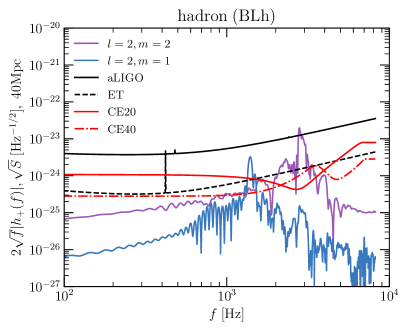
- 对于 $40\text{ km}$ Cosmic Explorer 探测器,$l=2,m=1$ 模式的信噪比从纯强子情形的 2.14 降低至强子-夸克情形的 1.08,抑制因子约为 2。
- $l=2,m=1$ 引力波峰(1–2 kHz)和 $l=2,m=2$ 峰(2–4 kHz)分别位于 $40\text{ km}$ 和 $20\text{ km}$ Cosmic Explorer 配置的最敏感频带内。
- $l=2,m=1$ 模式的抑制由动力学时标(约 10 ms)主导,表明这是抑制不稳定的主导机制,且独立于更长时标效应。
- 未来工作需进一步探索质量比、中微子输运和交叉过渡的联合效应,以全面验证所观察到的反相关性的稳健性。
阅读本论文
在 Nubint 阅读器中打开原文,边读边就任意段落提问。
在 Nubint 中阅读本论文本解读由 AI 根据论文原文生成,引用前请核对原文。