
[论文解读] Revisiting oldest stars as cosmological probes: new constraints on the Hubble constant
本研究将最古老的恒星——球状星团、白矮星和超昏暗星系作为独立的宇宙学探针,以约束哈勃常数 $H_0$。在平坦 $\Lambda$CDM 模型下,采用贝叶斯推断方法,对形成红移施加保守的先验($11 \leq z_f \leq 30$),并结合 $\Omega_{\rm M} = 0.30 \pm 0.02$,基于最精确的单个年龄估计得出 $H_0 < 70.6$ km/s/Mpc,而在对子样本平均时,90.3% 置信水平下 $H_0 < 73.0$ km/s/Mpc,结果更倾向于 Planck2020 的值而非 SH0ES 的结果。
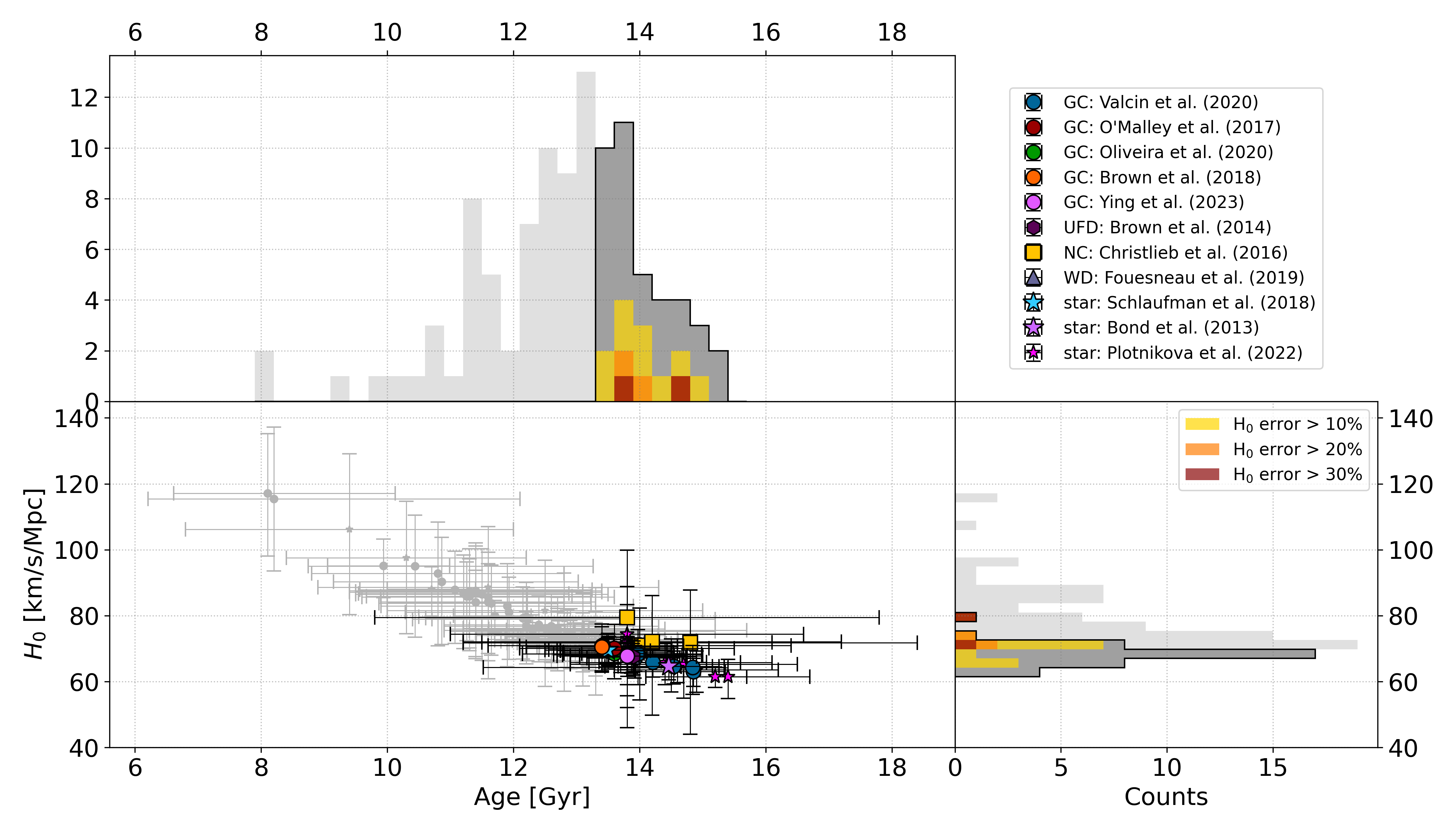
Despite the tremendous advance of observational cosmology, the value of the Hubble constant ($H_0$) is still controversial (the so called ``Hubble tension'') because of the inconsistency between local/late-time measurements and those derived from the cosmic microwave background. As the age of the Universe is very sensitive to $H_0$, we explored whether the present-day oldest stars could place independent constraints on the Hubble constant. To this purpose, we selected from the literature the oldest objects (globular clusters, stars, white dwarfs, ultra-faint and dwarf spheroidal galaxies) with accurate age estimates. Adopting a conservative prior on their formation redshifts ($11 \leq z_{ m f} \leq 30$) and assuming $Ω_{ m M} = 0.3 \pm 0.02$, we developed a method based on Bayesian statistics to estimate the Hubble constant. We selected the oldest objects ($>13.3$ Gyr) and estimated $H_0$ both for each of them individually and for the average ages of homogeneous subsamples. Statistical and systematic uncertainties were properly taken into account. The constraints based on individual ages indicate that $H_0<70.6$ km/s/Mpc when selecting the most accurate estimates. If the ages are averaged and analyzed independently for each subsample, the most stringent constraints imply $H_0<73.0$ with a probability of 90.3% and errors around 2.5 km/s/Mpc. We also constructed an ``accuracy matrix'' to assess how the constraints on $H_0$ become more stringent with further improvements in the accuracy of stellar ages and $Ω_{ m M}$. The results show the high potential of the oldest stars as independent and competitive cosmological probes not only limited to the Hubble constant.
研究动机与目标
- 评估最古老恒星作为独立宇宙学探针以约束哈勃常数 $H_0$ 的潜力。
- 通过利用最古老可观测天体的年龄(必须比宇宙年龄更年轻)来解决哈勃张力问题。
- 构建一个贝叶斯框架,以考虑恒星年龄估计和宇宙学参数中的统计与系统不确定性。
- 量化年龄和 $\Omega_{\rm M}$ 精度提升对 $H_0$ 约束的改善程度。
- 评估观测到的恒星年龄与晚期宇宙($H_0$)和早期宇宙($H_0$)测量值(特别是 Planck2020 与 SH0ES)的兼容性。
提出的方法
- 在平坦 $\Lambda$CDM 模型下,应用贝叶斯推断,利用最古老恒星的年龄估计 $H_0$。
- 对形成红shift $z_f \in [11, 30]$ 施加保守的均匀先验,以最小化模型依赖性。
- 对 $\Omega_{\rm M} = 0.30 \pm 0.02$ 使用高斯先验,其依据来自独立于 CMB 数据的晚期宇宙探测。
- 采用积分关系 $H_0 = A / t \int_0^{z_f} [\Omega_{\rm M}(1+z)^3 + (1 - \Omega_{\rm M})]^{-1/2} dz$ 将年龄 $t$ 与 $H_0$ 关联。
- 分析 39 个年龄超过 13.3 Gyr 的天体,分别计算其 $H_0$ 值,并在同质子样本(如球状星团、白矮星)中进行平均。
- 构建一个“精度矩阵”,以预测未来恒星年龄和 $\Omega_{\rm M}$ 不确定性降低后对 $H_0$ 约束的收紧程度。

实验结果
研究问题
- RQ1现今宇宙中最古老恒星的年龄能否为哈勃常数 $H_0$ 提供独立约束?
- RQ2恒星年龄估计中的系统不确定性如何影响推导出的 $H_0$ 值?这些不确定性能否被缓解?
- RQ3观测到的最古老恒星年龄与 Planck CMB 和 SH0ES 局域测量得到的 $H_0$ 值在多大程度上兼容?
- RQ4未来恒星年龄精度的提升在多大程度上可减少 $H_0$ 的不确定性?
- RQ5最古老恒星能否帮助区分标准 $\Lambda$CDM 模型与试图解决哈勃张力的早期暗能量模型?
主要发现
- 最精确的单个年龄估计得出 $H_0 < 70.6$ km/s/Mpc,具有高置信度,倾向于更低的 $H_0$ 值。
- 在同质子样本中对年龄进行平均后,$H_0$ 的 90.3% 可信上限为 $73.0$ km/s/Mpc,低于 SH0ES 的 $73.04 \pm 1.04$ km/s/Mpc。
- 结果强烈倾向于 Planck2020 的 $H_0$ 值($67.4 \pm 0.5$ km/s/Mpc)而非 SH0ES 的值,依据是宇宙中最古老恒星的年龄。
- 来自 $\Omega_{\rm M}$ 先验的系统不确定性最多贡献 $\sigma_{\rm syst} = 2.37$ km/s/Mpc,表明该方法对先验假设具有鲁棒性。
- 精度矩阵显示,若将恒星年龄不确定性降低至 $\lesssim 0.3-0.4$ Gyr,$H_0$ 的约束可收紧至 $\sim 1-2$ km/s/Mpc,使其与其他宇宙学探针具有可比性。
- 本研究证明,最古老恒星不仅是可行的,而且是极具前景的宇宙学探针,具有约束 $H_0$ 和检验早期暗能量等模型的潜力。
阅读本论文
在 Nubint 阅读器中打开原文,边读边就任意段落提问。
在 Nubint 中阅读本论文本解读由 AI 根据论文原文生成,引用前请核对原文。