
[论文解读] ReWOO: Decoupling Reasoning from Observations for Efficient Augmented Language Models
ReWOO 将推理与工具观测分离,在增强语言模型中显著降低标记(token)使用,同时在多步 NLP 任务中保持或提升准确性,并实现小模型的推理专门化。
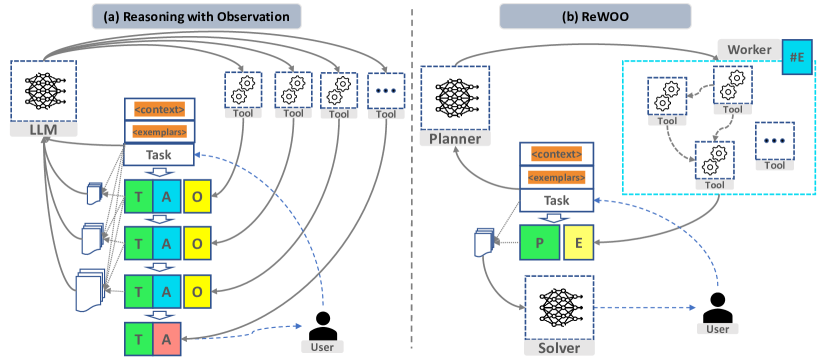
Augmented Language Models (ALMs) blend the reasoning capabilities of Large Language Models (LLMs) with tools that allow for knowledge retrieval and action execution. Existing ALM systems trigger LLM thought processes while pulling observations from these tools in an interleaved fashion. Specifically, an LLM reasons to call an external tool, gets halted to fetch the tool's response, and then decides the next action based on all preceding response tokens. Such a paradigm, though straightforward and easy to implement, often leads to huge computation complexity from redundant prompts and repeated execution. This study addresses such challenges for the first time, proposing a modular paradigm ReWOO (Reasoning WithOut Observation) that detaches the reasoning process from external observations, thus significantly reducing token consumption. Comprehensive evaluations across six public NLP benchmarks and a curated dataset reveal consistent performance enhancements with our proposed methodology. Notably, ReWOO achieves 5x token efficiency and 4% accuracy improvement on HotpotQA, a multi-step reasoning benchmark. Furthermore, ReWOO demonstrates robustness under tool-failure scenarios. Beyond prompt efficiency, decoupling parametric modules from non-parametric tool calls enables instruction fine-tuning to offload LLMs into smaller language models, thus substantially reducing model parameters. Our illustrative work offloads reasoning ability from 175B GPT3.5 into 7B LLaMA, demonstrating the significant potential for truly efficient and scalable ALM systems.
研究动机与目标
- 通过将推理与观测分离,激励在工具增强的LLM工作流中减少标记冗余。
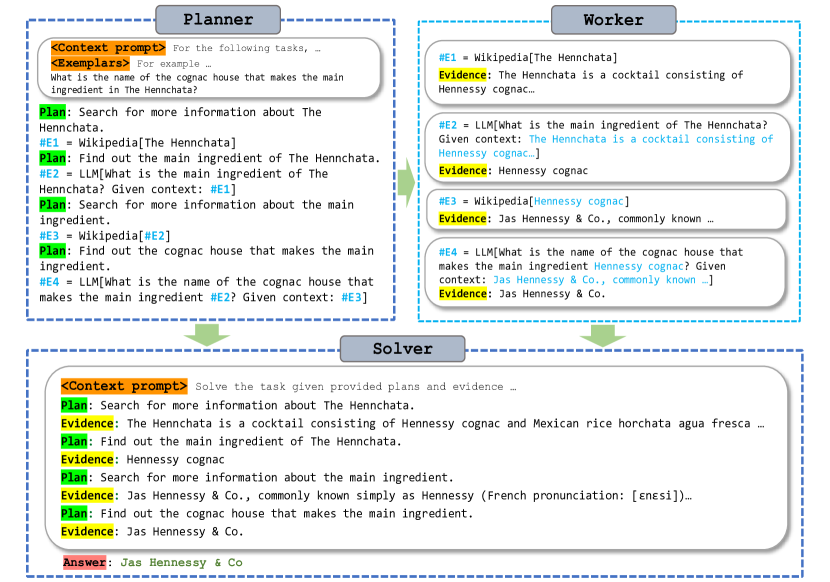
- 提出一个模块化的 Planner-Worker-Solver 框架(ReWOO),以将推理与工具反馈解耦。
- 量化在多样基准上的标记效率提升和准确性提升。
- 展示对工具故障的鲁棒性,并展示通过专业化将推理外包给更小模型的潜力。
提出的方法
- 引入 Planner-Worker-Solver 架构,用于分离推理、工具调用和证据综合。
- 提供形式化的提示-令牌分析,显示相较于依赖观测的提示,标记使用量降低。
- 使用示例和多样化工具集,在工具响应前进行规划。
- 通过指令微调,将可预见的推理外包给更小的LLM(Planner 7B)以实现专业化。
- 使用多个基准(HotpotQA、TriviaQA、GSM8K、StrategyQA、PhysicsQA、SportsUnderstanding、SOTUQA)进行评估,并以 GPT-3.5-turbo 作为基线。
实验结果
研究问题
- RQ1将推理与观测解耦是否可以在不牺牲准确性的前提下降低ALMs的标记成本?
- RQ2在多步NLP任务中,ReWOO 相对于 ReAct 和直接提示的表现如何?
- RQ3在多大程度上可以通过专业化将可预见的推理外包给更小的模型?
- RQ4ReWOO 对工具故障和额外工具的鲁棒性如何?
- RQ5对话中的 RLHF 对这种范式下的性能有什么影响?
主要发现
- 在六个NLP基准上,ReWOO 平均将标记使用减少了64%。
- 相较于 ReAct,ReWOO 平均在绝对准确率上提升4.4个百分点。
- 在 SOTUQA 上,ReWOO 以 43% 更少的标记使用量,绝对准确率比 ReAct 高8个百分点。
- 在工具失败情景下,ReWOO 维持鲁棒性,工具失败时的退化程度低于 ReAct。
- 专业化可以使基于7B LLaMA 的 Planner 在若干基准上达到与GPT-3.5 25倍规模的性能相当。
- 在各基准上,ReWOO 展现出一致的性能,同时提示成本显著降低。
阅读本论文
在 Nubint 阅读器中打开原文,边读边就任意段落提问。
在 Nubint 中阅读本论文本解读由 AI 根据论文原文生成,引用前请核对原文。