
[论文解读] RoboScript: Code Generation for Free-Form Manipulation Tasks across Real and Simulation
RoboScript 引入了一个统一的代码生成流程,将高层语言指令无缝连接到仿真和真实世界部署的可执行机器人控制代码。通过与 ROS、Gazebo 和 MoveIt 集成,它实现了从自然语言到运动规划的端到端执行。消融研究显示,感知噪声可导致性能下降高达 15.0%,凸显了准确感知在真实世界机器人自主中的关键作用。
Rapid progress in high-level task planning and code generation for open-world robot manipulation has been witnessed in Embodied AI. However, previous studies put much effort into general common sense reasoning and task planning capabilities of large-scale language or multi-modal models, relatively little effort on ensuring the deployability of generated code on real robots, and other fundamental components of autonomous robot systems including robot perception, motion planning, and control. To bridge this ``ideal-to-real'' gap, this paper presents extbf{RobotScript}, a platform for 1) a deployable robot manipulation pipeline powered by code generation; and 2) a code generation benchmark for robot manipulation tasks in free-form natural language. The RobotScript platform addresses this gap by emphasizing the unified interface with both simulation and real robots, based on abstraction from the Robot Operating System (ROS), ensuring syntax compliance and simulation validation with Gazebo. We demonstrate the adaptability of our code generation framework across multiple robot embodiments, including the Franka and UR5 robot arms, and multiple grippers. Additionally, our benchmark assesses reasoning abilities for physical space and constraints, highlighting the differences between GPT-3.5, GPT-4, and Gemini in handling complex physical interactions. Finally, we present a thorough evaluation on the whole system, exploring how each module in the pipeline: code generation, perception, motion planning, and even object geometric properties, impact the overall performance of the system.
研究动机与目标
- 通过实现从自然语言指令到可部署代码生成,弥合机器人操作中‘理想’与‘现实’之间的差距。
- 开发一个统一的流程,通过 ROS 抽象支持仿真(Gazebo)和真实机器人(Franka、UR5)。
- 创建一个基准,用于评估在物理空间、约束和物体属性方面的推理能力,超越语义理解。
- 评估感知准确性、运动规划鲁棒性以及几何属性对系统性能的影响。
- 通过支持 conda 兼容的 ROS(Robostack),实现在多种机器人本体和夹爪类型之间的无缝部署。
提出的方法
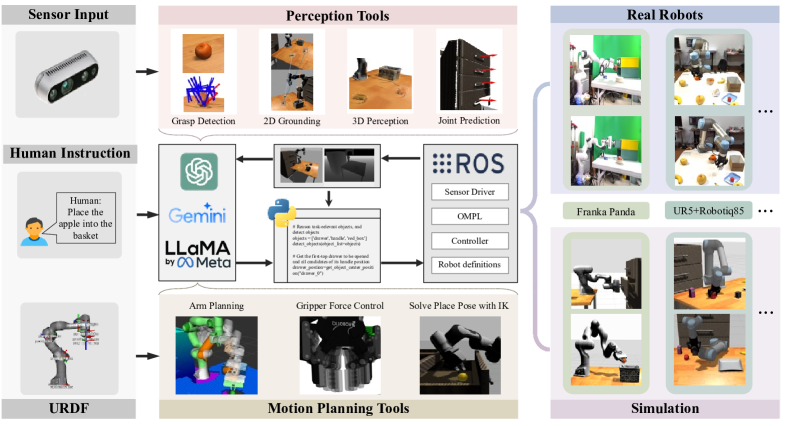
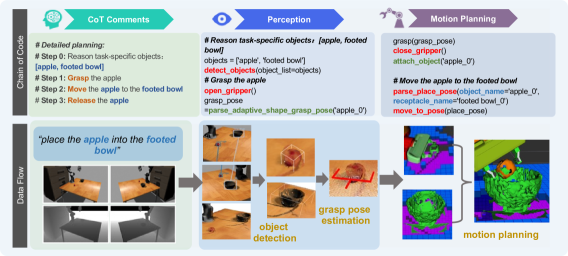
- 该框架采用模块化流程:输入来自 RGBD 传感器和自然语言指令,经由感知工具(如 AnyGrasp 用于抓取位姿预测)和多视角融合的 3D 场景重建进行处理。
- 感知输出通过 MoveIt 输入到运动规划中,利用逆运动学和碰撞避免生成轨迹。
- 所有代码使用大语言模型(GPT-3.5、GPT-4、Gemini)生成,并通过 Gazebo 中的语法验证和仿真测试确保可部署性。
- 基于 ROS 的代码生成测试接口确保语法正确性,并可通过 conda 兼容的 Robostack 实现直接部署到真实机器人。
- 感知闭环流程将预测的抓取位姿和边界框作为规划输入,模拟真实世界中的感知误差。
- 全面的基准测试评估了在物理约束、工作空间限制和物体几何形状方面的推理能力,同时提供真实数据以减轻噪声影响。
实验结果
研究问题
- RQ1感知噪声在真实机器人部署中如何影响运动规划的成功率?
- RQ2GPT-4 和 Gemini 等大语言模型在物理约束和物体属性推理方面相较于 GPT-3.5 的优势有多大?
- RQ3感知、规划与控制的集成如何影响真实世界机器人操作中的端到端任务成功率?
- RQ4机器人形态(如 Franka 与 UR5)和夹爪类型对代码生成和任务执行有何影响?
- RQ5统一的代码生成流程能否确保在多样化机器人平台之间可靠的仿真到真实迁移?
主要发现
- 感知噪声分别导致抓取-放置和打开抽屉任务的成功率下降 14.0% 和 15.0%,表明感知是主要瓶颈。
- 错误的 2D 定位导致错误的 3D 边界框,错误地包含了机械臂本身,导致 MoveIt 中出现无法解决的自碰撞问题,最终引发运动规划失败。
- GPT-4 在物理约束和物体几何推理方面优于 GPT-3.5 和 Gemini,尤其在复杂空间推理任务中表现更优。
- 该系统在 Franka Panda 和 UR5 上均成功实现真实世界部署,使用 Robotiq 85 夹爪,验证了统一流程在不同硬件平台上的有效性。
- MoveIt 运动规划对检测误差高度敏感,尤其当物体边界框被扩大并包含机器人自身网格时。
- 消融研究证实,感知不准确对性能的影响大于运动规划或控制误差,凸显了在真实系统中对鲁棒感知的迫切需求。
阅读本论文
在 Nubint 阅读器中打开原文,边读边就任意段落提问。
在 Nubint 中阅读本论文本解读由 AI 根据论文原文生成,引用前请核对原文。