
[论文解读] Robust Failure Diagnosis of Microservice System through Multimodal Data
该论文提出 DiagFusion,一种针对微服务系统的鲁棒故障诊断方法,通过使用 fastText 嵌入和依赖图上的图神经网络(GNNs),统一多模态数据(追踪记录、日志、指标)。相比现有方法,其在根因定位上提升 20.9% 至 368%,在故障类型检测上提升 11.0% 至 169%,并利用数据增强技术缓解类别不平衡问题。
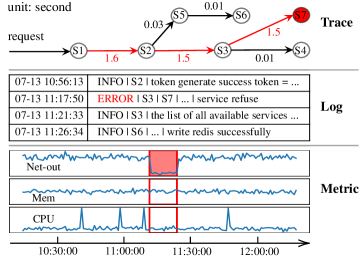
Automatic failure diagnosis is crucial for large microservice systems. Currently, most failure diagnosis methods rely solely on single-modal data (i.e., using either metrics, logs, or traces). In this study, we conduct an empirical study using real-world failure cases to show that combining these sources of data (multimodal data) leads to a more accurate diagnosis. However, effectively representing these data and addressing imbalanced failures remain challenging. To tackle these issues, we propose DiagFusion, a robust failure diagnosis approach that uses multimodal data. It leverages embedding techniques and data augmentation to represent the multimodal data of service instances, combines deployment data and traces to build a dependency graph, and uses a graph neural network to localize the root cause instance and determine the failure type. Our evaluations using real-world datasets show that DiagFusion outperforms existing methods in terms of root cause instance localization (improving by 20.9% to 368%) and failure type determination (improving by 11.0% to 169%).
研究动机与目标
- 为解决单模态故障诊断在微服务系统中的局限性,此类方法常因数据覆盖不全而遗漏故障模式。
- 克服将异构多模态数据(追踪记录、日志、指标)统一表示为一种信息丰富且一致的表示方式以支持诊断的挑战。
- 缓解训练数据中故障类型不平衡的影响,该问题会阻碍模型泛化能力和性能表现。
- 将系统拓扑(通过依赖图表示)与实例级事件表示相结合,以实现更精确的根因定位。
提出的方法
- 使用轻量级解析和模式识别技术从追踪记录、日志和指标中提取事件。
- 应用 fastText 嵌入将不同模态的事件表示统一映射到共享向量空间。
- 利用追踪记录和部署数据构建依赖图,以建模服务间交互关系和故障传播路径。
- 在训练过程中采用数据增强技术,以平衡罕见故障类型并提升模型鲁棒性。
- 使用图神经网络(GNN)将事件嵌入与依赖图进行融合,以推断根因实例和故障类型。
- 采用端到端训练策略,联合优化根因定位与故障类型分类任务。
实验结果
研究问题
- RQ1在真实微服务系统中,与单模态方法相比,结合多模态数据(追踪记录、日志、指标)是否能显著提升故障诊断准确率?
- RQ2如何有效将异构数据格式(时间序列、文本、树状追踪记录)统一为统一的表示形式以支持诊断?
- RQ3数据增强在多大程度上可以缓解微服务故障数据集中因故障类型不平衡导致的性能下降问题?
- RQ4与忽略架构关系的方法相比,通过依赖图引入系统拓扑在多大程度上能提升根因定位的准确性?
主要发现
- 与最先进的单模态和多模态方法相比,DiagFusion 在根因实例定位准确率上提升了 20.9% 至 368%。
- 相比现有方法,故障类型判定性能提升 11.0% 至 169%,展现出更优的分类性能。
- 使用 fastText 嵌入实现了有效的跨模态表示学习,能够捕捉日志、追踪记录和指标之间的语义与时间模式。
- 数据增强显著提升了模型在罕见故障类型上的泛化能力,降低了在不平衡数据集上的性能下降。
- 将 GNN 与依赖图结合,通过建模故障传播路径,实现了更精确的故障定位。
- 即使仅提供三类模态中的两类,DiagFusion 仍能保持优异性能,展现出良好的鲁棒性和实际可部署性。
阅读本论文
在 Nubint 阅读器中打开原文,边读边就任意段落提问。
在 Nubint 中阅读本论文本解读由 AI 根据论文原文生成,引用前请核对原文。