
[论文解读] RoPINN: Region Optimized Physics-Informed Neural Networks
该论文提出RoPINN,一种区域优化的物理信息神经网络,通过将优化从离散点扩展到连续邻域区域,提升PINN训练效果,降低泛化误差并增强高阶约束满足。通过使用自适应信任区域校准的蒙特卡洛采样,RoPINN在19项多样化的PDE任务中实现性能提升,且无需额外梯度计算。
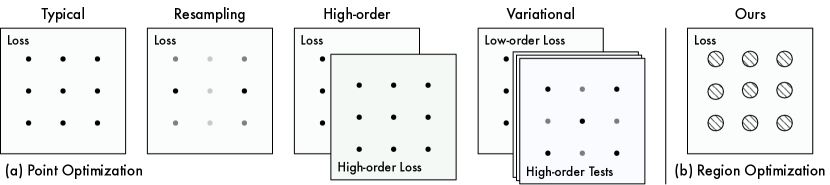
Physics-informed neural networks (PINNs) have been widely applied to solve partial differential equations (PDEs) by enforcing outputs and gradients of deep models to satisfy target equations. Due to the limitation of numerical computation, PINNs are conventionally optimized on finite selected points. However, since PDEs are usually defined on continuous domains, solely optimizing models on scattered points may be insufficient to obtain an accurate solution for the whole domain. To mitigate this inherent deficiency of the default scatter-point optimization, this paper proposes and theoretically studies a new training paradigm as region optimization. Concretely, we propose to extend the optimization process of PINNs from isolated points to their continuous neighborhood regions, which can theoretically decrease the generalization error, especially for hidden high-order constraints of PDEs. A practical training algorithm, Region Optimized PINN (RoPINN), is seamlessly derived from this new paradigm, which is implemented by a straightforward but effective Monte Carlo sampling method. By calibrating the sampling process into trust regions, RoPINN finely balances optimization and generalization error. Experimentally, RoPINN consistently boosts the performance of diverse PINNs on a wide range of PDEs without extra backpropagation or gradient calculation. Code is available at this repository: https://github.com/thuml/RoPINN.
研究动机与目标
- 为解决PINNs仅在离散点上优化的固有局限性,这些点可能在连续PDE定义域上泛化能力不足。
- 通过从基于点的优化转向基于区域的优化,降低泛化误差,特别是针对隐藏的高阶PDE约束。
- 开发一种实用且高效的训练算法,保持与现有PINN主干网络和优化器的兼容性。
- 通过自适应信任区域校准实现采样效率与估计精度之间的平衡,调节区域大小。
提出的方法
- 提出一种名为区域优化的新训练范式,将PINN损失最小化从孤立点扩展至连续邻域区域。
- 推导出一种实用算法RoPINN,利用蒙特卡洛采样近似基于区域的损失函数。
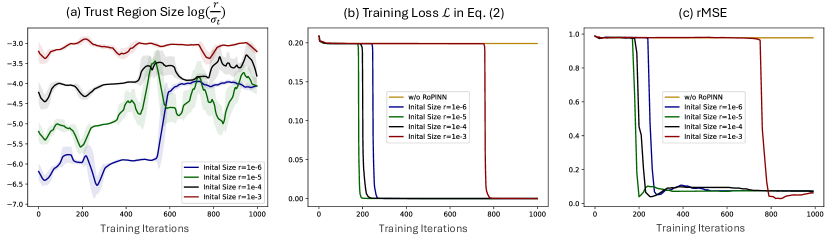
- 引入一种信任区域校准策略,根据训练迭代过程中梯度方差自适应调整采样区域大小。
- 采用采样区域内残差损失的L2范数作为目标函数,替代点级损失最小化。
- 采用动态区域大小更新规则,根据前序迭代中梯度的方差缩小或扩大区域。
- 通过避免额外反向传播或梯度计算,保持与标准PINN框架的兼容性。
实验结果
研究问题
- RQ1将PINN的优化从孤立点扩展到连续区域,能否降低PDE解的泛化误差?
- RQ2与基于点的训练相比,基于区域的优化如何影响高阶PDE约束的满足程度?
- RQ3基于采样的区域优化方法能否在不引入额外梯度计算的情况下实现更优性能?
- RQ4自适应信任区域校准对基于区域训练的稳定性和收敛性有何影响?
- RQ5该区域优化范式在多种PDE类型和网络架构中表现如何?
主要发现
- RoPINN在19项不同的PDE任务中均实现一致的性能提升,其中至少在一个主干配置下,100%的任务均表现出改进。
- 在二维对流-扩散问题中,与使用标准主干的基线PINN相比,RoPINN将测试损失降低了63.1%。
- 在三维对流-扩散问题中,RoPINN相比标准PINN将测试损失降低了163.6%,展现出在高维PDE上的强大性能。
- 在二维纳维-斯托克斯问题中,与基线相比,RoPINN将测试损失降低了69.7%,凸显其在复杂流体动力学方程上的有效性。
- 该方法在标准主干和基于Transformer的PINN主干上均提升了性能,显示出广泛的兼容性与泛化能力。
- 对于基于Transformer的模型,表现出改进的任务比例达到93.8%,表明在各类架构中均实现强大且一致的性能增益。
阅读本论文
在 Nubint 阅读器中打开原文,边读边就任意段落提问。
在 Nubint 中阅读本论文本解读由 AI 根据论文原文生成,引用前请核对原文。