
[论文解读] S4Fusion: Saliency-aware Selective State Space Model for Infrared Visible Image Fusion
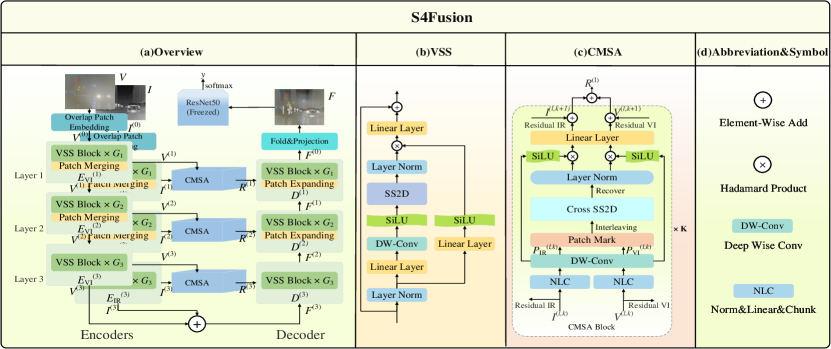
S4Fusion 提出了一种显著性感知的可选状态空间模型用于红外-可见光图像融合,引入了跨模态空间感知(CMSA)模块,以线性复杂度联合捕捉全局空间与跨模态交互。通过最小化预训练 ResNet50 决策层中的不确定性,该方法自适应地增强显著目标,在融合质量与下游检测任务中均优于当前最先进方法。
As one of the tasks in Image Fusion, Infrared and Visible Image Fusion aims to integrate complementary information captured by sensors of different modalities into a single image. The Selective State Space Model (SSSM), known for its ability to capture long-range dependencies, has demonstrated its potential in the field of computer vision. However, in image fusion, current methods underestimate the potential of SSSM in capturing the global spatial information of both modalities. This limitation prevents the simultaneous consideration of the global spatial information from both modalities during interaction, leading to a lack of comprehensive perception of salient targets. Consequently, the fusion results tend to bias towards one modality instead of adaptively preserving salient targets. To address this issue, we propose the Saliency-aware Selective State Space Fusion Model (S4Fusion). In our S4Fusion, the designed Cross-Modal Spatial Awareness Module (CMSA) can simultaneously focus on global spatial information from both modalities while facilitating their interaction, thereby comprehensively capturing complementary information. Additionally, S4Fusion leverages a pre-trained network to perceive uncertainty in the fused images. By minimizing this uncertainty, S4Fusion adaptively highlights salient targets from both images. Extensive experiments demonstrate that our approach produces high-quality images and enhances performance in downstream tasks.
研究动机与目标
- 为解决现有融合模型在交互过程中无法同时捕捉全局空间与跨模态信息的局限性。
- 通过基于人类视觉感知的可选自适应融合,增强显著目标的感知能力。
- 通过利用预训练网络决策层中的不确定性最小化,减少融合结果中的模态偏差。
- 设计一种单阶段融合模块,以线性复杂度高效整合全局空间与模态间信息。
- 通过全面的消融实验、定性分析、定量评估及下游任务验证方法的优越性。
提出的方法
- 提出跨模态空间感知(CMSA)模块,利用可选状态空间机制,同时建模模态内空间特征与模态间交互。
- 引入感知增强损失函数,通过最小化预训练 ResNet50 决策层中的不确定性,引导模型突出显著结构。
- 采用多尺度网络架构,在编码器与解码器中均使用 S4 块,特征细化采用 G=[1,2,1] 配置。
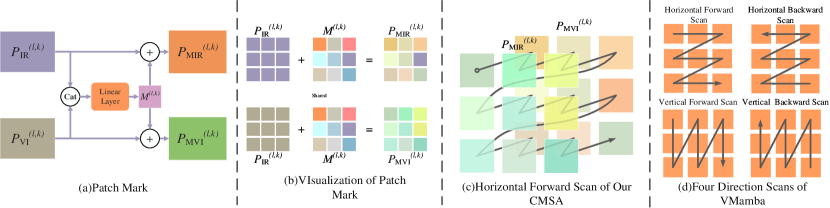
- 在跨模态-SS2D 注意力机制中引入 Patch Mark,以区分空间与跨模态交互,提升特征解耦能力。
- 在单阶段融合框架中应用 CMSA 模块,实现具备全局上下文感知能力的端到端学习。
- 利用 ResNet50 的预训练特征作为监督信号,引导融合网络实现类人对显著内容的感知。
实验结果
研究问题
- RQ1融合模型能否在跨模态交互过程中有效捕捉来自红外与可见光模态的全局空间上下文?
- RQ2如何利用预训练网络决策层中的不确定性来引导融合图像中显著性的自适应增强?
- RQ3所提出的 CMSA 模块是否在保留纹理与显著目标信息方面优于现有注意力或融合模块?
- RQ4与手工设计的损失函数相比,感知增强损失在提升融合质量与下游任务性能方面有多大改善?
- RQ5若缺失 Patch Mark 或关键组件,模型在保留保真度与互补信息方面的能力会受到何种影响?
主要发现
- S4Fusion 在三个基准数据集(FLIR、TILRD、M3FD)上达到最先进性能,SSIM、AG、SF 与 Qabf 指标均高于所有对比方法。
- 在 M3FD 数据集上,多模态目标检测的 mAP@50 达到 82.1,优于 U2Fusion、DeFusion 与 EMMA。
- 消融实验表明,移除感知增强损失会导致性能显著下降,验证了其在显著性增强中的关键作用。
- 将 CMSA 替换为 ADD、Cross Attention、CNN 或 FSSM 均导致性能下降,其中 Cross Attention 与 FSSM 在全局上下文建模方面表现尤为失败。
- 可视化结果表明,CMSA 在后处理中同时提升了可见光与红外特征,显著目标表征更清晰,背景一致性更优。
- 在 CMSA 中移除 Patch Mark 导致信息保留与融合保真度明显下降,证实其在解耦空间与跨模态交互中的重要性。
阅读本论文
在 Nubint 阅读器中打开原文,边读边就任意段落提问。
在 Nubint 中阅读本论文本解读由 AI 根据论文原文生成,引用前请核对原文。