
[论文解读] SafePowerGraph: Safety-aware Evaluation of Graph Neural Networks for Transmission Power Grids
SafePowerGraph 是一种面向输电网络中图神经网络(GNN)的仿真器无关、面向安全的基准框架,整合了四种主流的潮流(PF)与最优潮流(OPF)仿真器,用于评估 GNN 在真实世界安全关键场景(如线路跳闸和电价波动)下的鲁棒性。结果表明,自监督学习与图注意力网络(GAT)能显著提升 GNN 的鲁棒性,其中 GAT 模型在电价波动下可将物理约束违规减少多达六个数量级。
Power grids are critical infrastructures of paramount importance to modern society and their rapid evolution and interconnections has heightened the complexity of power systems (PS) operations. Traditional methods for grid analysis struggle with the computational demands of large-scale RES and ES integration, prompting the adoption of machine learning (ML) techniques, particularly Graph Neural Networks (GNNs). GNNs have proven effective in solving the alternating current (AC) Power Flow (PF) and Optimal Power Flow (OPF) problems, crucial for operational planning. However, existing benchmarks and datasets completely ignore safety and robustness requirements in their evaluation and never consider realistic safety-critical scenarios that most impact the operations of the power grids. We present SafePowerGraph, the first simulator-agnostic, safety-oriented framework and benchmark for GNNs in PS operations. SafePowerGraph integrates multiple PF and OPF simulators and assesses GNN performance under diverse scenarios, including energy price variations and power line outages. Our extensive experiments underscore the importance of self-supervised learning and graph attention architectures for GNN robustness. We provide at https://github.com/yamizi/SafePowerGraph our open-source repository, a comprehensive leaderboard, a dataset and model zoo and expect our framework to standardize and advance research in the critical field of GNN for power systems.
研究动机与目标
- 解决当前在电力系统运行中对 GNN 缺乏标准化、面向安全的评估问题,特别是在真实、受扰动场景下的表现。
- 克服现有基准(如 LIPS 和 PowerGraph)的局限性,这些基准忽略了仿真器差异、安全关键扰动以及现代自监督学习方法。
- 提供一个统一的开源框架,支持多种 PF 与 OPF 仿真器,并同时评估监督学习误差与物理约束违规。
- 通过引入分布内、电价波动与线路跳闸场景,标准化输电系统中 GNN 的鲁棒性评估。
- 通过发布全面的数据集、模型库与排行榜,推动 GNN 在电力系统研究中的发展,实现可复现且可比较的基准测试。
提出的方法
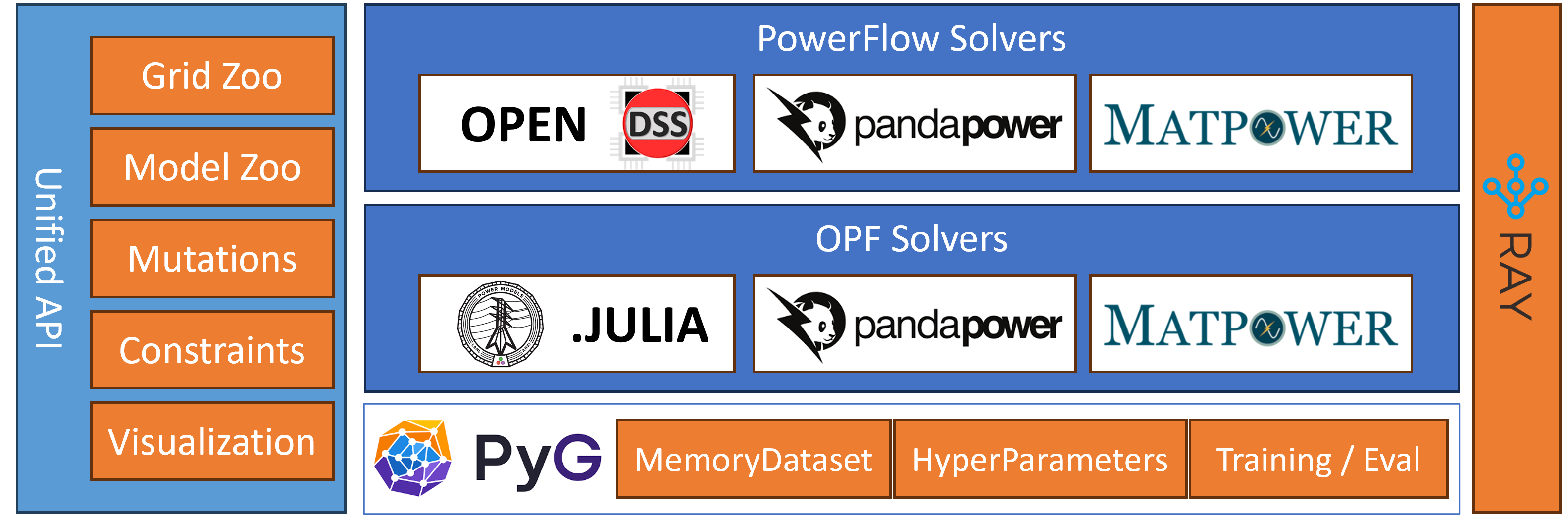
- 设计一种仿真器无关的框架,原生集成四种广泛使用的 PF 与 OPF 仿真器(如 MATPOWER、pandapower 等),以确保在不同工具间的评估可移植性。
- 定义三种评估场景:分布内(ID)场景、电价波动场景与线路跳闸场景,以模拟真实运行中的压力因素。
- 使用监督指标(均方误差)与物理约束违规(如潮流与边界约束违规)双重衡量模型性能。
- 在三种电网规模(9 节点、30 节点、118 节点)下,对多种扰动(如随机线路跳闸与电价波动)进行 GNN 评估。
- 将自监督学习(SSL)与监督学习(SL)结合,评估其对鲁棒性的影响,特别是在分布偏移与类似对抗性扰动下的表现。
- 实现一个全面的评估流程,同时报告预测准确率与物理可行性,支持面向安全的模型选择与分析。
实验结果
研究问题
- RQ1与标准的分布内评估相比,GNN 在真实世界安全关键扰动(如线路跳闸与电价波动)下的表现如何?
- RQ2自监督学习在输电网络中 AC 潮流与最优潮流任务的 GNN 鲁棒性方面,能提升到何种程度?
- RQ3在物理与经济扰动下,GAT、GCN 与 GIN 三种 GNN 架构中,哪一种展现出更优的鲁棒性与约束遵守能力?
- RQ4物理约束违规如何随电网规模与扰动严重性变化?哪些场景最可能导致运行不稳定性?
- RQ5统一的、仿真器无关的基准框架能否提升电力系统中 GNN 研究的可复现性与可比性?
主要发现
- GNN 模型在电价波动下表现出极端脆弱性,118 节点电网在价格波动下,母线潮流预测误差最高可增加六个数量级。
- 图注意力网络(GAT)在所有电网规模与场景下均持续优于 GCN 与 GIN,实现最低的物理约束违规与最高的鲁棒性。
- 自监督学习(SSL)在电价波动与线路跳闸场景下显著提升了 GNN 的鲁棒性,且在分布内数据上无性能下降,在八种场景中的六种中表现更优。
- 电价波动场景导致的约束违规显著多于线路跳闸场景,表明经济波动对运行安全的威胁大于物理网络故障。
- SSL 与 SL 的结合在电价波动场景下可将均方误差(MSE)降低高达 90%,并显著提升约束遵守能力,尤其在大规模电网中表现突出。
- SafePowerGraph 框架成功识别出 GAT 搭配 SSL 在准确率与物理可行性之间实现了最佳平衡,是安全关键电力系统应用中最合适的架构。

阅读本论文
在 Nubint 阅读器中打开原文,边读边就任意段落提问。
在 Nubint 中阅读本论文本解读由 AI 根据论文原文生成,引用前请核对原文。