
[论文解读] Salute the Classic: Revisiting Challenges of Machine Translation in the Age of Large Language Models
本文在大语言模型(LLMs)背景下重新审视了机器翻译中的六个经典挑战,表明尽管LLMs显著降低了对平行语料的依赖,并在长句翻译(最长512词)方面表现出色,但在领域不匹配、罕见词预测、推理效率、低资源语言表现以及与人类对齐的评估方面仍存在持续问题。研究指出,LLMs引入了超越传统神经机器翻译(NMT)的新挑战,亟需改进评估方法与模型可解释性。
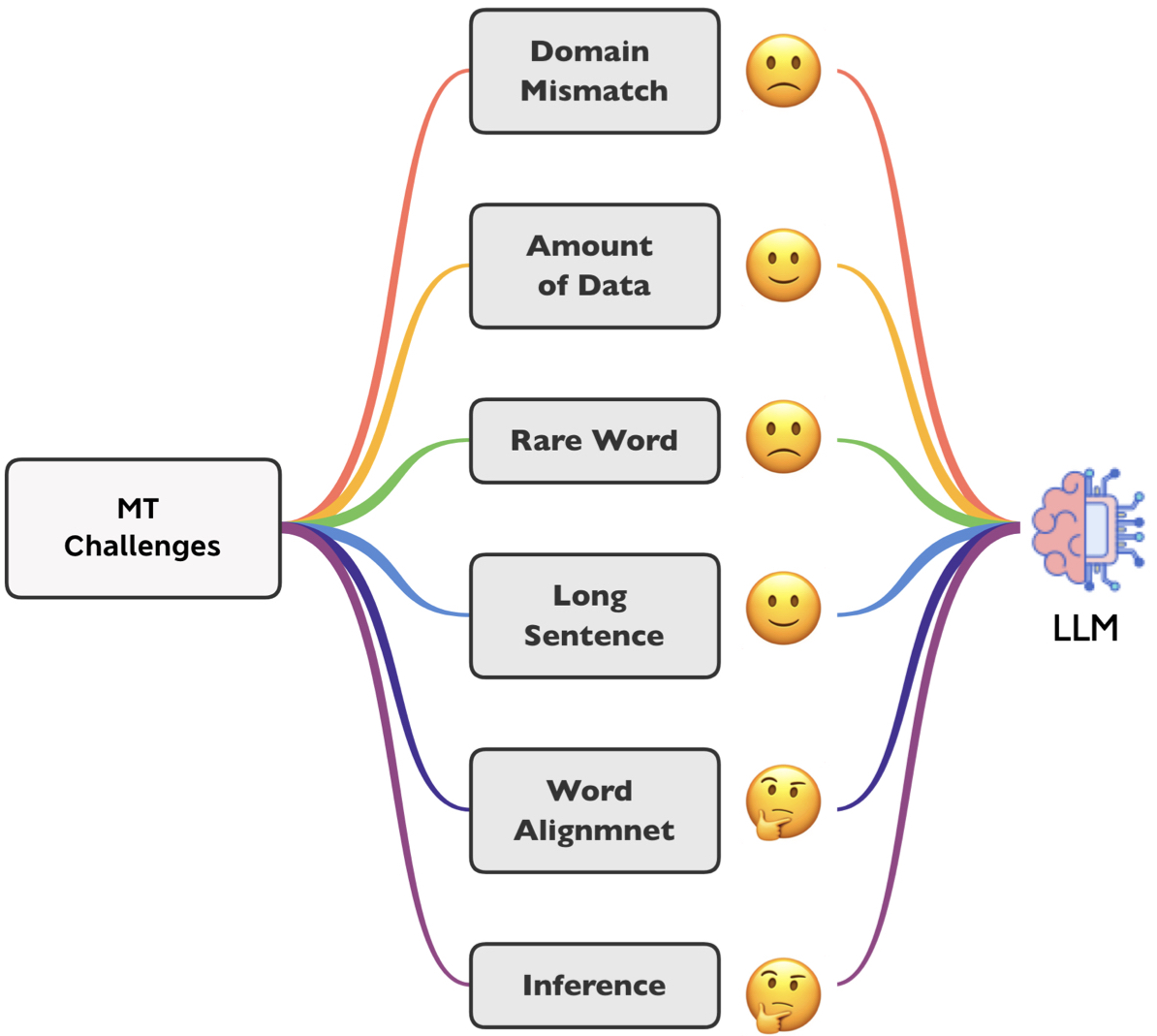
The evolution of Neural Machine Translation (NMT) has been significantly influenced by six core challenges (Koehn and Knowles, 2017), which have acted as benchmarks for progress in this field. This study revisits these challenges, offering insights into their ongoing relevance in the context of advanced Large Language Models (LLMs): domain mismatch, amount of parallel data, rare word prediction, translation of long sentences, attention model as word alignment, and sub-optimal beam search. Our empirical findings indicate that LLMs effectively lessen the reliance on parallel data for major languages in the pretraining phase. Additionally, the LLM-based translation system significantly enhances the translation of long sentences that contain approximately 80 words and shows the capability to translate documents of up to 512 words. However, despite these significant improvements, the challenges of domain mismatch and prediction of rare words persist. While the challenges of word alignment and beam search, specifically associated with NMT, may not apply to LLMs, we identify three new challenges for LLMs in translation tasks: inference efficiency, translation of low-resource languages in the pretraining phase, and human-aligned evaluation. The datasets and models are released at https://github.com/pangjh3/LLM4MT.
研究动机与目标
- 重新评估科恩与诺尔斯(2017)定义的六个经典机器翻译挑战在大语言模型(LLMs)时代的相关性。
- 评估LLMs在传统机器翻译挑战(如领域不匹配、罕见词预测和长序列翻译)上的表现。
- 识别LLM-based翻译中出现的新挑战,包括推理效率、低资源语言表现以及评估差异。
- 比较自动评估(BLEU)与人工评估(MQM)指标,发现两者之间存在中等程度的负相关性(-0.53)。
- 倡导在LLM-based翻译系统中推进以人类为中心的评估与可解释性改进。
提出的方法
- 本研究以Llama2-7b作为基础大语言模型用于德语到英语的翻译任务,利用其在大规模单语数据上的预训练。
- 实验在多个领域(法律、医疗、IT、古兰经、字幕)进行,使用领域内与领域外的测试集评估性能。
- 文档级翻译通过20万条通用领域训练数据集进行评估,并采用sacreBLEU(d-BLEU)进行自动评估。
- 人工评估采用针对文学翻译定制的多维质量指标(MQM),并采用区分大小写的评分方式。
- 使用皮尔逊积矩相关系数计算人工评估(MQM)与自动评估(d-BLEU)之间的相关性。
- 本研究将LLM-based翻译(Llama2-MT)与GPT-4及Google Translate进行对比,以评估相对性能与评估分歧。
实验结果
研究问题
- RQ1LLMs在多大程度上解决了科恩与诺尔斯(2017)定义的六个经典机器翻译挑战?
- RQ2LLMs在领域外翻译任务中的表现如何变化,特别是在术语、风格与幻觉方面?
- RQ3LLMs在翻译中引入了哪些超越经典NMT挑战的新挑战?
- RQ4自动评估指标(如d-BLEU)与人工评估(MQM)在评估LLM-based翻译质量方面有何差异?
- RQ5观察到的人工评估与自动评估之间相关性(r = -0.53)对未来的模型开发有何启示?
主要发现
- 基于LLM的翻译系统显著降低了对高资源语言(如英语和德语)平行训练数据的依赖。
- LLMs在翻译长句(最长80词)和约500词的文档方面表现出一致性能,优于传统NMT在此方面的表现。
- 尽管有所改进,领域不匹配仍是挑战,尤其在法律或宗教文本等领域外文本上出现显著性能下降。
- 罕见词预测仍是持续问题,LLMs常遗漏或错误翻译罕见术语,尤其在低资源领域中更为明显。
- 推理效率是主要瓶颈,LLMs相比标准NMT模型表现出100倍的延迟增加。
- 人工评估(MQM)与自动评估(d-BLEU)之间存在中等程度的负相关性(r = -0.53),表明对翻译质量的感知存在显著差异。

阅读本论文
在 Nubint 阅读器中打开原文,边读边就任意段落提问。
在 Nubint 中阅读本论文本解读由 AI 根据论文原文生成,引用前请核对原文。