
[论文解读] SAM on Medical Images: A Comprehensive Study on Three Prompt Modes
论文在医疗影像上评估 Segment Anything Model (SAM),使用三种提示模式(auto、box、point),覆盖 12 个公开数据集,发现 box 提示实现最佳的零-shot 性能,而盒子大小的抖动和提示点数量显著影响结果。
The Segment Anything Model (SAM) made an eye-catching debut recently and inspired many researchers to explore its potential and limitation in terms of zero-shot generalization capability. As the first promptable foundation model for segmentation tasks, it was trained on a large dataset with an unprecedented number of images and annotations. This large-scale dataset and its promptable nature endow the model with strong zero-shot generalization. Although the SAM has shown competitive performance on several datasets, we still want to investigate its zero-shot generalization on medical images. As we know, the acquisition of medical image annotation usually requires a lot of effort from professional practitioners. Therefore, if there exists a foundation model that can give high-quality mask prediction simply based on a few point prompts, this model will undoubtedly become the game changer for medical image analysis. To evaluate whether SAM has the potential to become the foundation model for medical image segmentation tasks, we collected more than 12 public medical image datasets that cover various organs and modalities. We also explore what kind of prompt can lead to the best zero-shot performance with different modalities. Furthermore, we find that a pattern shows that the perturbation of the box size will significantly change the prediction accuracy. Finally, Extensive experiments show that the predicted mask quality varied a lot among different datasets. And providing proper prompts, such as bounding boxes, to the SAM will significantly increase its performance.
研究动机与目标
- 评估 SAM 在医疗图像分割中的零-shot 泛化能力,使用三种提示模式(auto、box、point)。
- 确定哪种提示模式在多样的医疗成像模态中提供最佳表现。
- 分析提示设计(盒子大小、抖动、点数)如何影响分割精度。
- 探索 SAM 在不同数据集和模态上的表现变异性,为未来医疗基础模型开发提供指导。
提出的方法
- 收集覆盖 CT、X-ray、MRI、内窥镜、超声和 OCT 的 12 个公开医疗影像数据集。
- 评估 SAM 在三种提示模式:auto-prompt、box-prompt、point-prompt。
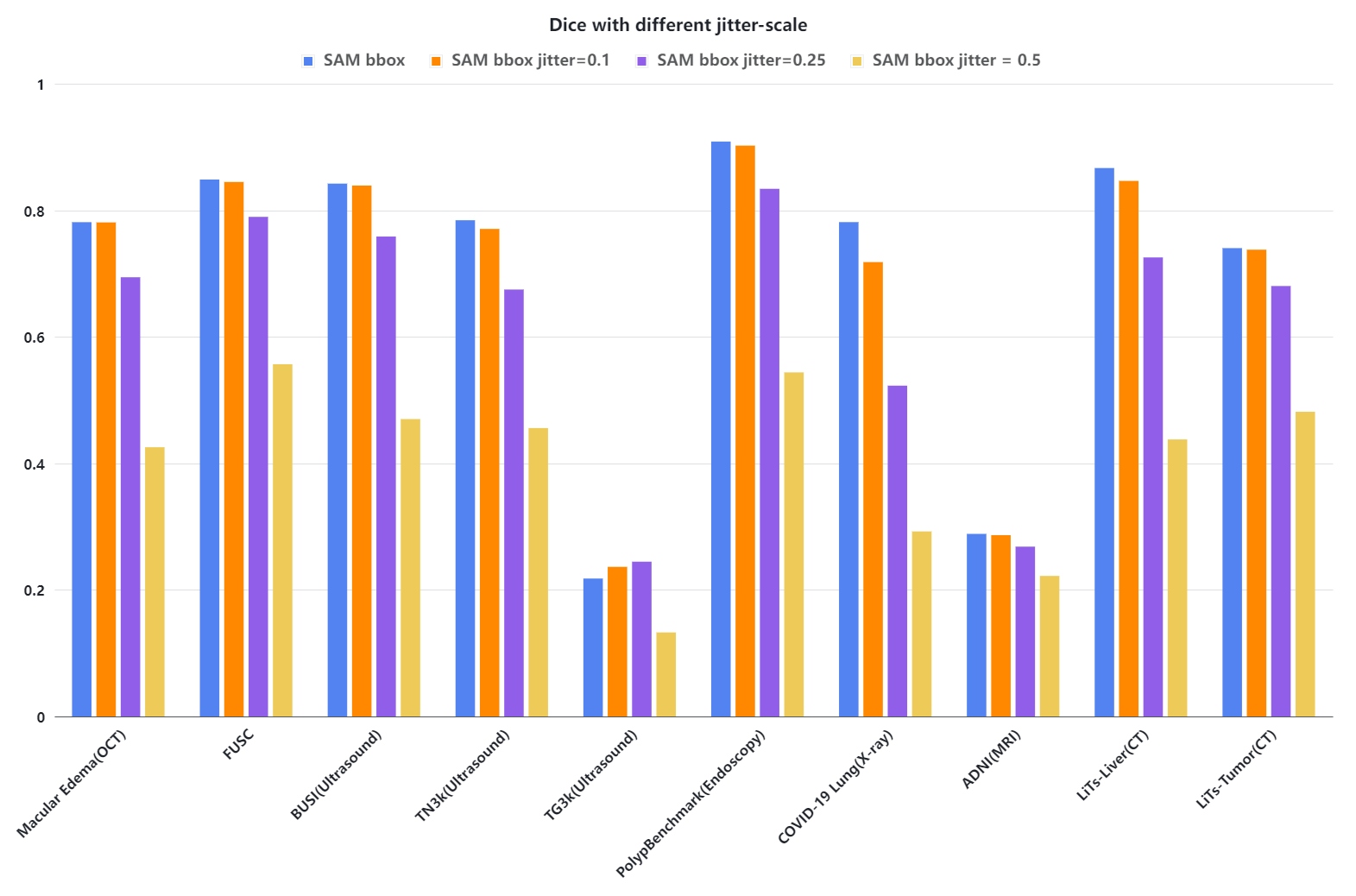
- 对于 box-prompt,输入基于真值框并具有不同抖动尺度的边界框以研究鲁棒性。
- 对于 point-prompt,测试单点、3 点和 10 点提示,观察提示密度如何影响零-shot 性能。
- 将 SAM 零-shot 结果与同一数据集上的最先进监督方法进行比较。
- 分析抖动和提示配置如何影响 dice 分数和分割质量。
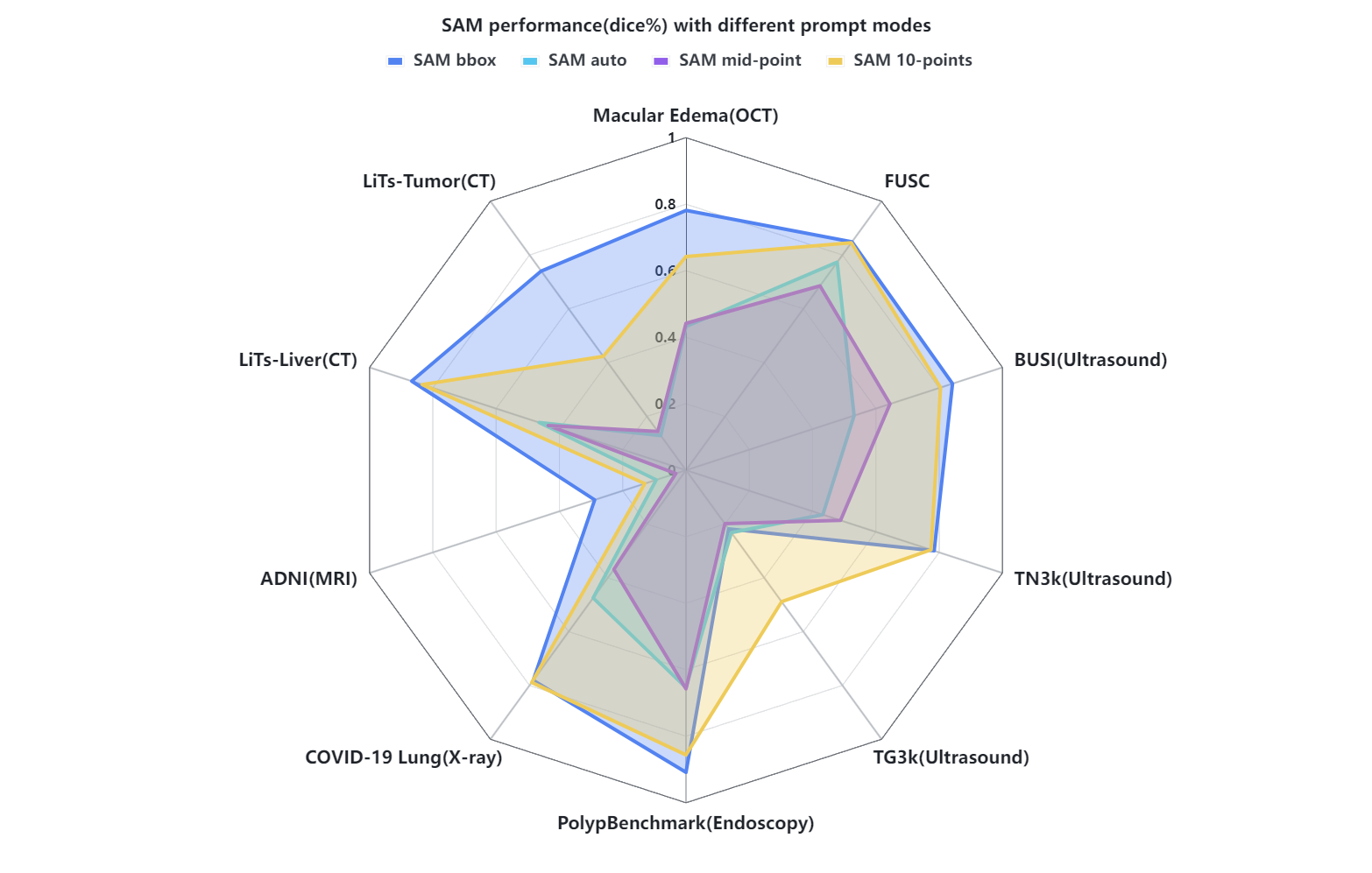
实验结果
研究问题
- RQ1哪种 SAM 提示模式在多样的医疗影像数据集上产生最高的零-shot dice 分数?
- RQ2提示设计选择(盒子抖动、点数量)如何影响 SAM 在医疗影像中的分割精度?
- RQ3相比监督方法,SAM 在模态和数据集上的零-shot 性能变异性如何?
主要发现
- 零抖动的 Box-prompt 模式通常在所评估的医疗数据集中提供最佳的平均 dice。
- 增加盒子提示的抖动会降低分割精度,表明对盒子大小和定位的敏感性。
阅读本论文
在 Nubint 阅读器中打开原文,边读边就任意段落提问。
在 Nubint 中阅读本论文本解读由 AI 根据论文原文生成,引用前请核对原文。