
[论文解读] Scalable Qualitative Coding with LLMs: Chain-of-Thought Reasoning Matches Human Performance in Some Hermeneutic Tasks
GPT-4 在零-shot 提示下对一个案例研究实现了与人类等效的定性编码,且通过链式推理提高了可靠性;GPT-3.5 在大多数方面表现较差。
Qualitative coding, or content analysis, extracts meaning from text to discern quantitative patterns across a corpus of texts. Recently, advances in the interpretive abilities of large language models (LLMs) offer potential for automating the coding process (applying category labels to texts), thereby enabling human researchers to concentrate on more creative research aspects, while delegating these interpretive tasks to AI. Our case study comprises a set of socio-historical codes on dense, paragraph-long passages representative of a humanistic study. We show that GPT-4 is capable of human-equivalent interpretations, whereas GPT-3.5 is not. Compared to our human-derived gold standard, GPT-4 delivers excellent intercoder reliability (Cohen's $κ\geq 0.79$) for 3 of 9 codes, and substantial reliability ($κ\geq 0.6$) for 8 of 9 codes. In contrast, GPT-3.5 greatly underperforms for all codes ($mean(κ) = 0.34$; $max(κ) = 0.55$). Importantly, we find that coding fidelity improves considerably when the LLM is prompted to give rationale justifying its coding decisions (chain-of-thought reasoning). We present these and other findings along with a set of best practices for adapting traditional codebooks for LLMs. Our results indicate that for certain codebooks, state-of-the-art LLMs are already adept at large-scale content analysis. Furthermore, they suggest the next generation of models will likely render AI coding a viable option for a majority of codebooks.
研究动机与目标
- Adapt a human codebook for LLM-driven qualitative coding in a humanities-like task.
- Assess whether state-of-the-art LLMs can match human intercoder reliability across multiple codes.
- Evaluate the impact of prompting strategies, including chain-of-thought, on coding fidelity.
- Provide best-practice guidance for designing LLM-assisted coding workflows.
提出的方法
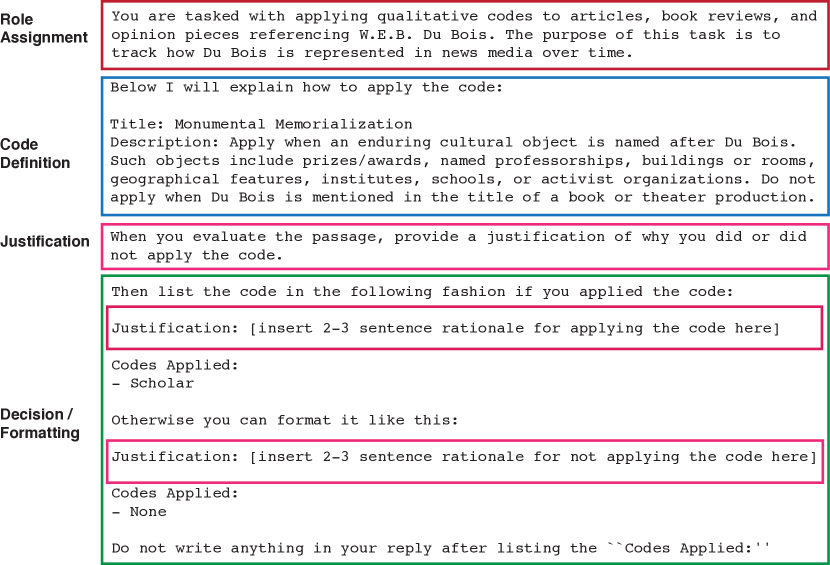
- Use a human-derived codebook for nine codes across three categories.
- Compare GPT-4 and GPT-3.5 on 111 gold-standard passages mentioning Du Bois (average ~94 words).
- Evaluate zero-shot prompts with Per Code vs Full Codebook task presentations.
- Incorporate chain-of-thought prompting to assess impact of rationale on coding decisions.
- Test Prompting variations (rationale, one code at a time vs full codebook) and report intercoder reliability (Cohen’s kappa).
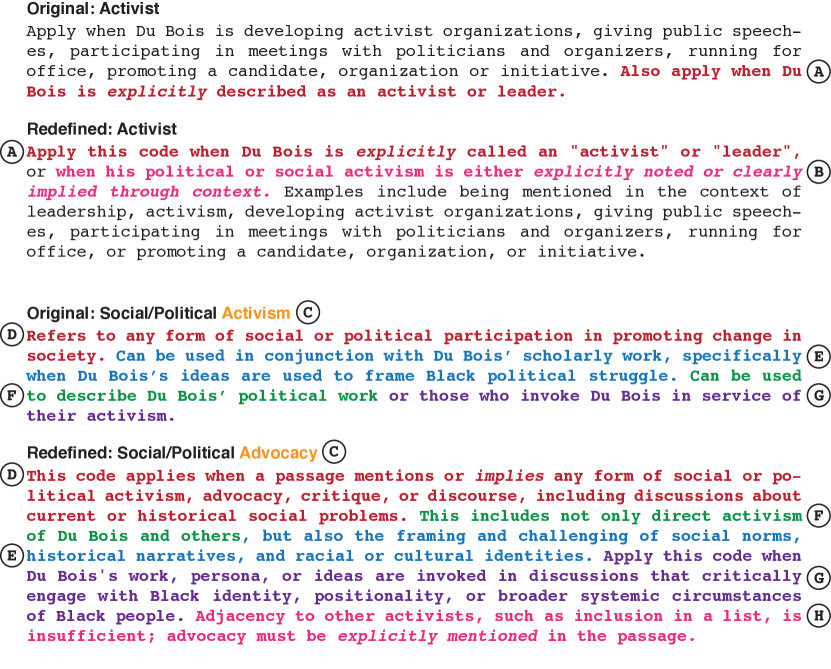
- Provide practical best-practice guidance for adapting codebooks to LLMs.
实验结果
研究问题
- RQ1Can GPT-4 and GPT-3.5 achieve intercoder reliability comparable to human coders on qualitative coding tasks?
- RQ2Does chain-of-thought prompting improve coding fidelity for LLMs in humanities-like codebooks?
- RQ3Is presenting codes as separate prompts (one code per task) more effective than a full codebook prompt for LLM-based coding?
- RQ4What codebook adaptations and prompt designs maximize alignment with human gold standards?
主要发现
- GPT-4 achieves human-equivalent interpretation for several codes with zero-shot prompts (e.g., 3 of 9 codes exceed a kappa of 0.75).
- GPT-4 shows substantial reliability (kappa ≥ 0.6) for 8 of 9 codes and excellent reliability (kappa ≥ 0.79) for 3 codes in Per Code prompts.
- GPT-3.5 underperforms across codes (mean kappa ≈ 0.34; max ≈ 0.55).
- Prompting GPT-4 to provide rationale (chain-of-thought) improves coding fidelity (average kappa, Per Code: 0.68 with CoT vs. 0.59 without; Full Codebook: 0.60 with CoT vs. 0.46 without).
- Presenting each code as a separate prompt yields higher reliability than the full codebook approach (average kappa 0.68 vs. 0.60 in the reported comparisons).
- Rationale and per-code prompting are identified as practical best practices for improving LLM-guided qualitative coding.
阅读本论文
在 Nubint 阅读器中打开原文,边读边就任意段落提问。
在 Nubint 中阅读本论文本解读由 AI 根据论文原文生成,引用前请核对原文。