
[论文解读] Scaling Down to Scale Up: A Guide to Parameter-Efficient Fine-Tuning
对参数高效微调(PEFT)方法的系统性概览和分类,比较了 40 篇论文(2019-2023)并强调大规模变换器的效率、取舍及尚待解决的挑战。
This paper presents a systematic overview of parameter-efficient fine-tuning methods, covering over 50 papers published between early 2019 and mid-2024. These methods aim to address the challenges of fine-tuning large language models by training only a small subset of parameters. We provide a taxonomy that covers a broad range of methods and present a detailed method comparison with a specific focus on real-life efficiency in fine-tuning multibillion-scale language models. We also conduct an extensive head-to-head experimental comparison of 15 diverse PEFT methods, evaluating their performance and efficiency on models up to 11B parameters. Our findings reveal that methods previously shown to surpass a strong LoRA baseline face difficulties in resource-constrained settings, where hyperparameter optimization is limited and the network is fine-tuned only for a few epochs. Finally, we provide a set of practical recommendations for using PEFT methods and outline potential future research directions.
研究动机与目标
- 提供对 PEFT 方法的全面分类,并对 2019 至 2023 年的超过 40 篇论文进行分类。
- 在存储、内存、计算、精度和推理开销等方面比较 PEFT 方法。
- 分析在数十亿参数模型上的实际效率并识别现实世界部署中的考虑因素。
- 突出未解决的挑战并提出标准化基准和未来研究方向的途径。
提出的方法
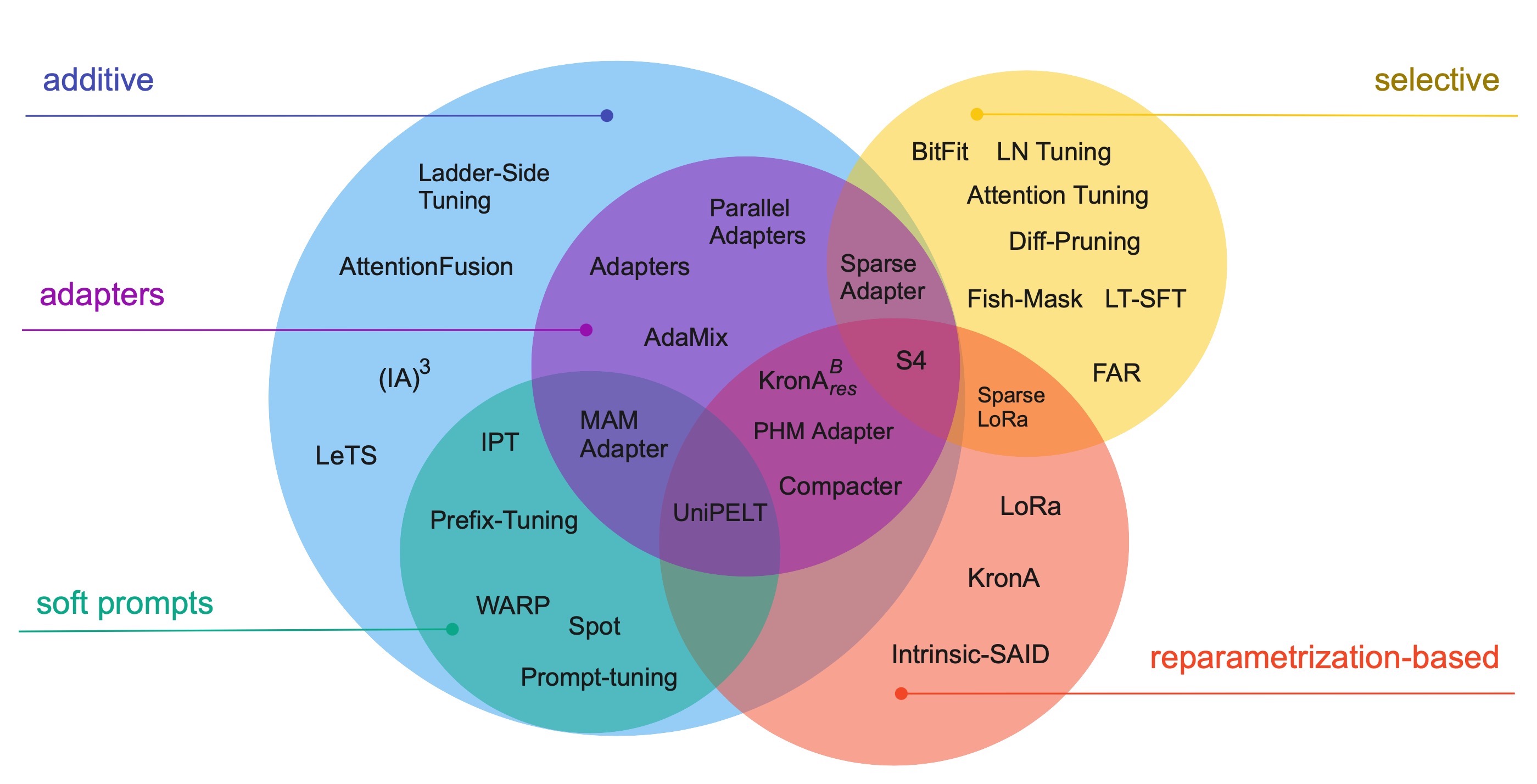
- 将 PEFT 方法分为基于添加、基于选择、基于再参数化的类别,以及混合形式。
- 详细说明添加型子类型,包括 Adapters 和 Soft Prompts,及其代表性变体与权衡。
- 描述选择性方法与再参数化技术,包括 Intrinsic SAID 与 LoRa,并概述它们在内存与参数效率方面的要点。
- 提供跨方法比较,聚焦参数数量、存储、内存以及训练/推理成本。
- 提供伪代码片段和实际实现说明,以阐释核心思想。
实验结果
研究问题
- RQ1主要的 PEFT 范式及其在存储、内存、计算和精度方面的权衡是什么?
- RQ2具有代表性的 PEFT 方法如何随模型规模和数据集复杂度扩展,尤其是针对多十亿参数的变换器?
- RQ3在实际应用环境中基准测试和部署 PEFT 方法的当前差距、挑战与最佳实践是什么?
主要发现
- PEFT 方法显著减少可训练参数,并能够对非常大规模的模型进行微调,而使用全微调在现实中难以实现。
- 添加型、选择型和再参数化型 PEFT 方法各自提供不同的内存与计算特征,并在适用于不同模型规模方面存在差异。
- 混合方法可以结合多类 PEFT 的优势,在有限的参数更新下实现更优的精度。
- 在理论理解、基准标准和报告实践方面仍存在差距,提示需要标准化的 PEFT 基准和更深入的超参数/可解释性研究方向。
阅读本论文
在 Nubint 阅读器中打开原文,边读边就任意段落提问。
在 Nubint 中阅读本论文本解读由 AI 根据论文原文生成,引用前请核对原文。