
[论文解读] Search-based Motion Planning for Quadrotors using Linear Quadratic Minimum Time Control
本文提出了一种基于搜索的四旋翼运动规划框架,通过使用线性二次最小时间(LQMT)控制导出的运动基元,在复杂环境中生成动态可行且时间最短的轨迹。该方法通过最优控制解对状态空间进行离散化,实现具有紧密启发式的高效图搜索,并在无需预计算几何路径的情况下,实现比基于路径的方法更平滑、全局最优的实时在线重规划轨迹。
In this work, we propose a search-based planning method to compute dynamically feasible trajectories for a quadrotor flying in an obstacle-cluttered environment. Our approach searches for smooth, minimum-time trajectories by exploring the map using a set of short-duration motion primitives. The primitives are generated by solving an optimal control problem and induce a finite lattice discretization on the state space which can be explored using a graph-search algorithm. The proposed approach is able to generate resolution-complete (i.e., optimal in the discretized space), safe, dynamically feasibility trajectories efficiently by exploiting the explicit solution of a Linear Quadratic Minimum Time problem. It does not assume a hovering initial condition and, hence, is suitable for fast online re-planning while the robot is moving. Quadrotor navigation with online re-planning is demonstrated using the proposed approach in simulation and physical experiments and comparisons with trajectory generation based on state-of-art quadratic programming are presented.
研究动机与目标
- 解决基于路径的轨迹生成方法的局限性,该方法将轨迹限制在同伦类中,且在忽略动力学时可能产生次优或不可行的路径。
- 在障碍物密集环境中,实现无需依赖预计算几何路径的全局最优、动态可行且时间最短的四旋翼轨迹规划。
- 通过利用LQMT问题的显式解,开发一种计算高效的在线重规划方法,适用于高速飞行场景。
- 通过基于最优控制导出的运动基元对状态空间进行离散化,实现分辨率完备的规划,支持具有强启发式引导的图搜索。
提出的方法
- 通过在短时间间隔内求解线性二次最小时间(LQMT)最优控制问题生成运动基元,确保状态间实现最短时间过渡。
- LQMT解提供显式、闭式控制输入,将状态转移映射为控制输入,从而实现状态空间的有限格点离散化。
- 构建图结构,其中节点表示离散化状态,边表示运动基元,从而实现在状态空间上的基于搜索的轨迹规划。
- 采用基于LQMT解的紧密启发式方法引导A*搜索,显著加速高维状态空间中的收敛速度。
- 通过无约束二次规划对最终轨迹进行优化,确保即使在低维规划后,轨迹仍能精确满足四旋翼动力学的可行性要求。
- 该方法避免使用预计算的查表,且不假设初始状态为悬停,从而支持飞行过程中的快速在线重规划。
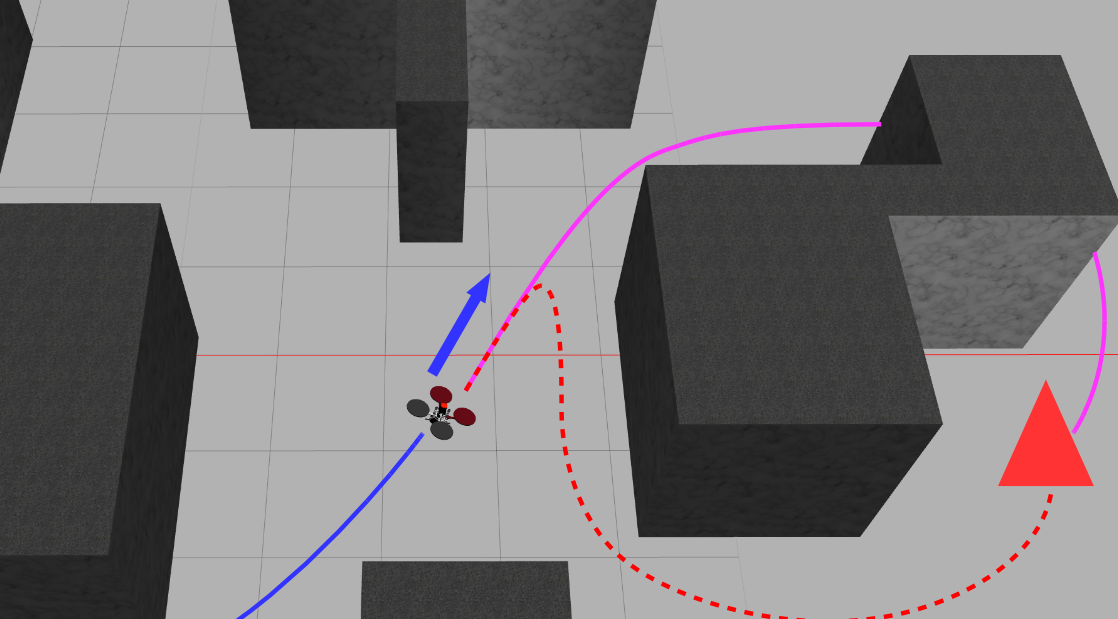
实验结果
研究问题
- RQ1能否利用最优控制导出的运动基元对状态空间进行离散化,从而实现高效图搜索的轨迹规划?
- RQ2LQMT问题的显式解能否提供一个紧密且可计算的启发式,以加速高维状态空间中的A*搜索?
- RQ3与依赖几何最短路径的基于路径的方法相比,所提方法是否能生成更平滑、更具动态可行性且时间最优的轨迹?
- RQ4该方法能否在不假设初始状态为悬停的条件下,支持高速四旋翼的实时在线重规划?
主要发现
- 所提方法通过使用LQMT导出的运动基元对状态空间进行离散化,生成分辨率完备、动态可行且时间最短的轨迹。
- 基于LQMT的启发式显著加速了A*搜索,使高维状态空间中的实时规划成为可能。
- 与传统基于路径的方法相比,该方法生成的轨迹更平滑,即使在在线重规划期间也能避免障碍物附近的剧烈转向。
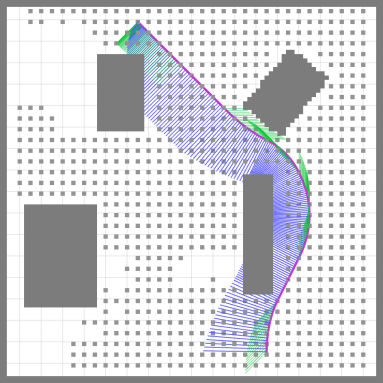
- 物理实验与仿真结果表明,在复杂环境中成功实现了在线重规划,生成的轨迹既安全又时间最优。
- 在动态场景中,该方法在轨迹平滑性和时间最优性方面优于当前最先进的基于二次规划的方法。
- 开源实现已发布于GitHub,支持可复现性,并可集成至更广泛的机器人系统中。
阅读本论文
在 Nubint 阅读器中打开原文,边读边就任意段落提问。
在 Nubint 中阅读本论文本解读由 AI 根据论文原文生成,引用前请核对原文。