
[论文解读] Searching for Time-Dependent Axion Dark Matter Signals in Pulsars
本研究首次利用匹配滤波法对来自脉冲星 PSR J2144−3933 的 MeerKAT 数据进行时域搜索,以探测轴子暗物质信号,证明时域分析相比时间平均流量方法能显著提升对轴子-光子耦合的灵敏度。研究者基于脉冲星因自转和介质效应引起的周期性信号调制,在轴子质量范围 $ 3.9{-}4.7\,\mu\text{eV} $ 内设定了新的上限:$ g_{a\gamma\gamma} < 5.5 \times 10^{-11}(D/0.165\,\text{pc})\,\text{GeV}^{-1} $。
Axion dark matter can be converted into photons in the magnetospheres of neutron stars leading to a spectral line centred on the Compton wavelength of the axion. Due to the rotation of the star and the plasma effects in the magnetosphere the signal is predicted to be periodic with significant time variation - a unique smoking gun for axion dark matter. As a proof of principle and to develop the methodology, we carry out the first time domain search of the signal using data from PSR J2144$-$3933 taken as part of the MeerTIME project on MeerKAT telescope. We search for specific signal templates using a matched filter technique and discuss when a time-domain analysis (as is typically the case in pulsar observations) gives greater sensitivity to the axion-coupling to photons in comparison to a simple time-averaged total flux study. We do not find any candidate signals and, hence, impose an upper limit on the axion-to-photon coupling of $g_{aγγ}<4 imes 10^{-11}\,{ m GeV}^{-1}$ over the mass range $m_{ m a}=3.9-4.7\,μ{ m eV}$ using this data. This limit relies on PSR J2144$-$3933 not being an extremely aligned rotator, as strongly supported by simple arguments based on the observed pulse profile width. We discuss the possibilities of improving this limit using future observations with MeerKAT and also SKA1-mid and the possibility of using other objects. Finally, to evade modelling uncertainties in axion radio signals, we also carry out a generic ``any periodic-signal search" in the data, finding no evidence for an axion signal.
研究动机与目标
- 开发并应用一种时域分析方法,以探测脉冲星射电辐射中的轴子暗物质信号。
- 量化利用脉冲星信号时变性相比时间平均流量测量所获得的灵敏度增益。
- 基于 PSR J2144−3933 的真实观测数据,设定轴子-光子耦合 $ g_{a\gamma\gamma} $ 的新上限。
- 通过独立于轴子特异性模板的通用周期信号搜索,检验信号模型的鲁棒性。
提出的方法
- 采用匹配滤波技术,使用基于中子星磁层中轴子-光子转换的射线追踪模拟生成的理论信号模板。
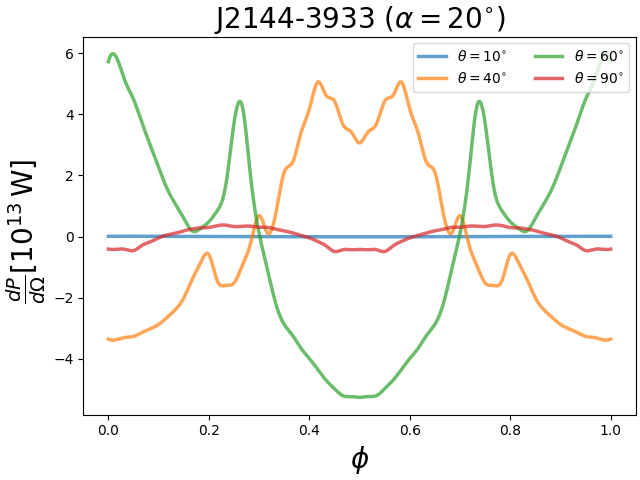
- 通过 SciPy 插值射线追踪结果,对不同观测角度 $ \theta $ 和 $ \alpha $ 下的时间依赖通量分布进行建模,降低计算成本。
- 在 MeerKAT 的 MeerTIME 项目数据上执行时域搜索,重点关注由于脉冲星自转和介质效应引起的信号周期调制。
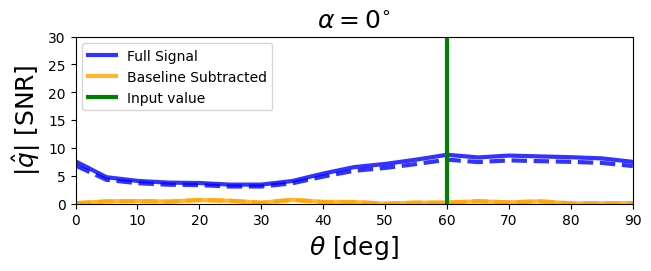
- 将时域分析的灵敏度与标准的时间平均通量方法进行比较,显示出信噪比有适度但有意义的提升。
- 开展通用周期信号搜索,以检测任何窄带、调制信号,而无需假设轴子特异性模型。
实验结果
研究问题
- RQ1与时间平均通量测量相比,对脉冲星信号进行时域分析是否能显著提升对轴子暗物质的探测灵敏度?
- RQ2基于对 PSR J2144−3933 实际数据的时域搜索,轴子-光子耦合 $ g_{a\gamma\gamma} $ 的上限是多少?
- RQ3包含介质效应和自转引起的调制后,轴子信号在脉冲星中的可探测性如何变化?
- RQ4不依赖特定理论模板的情况下,通用周期信号搜索能否检测到类轴子信号?
主要发现
- 时域分析相比时间平均通量方法,信噪比有适度但可测量的提升,增强了探测前景。
- 数据中未检测到候选轴子信号,因此在轴子质量 3.9 至 4.7 $\mu\text{eV}$ 范围内,设定上限为 $ g_{a\gamma\gamma} < 5.5 \times 10^{-11}(D/0.165\,\text{pc})\,\text{GeV}^{-1} $。
- 在假设 PSR J2144−3933 并非极端对准旋转体的前提下,该上限具有鲁棒性,该假设得到脉冲轮廓宽度分析的支持。
- 射线追踪结果的插值方法在分析中达到了足够的精度,验证了其在任意角度下替代完整模拟的可行性。
- 通用周期信号搜索未发现调制信号的证据,进一步支持了零结果,并降低了模型依赖性。
- 未来利用 MeerKAT 和 SKA1-mid 的观测有望进一步提升灵敏度,尤其是采用优化的时域策略时。
阅读本论文
在 Nubint 阅读器中打开原文,边读边就任意段落提问。
在 Nubint 中阅读本论文本解读由 AI 根据论文原文生成,引用前请核对原文。