
[论文解读] Second Euler number in four dimensional synthetic matter
本文在四维合成物质中引入第二欧拉数作为拓扑不变量,提出了两种新颖的紧束缚模型,实现了具有鲁棒无能隙边界态的非平凡4D欧拉相。关键结果是识别出在四能带子空间内由三重链接节点面构成的体节点结构,该结构可通过格拉斯曼流形构造的最小布洛赫哈密顿量在超冷原子系统中实现。
Two-dimensional Euler insulators are novel kind of systems that host multi-gap topological phases, quantified by a quantised first Euler number in their bulk. Recently, these phases have been experimentally realised in suitable two-dimensional synthetic matter setups. Here we introduce the second Euler invariant, a familiar invariant in both differential topology (Chern-Gauss-Bonnet theorem) and in four-dimensional Euclidean gravity, whose existence has not been explored in condensed matter systems. Specifically, we firstly define two specific novel models in four dimensions that support a non-zero second Euler number in the bulk together with peculiar gapless boundary states. Secondly, we discuss its robustness in general spacetime-inversion invariant phases and its role in the classification of topological degenerate real bands through real Grassmannians. In particular, we derive from homotopy arguments the minimal Bloch Hamiltonian form from which the tight-binding models of any second Euler phase can be generated. Considering more concretely the gapped Euler phase associated with the tangent bundle of the four-sphere, we show that the bulk band structure of the nontrivial 4D Euler phase necessarily exhibits triplets of linked nodal surfaces (where the three types of nodal surfaces are formed by the crossing of the three successive pairs of bands within one four-band subspace). Finally, we show how to engineer these new topological phases in a four-dimensional ultracold atom setup. Our results naturally generalize the second Chern and spin Chern numbers to the case of four-dimensional phases that are characterised by real Hamiltonians and open doors for implementing such unexplored higher-dimensional phases in artificial engineered systems, ranging from ultracold atoms to photonics and electric circuits.
研究动机与目标
- 通过在四维系统中引入第二欧拉数作为鲁棒不变量,扩展高维拓扑相的分类。
- 构建显式的四维紧束缚模型,支持非零第二欧拉数并表现出独特的无能隙边界模。
- 建立使用实格拉斯曼流形和同伦理论对拓扑简并实能带进行分类的一般框架。
- 推导出可系统生成所有第二欧拉相的最小布洛赫哈密顿量形式。
- 通过展示此类相如何在四维超冷原子系统中被工程化,证明其实验可行性。
提出的方法
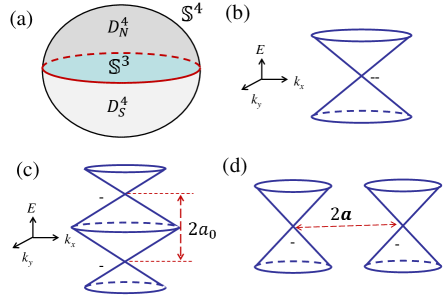
- 作者通过从布里渊区到实4-框架格拉斯曼流形的映射,将四维球面的切丛拉回到四维紧束缚模型中。
- 他们利用S⁴上的超球坐标构造一个酉标架,以定义切丛的光滑截面,进而构建具有有限跃迁范围的实哈密顿量。
- 通过在跃迁幅度中使用余弦和正弦项的有限傅里叶级数展开,对动量空间哈密顿量进行近似,实现该模型。
- 通过陈-高斯-博内定理计算第二欧拉数,将其与布里渊区上格拉斯曼丛的曲率联系起来。
- 通过实格拉斯曼流形的同伦群分析推导出最小布洛赫哈密顿量,确保在连续形变下具有拓扑鲁棒性。
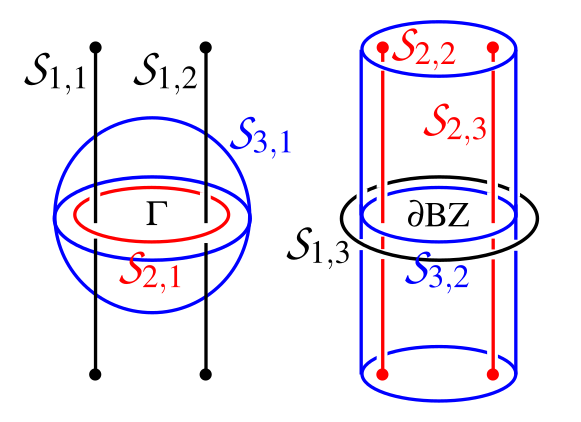
- 通过证明非平凡4D欧拉相包含由四能带子空间中连续能带交叉形成的三重链接节点面,验证了该构造。
实验结果
研究问题
- RQ1已知在微分拓扑和4D引力中作为不变量的第二欧拉数,能否在具有实哈密顿量的凝聚态系统中实现为拓扑不变量?
- RQ2在四维中支持非平凡第二欧拉数的最小布洛赫哈密顿量形式是什么?
- RQ3此类相的体能带结构如何表现,特别是从节点拓扑的角度?
- RQ4时空反演对称性在稳定第二欧拉不变量中起什么作用?
- RQ5此类4D拓扑相能否在超冷原子等合成量子系统中被工程化?
主要发现
- 非平凡4D欧拉相的体能带结构必然表现出三重链接节点面,这些节点面由单个四能带子空间内连续的三对能带交叉形成。
- 第二欧拉数在时空反演对称相中具有鲁棒性,表明在该对称性下存在拓扑保护。
- 任何第二欧拉相的最小布洛赫哈密顿量均源自实格拉斯曼流形的同伦不变量,提供了一个通用的构造框架。
- 该模型通过在倒易晶格中使用有限傅里叶级数对动量空间哈密顿量进行近似,实现了有限跃迁范围的紧束缚哈密顿量。
- 该系统支持由第二欧拉不变量保护的特殊无能隙边界态,类似于低维拓扑绝缘体中的边缘模。
- 通过基于格拉斯曼流形的构造工程化适当的跃迁幅度和能带结构,该相可在四维超冷原子系统中实现。
阅读本论文
在 Nubint 阅读器中打开原文,边读边就任意段落提问。
在 Nubint 中阅读本论文本解读由 AI 根据论文原文生成,引用前请核对原文。